
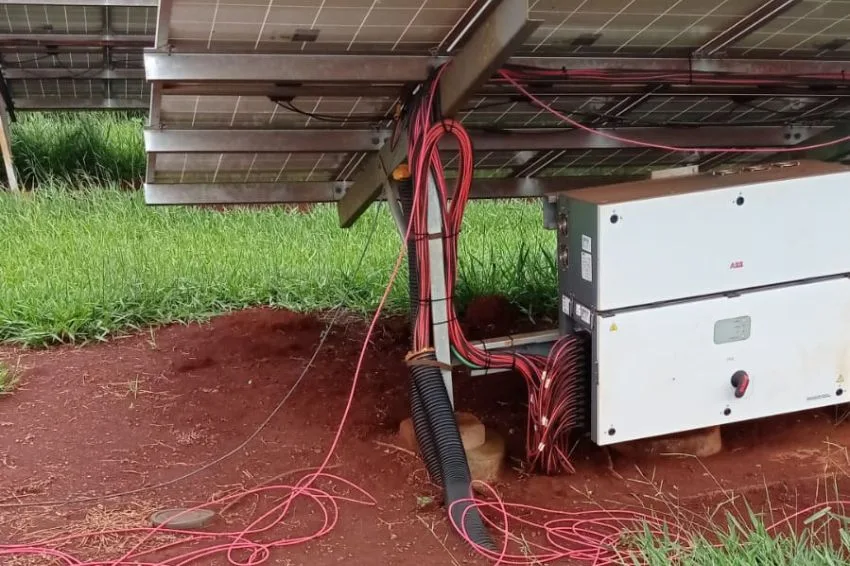
Last week, four men were arrested in the act by theft of cables at a solar power plant in the municipality of Diamantino (MT). One of the suspects is an employee of the commercial establishment that was targeted by the gang.
According to information from the Military Police, the group of robbers allegedly stole around 4 thousand meters of cables. They were found hiding in a wooded area and were using a vehicle as support to carry out the crime.
Although the arrest of the suspects was carried out by the corporation, this incident is far from being just an isolated case, as other municipalities have recently also recorded crimes of this nature.
Em Nova santa rita (RS), for example, the Military police location was recently called to investigate qualified thefts in the city, after solar plant owners report losses of up to 3,6 meters of cables stolen from their plants.
Geraldo Silveira, engineering manager at CS Consulting – Group company Canal Solar which offers commissioning services and technical inspections in photovoltaic plants throughout Brazil – explains that the cable theft at solar plants is a recurring problem, especially AC cables, which are often targeted.
“This is because AC cable contains pure copper, which is more valuable in the market, while DC cable is made of tinned copper, which has less commercial value. Therefore, AC cables are most often targeted for theft, especially during the plant construction phase,” he says.
For this reason, Silveira draws attention to the the importance of plant owners being aware of the security of their assets, especially during the implementation stage of photovoltaic plants.
"During construction, it is crucial to have surveillance on site, generally with armed security guards patrolling the perimeter, because while the plant is not ready, the security system, such as CCTV cameras, alarms and sensors, is not yet in operation”, he highlights.
To improve further safety in the places, the engineering manager says that some CS Consultoria clients use solar power in their plants speaker and sensor systems that emit audible alerts when detecting suspicious movements.
“Others also use a radar or sonar system to detect intrusions, which send an immediate alert to the control center, allowing a rapid response,” highlights Silveira.
Owner controls thefts at solar plant
No inside São Paulo, One 4,7 MW solar plant and that has already been victim of four attempted cable thefts, is now completely safe after a series of investments have been made.
Eduardo de Lima, project manager of Royal FIC, the company that manages the photovoltaic plant, explains that in the start of implementation of the plant there was an attempted theft, which was contained by hired armed security.
"Already during the operation phasewe had other three situations: In one of them, the criminals managed to take part of the AC cables. In the other two attempts, they cut DC cables, but were unable to take anything,” he said.
The professional highlights that With each new theft attempt, the company sought to improve security measures at the plant. “We installed locks on junction boxes, we implement alarms in transformers to prevent the removal of part of the plant's protection, and we increased the infrastructure security, with more cameras, including thermal cameras and better plant lighting.”
Lima explains, however, that the The big difference was the installation of a radar which maps the area, similar to an airplane's sonar. The equipment detects any intrusion and directs the cameras to the location, performing facial identification and triggering the alarm for the plant's security team.
"After all these investments in technology and infrastructure, we have not had any more incidents. With massive investment in technology and identification, we are able to act in a preventive and effective manner, since without these resources the security guard would often not be able to cover the location, as a complete round can take 15 to 20 minutes, which compromises a quick response”, points out Lima.
all the content of Canal Solar is protected by copyright law, and partial or total reproduction of this site in any medium is expressly prohibited. If you are interested in collaborating or reusing part of our material, please contact us by email: redacao@canalsolar.com.br.


Comments (3)
Comments are moderated before publication.Comments should be respectful and contribute to a healthy debate. Offensive comments may be removed. The opinions expressed here are those of the authors and do not necessarily reflect the views of the author. Canal Solar.
Another option would be to make crime so expensive that it becomes economically unviable.
Another alternative is to use aluminum insulated cable, the same one that distributors use. They can steal it too, but the loss is smaller.
There is no way to use this type of cable throughout the installation! The cable between the DJ and the inverter will always be copper!