

Report published in Magazine Canal Solar – Vol. 1, No. 1, December/2020
Updated October 9, 2025
Photovoltaic generation plants encompass a wide variety of installations. According to CE 003:102.001 – Electrical Grounding, of CB-3 – Electricity Committee of ABNT (Brazilian Association of Technical Standards), the following classification is generally adopted: photovoltaic generators and photovoltaic power plants.
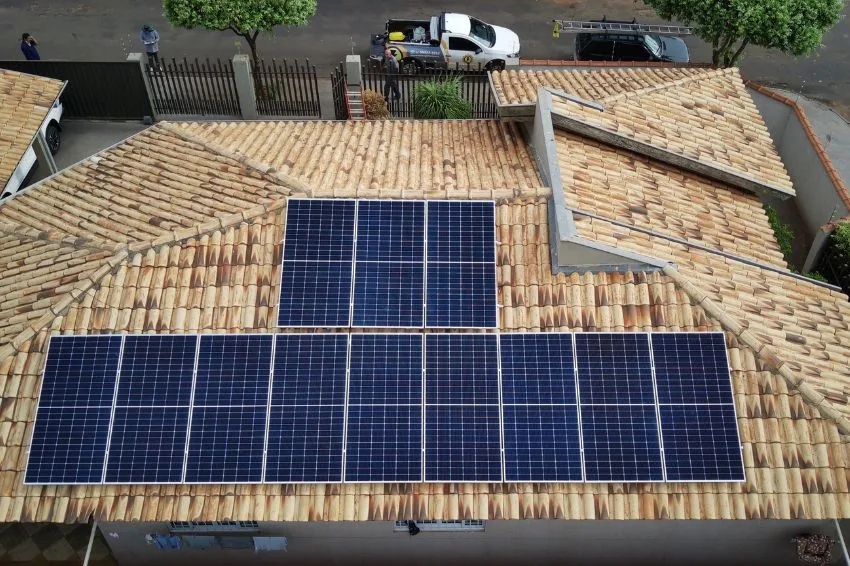
Photovoltaic generators are plants that directly serve a consumer, installed on the roofs of buildings or parking lots (residential, commercial and industrial), or on the ground, on land attached to other installations.
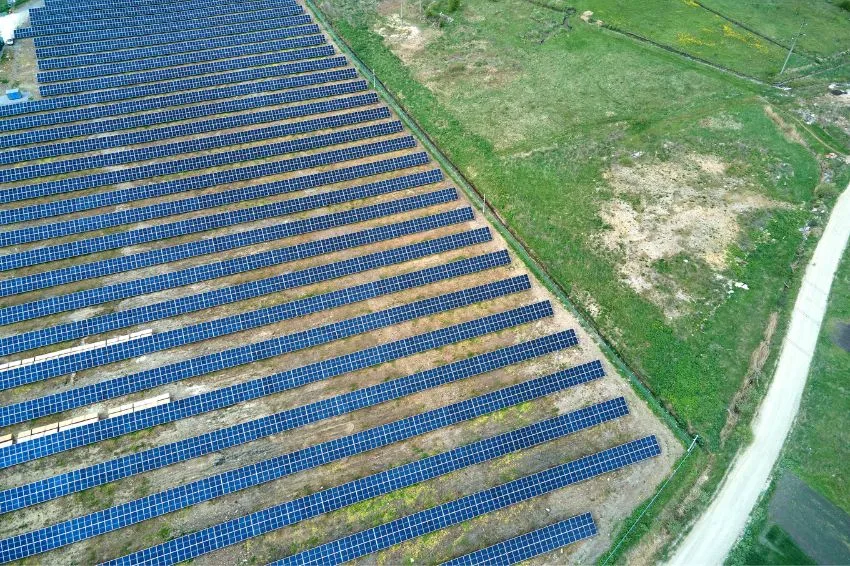
And photovoltaic plants are dedicated, ground-based generation plants, comprising several photovoltaic arrangements and interconnected directly to a concessionaire's medium-voltage network or interconnected to the SIN (National Interconnected System) through a high-voltage substation, also installed in a consortium with other generating plants, whether next to a wind farm or in a hydroelectric dam (floating photovoltaic plants).
What are photovoltaic plants?
These plants have a significant area, usually over 1 ha, and are subdivided into smaller units, sometimes called sectors, each consisting of arrangements of photovoltaic plates interconnected to a converter unit, where inverters make the dc/ac conversion.
In these plants, it is common to use trackers, motorized photovoltaic module support structures, controlled by equipment that monitors the position of the Sun and rotates the tables of the photovoltaic arrays in order to maximize energy generation throughout the day.
In medium-sized plants, with typical power in the range of 1 MWp to 5 MWp, the ac energy produced by groups of sectors is raised to a distribution voltage (13,8 kV or 25 kV) for interconnection with the concessionaire's network of local energy.
In large-scale plants, the sectors are larger, around 10 MWp, and concentrate the DC energy in the conversion units, where the inverters are located and where the voltage is increased, normally to 34,5 kV, with the generated energy being sent through underground circuits to the collector substation.
The grounding system of a photovoltaic plant It consists of a grounding grid, usually made of bare copper or copper-clad steel cable of 50 mm², which does not have the mesh pattern of a substation grid, and makes maximum use of existing cable trenches.
A grounding ring around the perimeter of the photovoltaic plant is mandatory. The design of this grounding system has three basic objectives:
- Provide a path to ground for general electrical currents, which may be electrostatic charges, lightning strikes, or ground faults in the DC/AC power grid;
- Ensure control of step and touch potentials throughout the photovoltaic plant area when a ground fault occurs at the collector substation;
- Promote the equipotentialization of all tracker structures and equipment (connection boxes, inverters, transformers, etc.) – where the term equipotentialization means interconnection, especially since it is impossible to effectively equipotentialization of a grounding system of this size, even at 60 Hz.
What are the grounding system standards for photovoltaic plants?
We often receive projects for grounding systems for solar plants that treat the photovoltaic plant as if it were a large substation, sometimes with a grounding mesh that constitutes an immense network.
This is a common misconception, due to the fact that this type of generation plant is relatively new in Brazil and, also, because there is still no ABNT standard that addresses the grounding system of large photovoltaic plants.
Within the scope of international standardization, there is the IEC/TS 62738:2018 standard – Ground-mounted photovoltaic power plants – Design guidelines and recommendations, which addresses large ground-mounted photovoltaic plants, but is silent on the grounding system.
The North American standard IEEE-2778-D4 – IEEE Guide for Solar Power Plant Grounding for Personnel Protection, addresses the topic well, focusing on ground photovoltaic plants with more than 5 MWp of installed power.
This standard greatly emphasizes the differences between the grounding designs of a photovoltaic plant and substations, the latter governed by the well-known IEEE Std. 80 standard.
Currently, the CE 003:102.001 committee – Electrical Grounding, of CB-3 – the Electricity Committee of ABNT (Brazilian Association of Technical Standards), is working on the development of a Brazilian standard for grounding large-scale photovoltaic power plants.
What does the IEEE-2778-D4:2020 standard say?
The scope of the IEEE (Institute of Electrical and Electronic Engineers Incorporated) standard focuses on ground-based photovoltaic plants with more than 5 MWp of installed power and emphasizes the differences between the grounding designs of photovoltaic plants and substations, the latter governed by the well-known IEEE Std. 80 standard.
In this aspect, the guide notes its non-applicability to photovoltaic plant substations, however if the grounding systems of the SE and the photovoltaic plant are interconnected, parts of the guide may be applicable.
Likewise, the scope highlights its non-applicability to photovoltaic generators, substation grounding and lightning protection systems.
The guide highlights that its main objective is the protection of people with regard to ground faults in the photovoltaic plant's electrical grid. The most critical ground fault, from the point of view of human safety, is the one that can occur on the medium or high-voltage busbar of the photovoltaic plant's substation.
In this respect, the need to control step and touch potentials across the entire area of the photovoltaic plant is emphasized.
Soil resistivity measurements must keep in mind the modeling of shallow and deep soil layers. Surveys for modeling shallow layers must be carried out along a matrix of stations spaced on the order of 500 m, with Wenner spacings of up to 32 meters.
Modeling deep layers requires a smaller number of sounding points, but with current electrode openings on the order of up to 1 km.
The standard recognizes that the grounding system of a photovoltaic plant is formed by metallic structures above the ground interconnected by buried bare copper or copper-steel cables.
It is emphasized that a good design will use the minimum amount of cable necessary to interconnect the tracker structures and the Conversion Units, which are sets of inverters and step-up transformers that serve a specific photovoltaic array sector. Conversion Units should be equipped with a grounding ring.
Due to the large area of a photovoltaic plant, the standard observes the inadequacy of a reticulated pattern mesh, as is done in substation projects, as well as the use of crushed stone to increase tolerable step and touch voltage values.
Due to the large amount of material used in the grounding system of a photovoltaic plant, conservative sizing or oversizing, as typically observed in substations, are not economically viable.
In terms of the basic topology of the grounding system, the standard suggests rings on the perimeter of photovoltaic array sectors, between 1 MWp and 4 MWp, which results in a grid mesh of the order of 150 m, as shown in Figure 1.
Tracker structures can be part of this grounding system, eliminating the need for the grid, as illustrated in Figure 2. Even so, the perimeter ring may be necessary to control potential gradients in the soil.
The standard notes that the large area of the grounding system of a photovoltaic plant makes manual calculation of groundings unfeasible, and clarifies that much more rigorous simulation software resources are required than those used for the design of grounding grids. substations.
In this case, it is necessary to use software that has the capacity to model large-scale systems and that considers the longitudinal impedance of the conductors (non-equipotential mesh). The fence should be the object of concern, with the calculation of the touch potentials and the evaluation of its interconnection, or not, to the grounding system of the photovoltaic plant.
Finally, the standard addresses the issue of commissioning, recommending integrity assessments of the grounding system and informing that a project based on an adequate soil model compensates for the impossibility of measuring grounding resistance/impedance, depending on the size of the system.
![Figure 1: Conceptual grounding mesh of a UFV with a grid of around 150 m [reproduction of Figure 2 from IEEE-2778-D4:2020].](https://canalsolar.com.br/wp-content/uploads/2021/01/Figura-1-Malha-de-aterramento-conceitual-de-uma-UFV-com-reticulado-da-ordem-de-150-m-reproducao-da-Figura-2-da-IEEE-2778-D4-2020.-768x448-1.jpg)
![Figure 2: Grounding system of a UFV using tracker structures [reproduction of Figure 2 from IEEE-2778-D4:2020]](https://canalsolar.com.br/wp-content/uploads/2021/01/Figura-2-Sistema-de-aterramento-de-uma-UFV-utilizando-as-estruturas-dos-trackers-reproducao-da-Figura-2-da-IEEE-2778-D4-2020.-300x185-1.jpg)
Draft ABNT standard for photovoltaic power plant grounding system
The aspects to be considered in this standard are listed below, many of which are addressed in the IEEE-2778-D4:2020 standard:
- Aspects related to geoelectric campaigns and soil modeling for the design of the grounding system, complementing or modifying the basic criteria already established in standard NBR-7117;
- The critical current for the UFV is the ground fault current in the medium or high voltage bus of the collector substation – the only current that will flow to the ground and that will generate potential gradients in the ground (step and touch voltages);
- Importance of simulation software that considers the longitudinal impedance of conductors – due to its large dimensions, the grounding system is not equipotential;
- UFV grounding interfaces with the grounding of their subsystems (ac, dc, medium voltage, high voltage), governed by other ABNT standards;
- Grounding of the medium-voltage network, including cable shields;
- Performance of the grounding system in the face of low-frequency events, typically a ground fault in the medium or high-voltage network, and of an impulsive nature, especially associated with lightning strikes;
- Fence grounding – if soil resistivity is high (> 1000 Ωm) the most critical soil potential gradients may occur at the corners of fences;
- The commissioning of UFV grounding must focus on continuity and integrity testing of connections, complementing or modifying the basic criteria already established in standard NBR-15.749.
Deepen your knowledge





Answers of 9
Dear, Paulo. Congratulations and thank you for sharing this important topic.
We recently received some work and we have questions about the grounding system that was delivered by the provider.
I would like you to clarify whether it is necessary to interconnect the UFV grounding grid with the old general grid, already existing in the factory's SPDA.
I thank!
Excellent work and a very complete approach to the allusive theme, which is extremely important in any Project, by our Master and Doctor Paulo Freire.
Congratulations on the great work. I need a small favor. I have a small electrical installation company. We are also starting out with the photovoltaic system. I need a grounding system for a plant with two 60-ah Weg inverters. Can it be connected to the solar power plant in the general grounding of the warehouse or does it have to be done separately? The warehouse is made of steel with galvanized tiles. It needs grounding in all the steel columns bolted to the ground.
Dear Paulo, congratulations on the article. I always see people talking about grounding systems for large solar plants but I see very little about small ground plants (photovoltaic generators), whether in the range of 0,1 to 1 MWp or even 1 to 5 MWp installed on land attached to consumer units. Is there any source of information about grounding for this type of photovoltaic generator?
Very good article, always adding information from the sector.
I am the owner in Bahia of an area with a wind project and with potential for 300MW of solar and it is always good to have professionals who use their knowledge to, in certain ways, clarify those people, who, like me, need this information.
I'm an Electrical Engineer, very good content for anyone implementing a photovoltaic solar system is the importance of the grounding mesh that will protect the equipment.
Wow, congratulations on the article! Quite enlightening! Indeed, large plants are recently built in Brazil. I hope this standard is drafted as soon as possible so that we can make our plants safer!
These articles are interesting, I'm saving and absorbing the content, as I want to build a solar power plant, and it's always good to gain knowledge about legislation, types of financing...