
Updated October 15, 2025
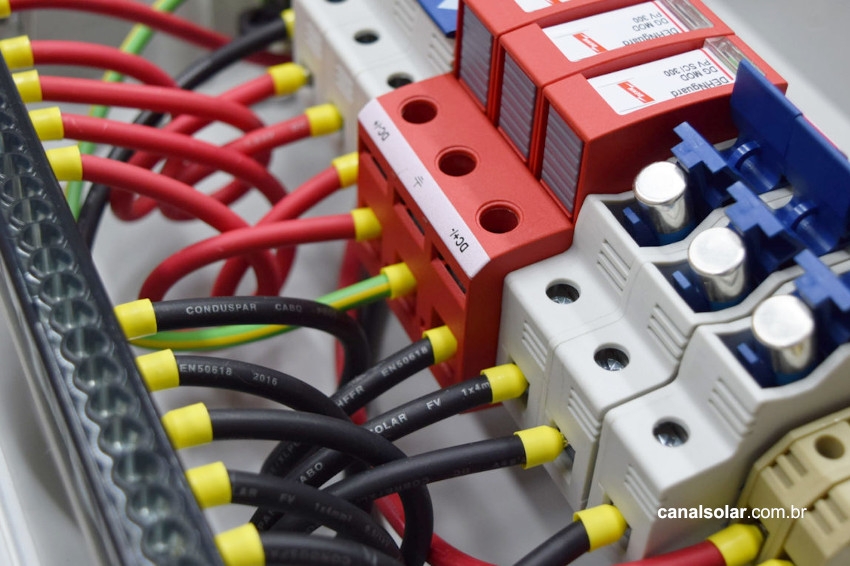
The string box is one of the main protective components on the direct current (DC) side of photovoltaic systems. Responsible for housing devices such as circuit breakers, SPDs, and disconnect switches, it plays an essential role in the electrical safety, ease of maintenance, and regulatory compliance of solar installations.
Standards NBR 5410 (low-voltage electrical installations) and NBR 16690 (photovoltaic systems – design and installation requirements) provide specific guidelines for the correct selection and installation of string boxes. In this article, you'll learn the basic specifications these components must meet to ensure the performance and protection of photovoltaic systems.
What is a string box?
The Brazilian standard for low voltage electrical installations – NBR 5410 – and the Brazilian standard on photovoltaic systems – NBR 16690 – provide that the installations must have as basic characteristics protection against user electric shock, protection against thermal effects and fires, protection against overcurrent, protection against overvoltage and sectioning capacity.
Photovoltaic systems are covered by technical standards and, therefore, must follow the basic principles already established. The string box acts as the main protective component for the direct current portion of the system.
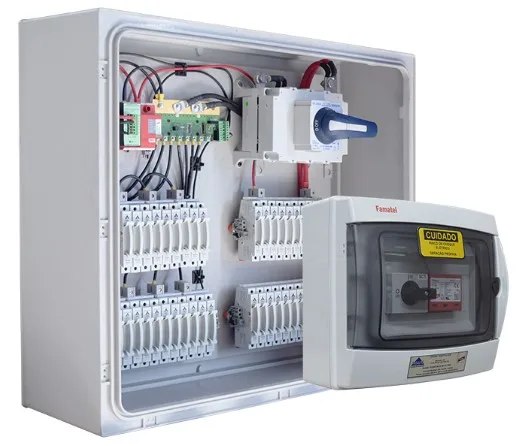
It connects the cables coming from the photovoltaic modules to the inverter, while providing overvoltage and overcurrent protection and allowing circuit disconnection. The basic elements of a string box are:
- Enclosure: where the protection devices and electrical connections will be located;
- Disconnecting device: can be implemented with a disconnecting switch or circuit breaker;
- Overvoltage protection device: DPS;
- Overcurrent protection device: circuit breaker or fuse;
- DC cables.
What are the components of a string box?
casing
The enclosure is the "box" that houses the protective devices and electrical connections. The enclosure's function is to protect the devices and connections from the elements and protect the user from electric shock.
Enclosures can be classified according to their tolerance to dust and water ingress. The IP rating system determines a number that reflects the enclosure's protection. The table with IP protection definitions is shown below.
Table 1 – IP degree of protection determination scheme
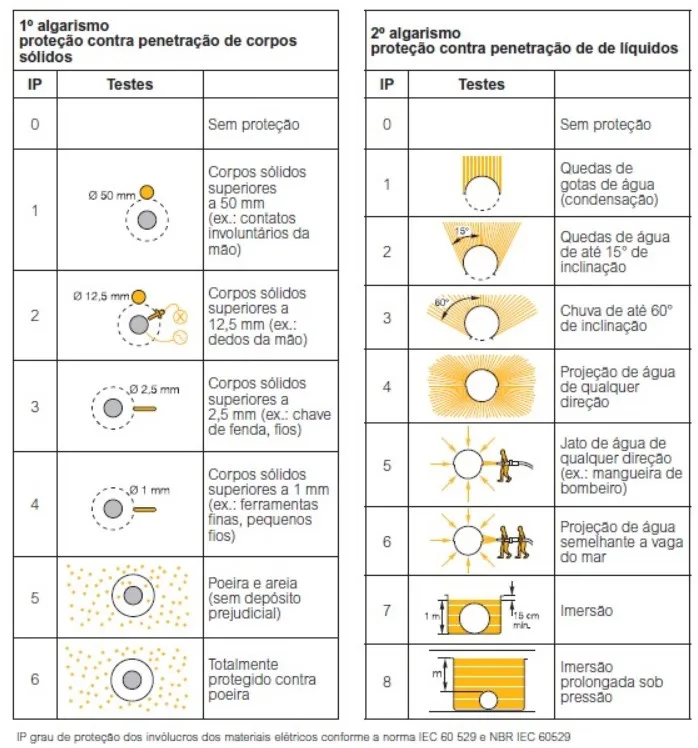
Enclosures can also be classified as suitable for indoor environments (minimum protection IP2X) or outdoor environments (minimum protection IP55). ABNT NBR IEC 60529 is the standard that characterizes enclosures suitable for electrical circuits.
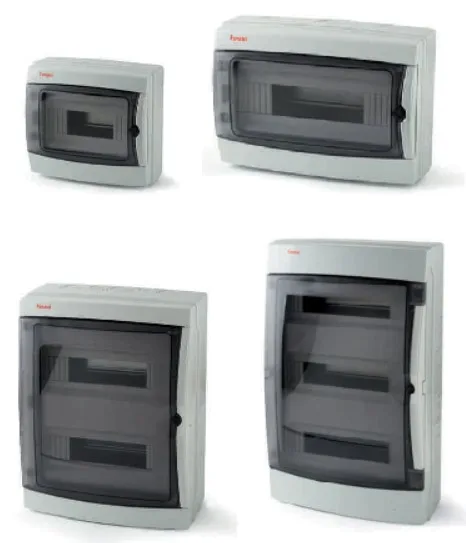
A installation standard 5410 establishes that alternating current (AC) and direct current (DC) circuits should not be mixed within a single enclosure. Furthermore, it is recommended that the maximum volumetric occupancy not exceed 50%. This rate limits the overheating effect of concentrating devices in a closed environment. Some examples of enclosures are shown below.
Disconnect switch
The disconnect switch is a device for connecting and disconnecting the DC portion of the photovoltaic system. Safe disconnection of the system is one in which there is no risk of electric shock to the user or fire from sparks at the moment of disconnection. The technical characteristics of disconnect switches are:
- Insulation/operating voltage: is the maximum voltage between the electrical connection points that the switch supports;
- Operating current: is the maximum current that runs through the electrical elements of the switch;
- Usage specification: defines whether the switch is suitable for AC or DC systems;
- Number of poles: is the number of conductors that the switch can section;
- Impulse withstand: the switch must be able to withstand an electrical impulse in the open position in accordance with the specifications in table 50 of NBR 5410.
For each switch operating voltage value, there is a maximum operating current. Manufacturers make this information available in the product's technical brochure. To prevent sparking during normal operation of the switch, the voltage, current and application limits must be respected.
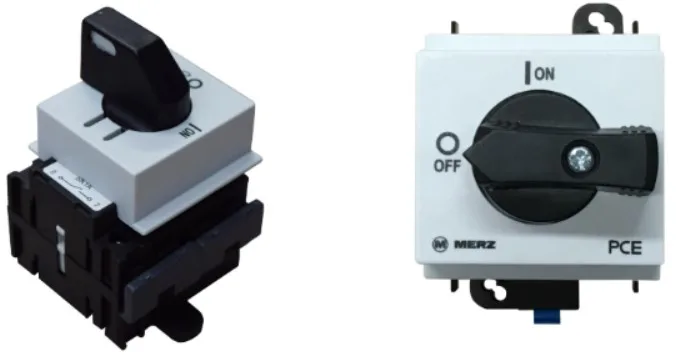
Some switches can simultaneously section several conductors, and can then assume a “general switch” characteristic of the string box.
DPS (Surge Protection Device)
The SPD is the device that reduces the effects of overvoltage on the circuit. The function of the SPD in the string box is to protect the inverter against overvoltages coming from the DC circuit.
The phenomena that can cause overvoltages are: atmospheric discharges in the SPDA system and nearby atmospheric discharges that induce current in the DC circuit. DPS is characterized according to the quantities below.
- Type: SPDs can be classified as type 1, 2, or 3. Type 1 SPDs are suitable for direct lightning strikes, while Type 2 SPDs are suitable for surges induced by nearby lightning strikes and power grid disturbances. Type 3 SPDs are suitable for protecting more sensitive electrical equipment.
- Uc: Maximum continuous operating voltage. This represents the maximum operating voltage that the SPD can withstand without triggering its overvoltage protection;
- Up: Protection voltage level. This is the maximum voltage between the SPD terminals when it is active and conducting a discharge current equal to In or Iimp. In other words, it is the maximum voltage that the circuits downstream (i.e., those after) the SPD receive;
- Iimp: Nominal protection current for type 1 SPDs. This is the maximum protection current that a type 1 SPD can divert to protective grounding. Iimp values typically occur in direct lightning strikes;
- In: Nominal protection current for Type 2 and 3 SPDs. This is the maximum current that the Type 2 SPD diverts to protective grounding. The SPD must withstand this current for at least 19 activations;
- Icc or Isc: This is the maximum short-circuit current that a SPD with an internal fuse or miniature circuit breaker can withstand. In the event of a SPD failure, the SPD must be capable of carrying the short-circuit current until it is interrupted by the SPD itself or by another protection device in the circuit;
- IMAX: This is the maximum current that a SPD can divert to protective ground. The ability to divert current when it reaches IMAX only occurs once. The SPD is damaged and cannot be reused.
To learn more about surge protection, read the article What is DPS and how is it used in photovoltaic systems.
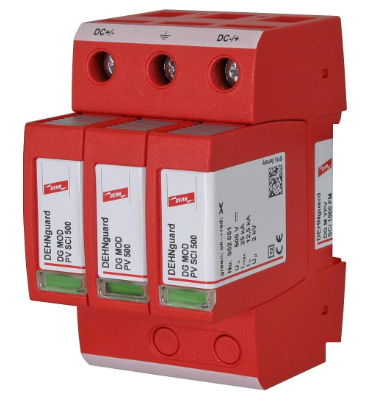
Fuse
A fuse is an overcurrent and short-circuit protection device that operates by melting a conductive element when the current exceeds its nominal value. The fuse's technical characteristics are:
- Dimensions: there are different fuse dimensions, which are a consequence of their type of use, current interruption capacity and nominal current;
- In: nominal current. This is the current used for overcurrent protection calculations;
- Maximum interrupting current: This is the highest current the fuse can block. Values above this limit do not guarantee current blocking and may also put the fuse at risk of fire.
- Operating voltage: this is the highest voltage at which the fuse operates without damage and risk of malfunction;
- Actuation curve: this is the curve that shows the time it takes for the device to actuate for each current value above the nominal value;
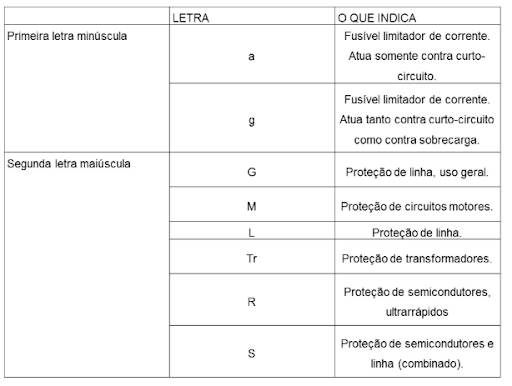
- Type: specifies the circuit/use the fuse is suitable for. The table below shows the most common fuse types;
- Non-melting current: maximum overload current above the nominal current value at which the fuse will not operate;
- Conventional time fusing current: overcurrent that ensures fuse operation within the conventional time specification (1 or 2 hours)
Table 2 – Fuse type
The curve that relates the operating time of a fuse to the electric current that passes through it is shown below.
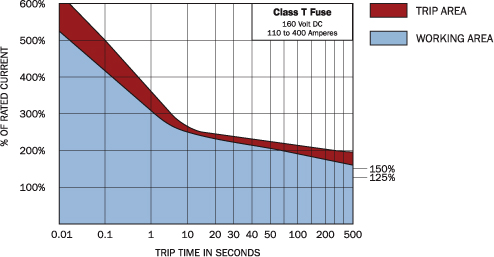
The fuse will not operate while operating in the blue region. The red region indicates the operating points that cause the fuse to trip.
For a current of 200% of the nominal value, for example, the fuse will operate between 50 and 200 seconds. For the fuse described in the graph, the non-melting current is 150% of the rated current.
The fuses suitable for photovoltaic circuits are of the gPV type and feature protection against short-circuit current and overcurrent. The PV designation refers to the fuses' ability to operate at DC current with voltage values typical of photovoltaic systems.
gPV type fuses also have a non-melting current of 1,13 times the nominal current and a melting current in conventional time (1 hour) of 1,35 times the nominal current. The minimum maximum interrupting current of a gPV fuse is 10kA.
Disconnector
A circuit breaker is a thermomagnetic device that protects against overcurrent and short-circuit current, and can also be used as a disconnecting element. The device operates by heating a bimetallic plate that deforms with temperature and a coil that generates a magnetic field.
Beyond a certain limit, the deformation of the bimetallic plate and the electromagnetic force generated by the coil will cause the circuit breaker's internal contacts to disconnect. Both the heat generated and the electromagnetic force are proportional to the current flowing through the circuit breaker. Circuit breakers can be characterized according to the following variables:
- In: Rated operating current. This is the maximum current at which the circuit breaker operates without activating its protection. Values above this current will cause the circuit breaker's protection to activate and the circuit to be disconnected.
- Icu: Maximum short-circuit current interrupting capacity. This is the maximum current that the circuit breaker can operate to disconnect the circuit. Values above this current do not guarantee proper protection and may pose a fire risk.
- Actuation curve: defines the characteristic of the protection's actuation time in relation to the overcurrent intensity;
- Operating voltage: defines the nominal operating voltage of the circuit breaker;
- Circuit type: defines whether the circuit breaker is suitable for AC or DC circuits;
- Conventional time operating current: current at which the circuit breaker guarantees disconnection in 1 hour.
The typical trip curve for a circuit breaker is shown below as an example.
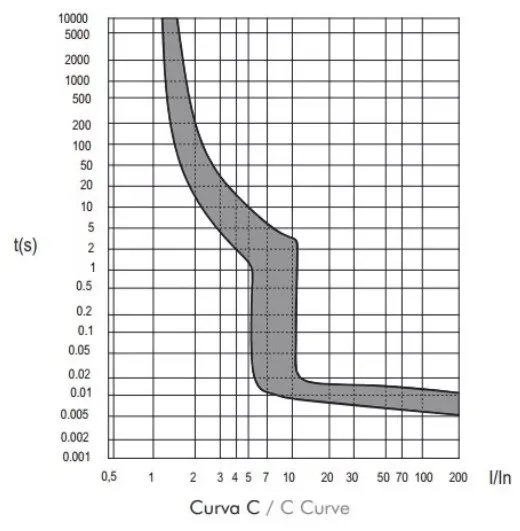
The blue area is the circuit breaker's normal operating zone. In this zone, the protection and circuit disconnection should not be activated. The red region is the zone in which the circuit breaker will trip, with the time depending on the ratio of the current passing through the device to the rated current. For a current of 10x the rated current, for example, the circuit breaker will trip in between 0,01 and 2,5 seconds.
Circuit breakers can replace fuses in photovoltaic systems, provided they have a tripping current, in conventional weather, equivalent to 135% of the nominal current. AC circuit breakers lack the insulation and arc-interrupting capacity suitable for direct current and should therefore not be used in string boxes.
DC cable
The string box receives the DC cables from the photovoltaic modules and routes them to the inverter. Therefore, the same criteria adopted when selecting module cables should be applied when selecting the string box conductors.
The cable must contain double insulation, be resistant to UV radiation, be capable of withstanding the DC voltages of the photovoltaic system (typically 600 to 1500 V) and must have a tinned copper conductor if it is in areas subject to salt spray.
The cable section depends on the installation method, circuit current, ambient temperature, circuit grouping and, if buried, soil thermal resistivity and soil temperature. The determination of the cable cross-section must follow standards NBR 16612, NBR 16690 and NBR 5410.
Connectors and connections
String circuit connections to the string box can be made using MC4 connectors or grommet-terminated cables. Paralleling or connecting multiple circuits to the terminal of a string box device is not permitted unless it has been specifically designed for this purpose.
Connections must be made using appropriate busbars or terminals. Improper circuit connections create hot spots in the cable, protective device, and terminals. These hot spots increase system losses and can become fire hazards.
The relationship between circuit breaker, fuse, overcurrent protection and reverse current
The module can be approached by a current source proportional to solar irradiation. The STC test conditions determine the short-circuit current and open voltage of the module assuming an irradiation of 1000 W/m2 and a cell temperature of 25°C.
In a real installation, the cell temperature reaches around 30°C above ambient temperature, the increase in cell temperature has a subtle effect on increasing the module's short-circuit current, in the order of +0,05% /°C . For an ambient temperature of 30°C, the increase in Isc compared to STC conditions is only 1,7%.
As in a real installation the maximum ambient temperature is limited, the current Isc will never exceed significant values beyond the values determined in STC + 2%. Therefore, there is no need for protection against overcurrent due to a possible increase in the module's generation.
Overcurrent protection through a fuse or circuit breaker has the main function of preventing reverse current flow from occurring. Reverse current occurs in a module set with strings in parallel when the open circuit voltage (Voc) of one string is lower than the open circuit voltage of the other strings.
When this occurs, the affected string behaves analogously to a system load, dissipating the heat generated by this reverse current flow. The most common causes of reverse current are:
- Short circuit in one of the modules;
- Short circuit between module cells;
- Module ground faults;
- Installation errors causing strings in parallel with different numbers of modules.
Conclusion
Properly specifying and assembling string boxes is essential to ensure the safety, durability, and regulatory compliance of photovoltaic systems. Understanding the regulatory requirements NBR 5410 and NBR 16690 helps not only to avoid failures, but also to deliver more efficient and professional installations.
Want to deepen your knowledge of solar power plant design and installation? Visit our course on photovoltaic plants and master the good practices required by the market.



Comments (6)
Comments are moderated before publication.Comments should be respectful and contribute to a healthy debate. Offensive comments may be removed. The opinions expressed here are those of the authors and do not necessarily reflect the views of the author. Canal Solar.
Very good content! Treats all significant points about the string box. I just thought I needed to talk a little about the cases in which not using the string box is recommended.
Hello, Eduardo, how are you? The cases in which non-use will be indicated will be when the inverter has all the necessary protections.
I would really like to learn and know everything about string boxes from 1 input to multiple inputs.
I work with electrical energy, and I intend to improve myself with solar energy and improve my knowledge in this area.
Beautiful to have you. We are guiding. Thank you and congratulations.
I am a mechanical engineer graduated from FEI in 1991
Electromechanical Technician graduated from ITF GO in 1986.
I have been working with air conditioning since 1989
I have worked with solar heating for 20 years and I am 52 years old.