
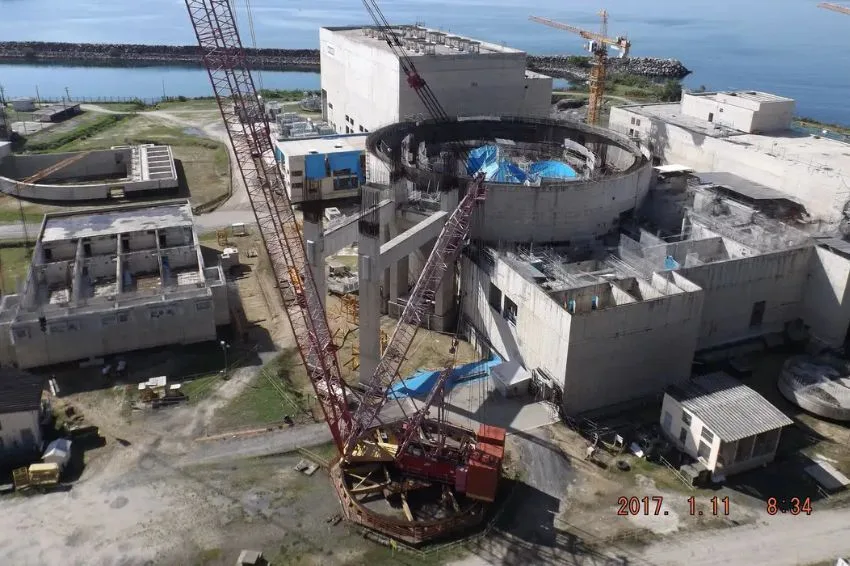
A new and comprehensive economic and financial feasibility study, prepared by BNDES (National Bank for Economic and Social Development), has brought a more positive outlook to the continuation of the construction of the Angra 3 nuclear power plant, which has been paralyzed since 2015.
The updated results, commissioned by the CNPE (National Council for Energy Policy), are already in the possession of the MME (Ministry of Mines and Energy). According to the survey, completing Angra 3 may be the most suitable option for Brazil.
However, the final decision on whether to continue or abandon the project rests with the CNPE, which is expected to decide at a meeting scheduled for 2025.
The topic has already been debated three times by the council since 2024, including a vote in favor of the conclusion cast by the council's president, who is the Minister of Mines and Energy, Alexandre Silveira, an outspoken advocate for the continued exploration of nuclear energy by Brazil.
Cost comparison
The estimated cost to complete the Angra 3 nuclear power plant was set at R$ 23,9 billion. In contrast, the study demonstrated that abandoning the project would require an expenditure ranging from R$ 21,9 billion to R$ 25,97 billion.
Eletronuclear, the company responsible for the project, emphasizes that the cost of abandoning the construction could even exceed the cost of completing the project. According to the state-owned company, abandoning the project would result in a significant expense without producing a single MWh of electricity.
The uncertainty surrounding the future of Angra 3 generates a considerable annual cost for Eletronuclear. To maintain the project while awaiting the CNPE's decision, the state-owned company spends approximately R$ 1 billion per year.
Of that amount, R$ 800 million relates to debt servicing with the BNDES and to Caixa Econômica Federal, and R$ 200 million is earmarked for the maintenance of equipment and infrastructure.
The project has already consumed approximately R$12 billion. Currently, the physical progress of the plant is at 66%.
Tariff Scenarios
BNDES analyzed three scenarios for the completion of the project. In all of them, the forecast is that the plant will begin commercial operation in March 2033.
The scenarios considered include the participation of a private partner, completion with public funds – from ENBPar and the Federal Government – and abandonment of the project.
The study projects the following equilibrium tariffs – based on November 2024: Scenario 1, R$ 778,86/MWh; Scenario 2a, R$ 817,27/MWh; Scenario 2b, R$ 791,81/MWh.
Eletronuclear argues that the resulting breakeven tariff is lower than the average generation cost of most large-scale thermal power plants in the country.
If completed, Angra 3 — along with Angra 1 and 2 — would become one of the most competitive thermal power plants of its kind in the Southeast subsystem.
There was an increase of approximately R$ 75/MWh in the equilibrium tariff compared to the previous study, presented to the CNPE in December 2024. This increase was mainly due to the postponement of the start of operations and the updating of financing and investment costs.
The study also indicates that there is potential to reduce final costs and, consequently, the tariff.
This can occur through: obtaining discounts when contracting the company that will resume the works ("EPC contractor"); better credit conditions; and the approval of tax incentives under discussion in the National Congress, such as Renuclear.
Benefits
Angra 3 will have an installed capacity of 1,4 GW, capable of producing approximately 12 million MWh annually. Its completion will contribute to the security of the national electricity supply.
The plant is capable of generating enough energy to supply 4,5 million inhabitants, or the equivalent of 70% of the consumption of the state of Rio de Janeiro, when combined with Angra 1 and 2.
all the content of Canal Solar is protected by copyright law, and partial or total reproduction of this site in any medium is expressly prohibited. If you are interested in collaborating or reusing part of our material, please contact us by email: redacao@canalsolar.com.br.
Comments
Comments are moderated before publication.Comments should be respectful and contribute to a healthy debate. Offensive comments may be removed. The opinions expressed here are those of the authors and do not necessarily reflect the views of the author. Canal Solar.