
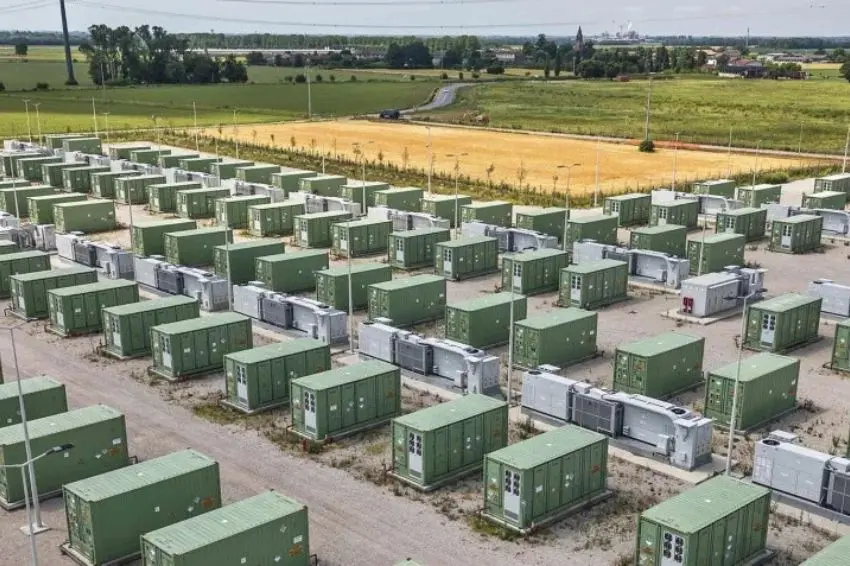
BNDES (Brazilian Development Bank) presented to the market the financing conditions that can be used by entrepreneurs interested in the LRCAPs (Capacity Reserve Auctions in the form of Power) for battery energy storage systems (BESS), scheduled for December 2nd and 4th.
In a webinar held this Wednesday (25), the technical team detailed the credit composition possibilities, the local content criteria, the bank's participation limits and the guarantee requirements, in addition to answering questions about the application of the rules to the winning projects.
The main guideline is to combine incentivized resources from the Climate Fund with traditional BNDES lines of credit and, eventually, other sources of financing, in a blended finance structure.
The design aims to favor projects with greater national content, without restricting funding solely to batteries: Brazilian equipment, materials, and services related to implementation may also be included in the funding base, provided they meet the bank's criteria.
Local content defines the composition of the credit.
The percentage of resources from the Climate Fund will depend on the technological accreditation route chosen by the entrepreneur. In Route 1, the structure will necessarily combine 80% of resources from the Climate Fund and 20% of traditional BNDES financing, with costs associated with the TLP (Long-Term Rate).
For Routes 2, 3, and 4, which have a higher density of local content, the funding may consist entirely of resources from the Climate Fund.
Alexandre Siciliano Esposito, head of the department in the area of Energy and Climate Transition, clarified that this differentiation is not related to the day on which the project will participate in the auction.
Therefore, winning projects in the December 4th competition will also be eligible for the Climate Fund, provided they meet the local content and accreditation requirements.
Another important clarification concerns the scope of eligible items. The accredited storage system is considered a major piece of equipment, but it is not the only eligible component.
Other nationally certified equipment may also be included, in addition to materials and services proven by invoices with national coding. This includes, for example, substation components and connection structures necessary for energy transmission.
Conversely, imported equipment is not eligible for financing under the Climate Fund, even when there is no equivalent domestic product. Expenses related to land acquisition, vehicles, and certain financial costs are also excluded.
The limit reaches 80% of the project.
BNDES's maximum participation will be limited by the lower of two parameters: 80% of the total project investment or 100% of the items considered eligible for financing. In a project worth R$ 1 billion, for example, if all expenses are eligible, the bank can finance up to R$ 800 million. If the eligible items represent only 70% of the investment, the ceiling drops to R$ 700 million.
For direct access to credit from the Climate Fund, the minimum amount is R$ 20 million. There is also an allocation limit of R$ 1 billion per economic group every 12 months. The calculation considers the corporate structure and control of the companies, and not simply the calendar year.
The overall budget of the Climate Fund, in turn, depends on the Union's annual program. The information is that BNDES does not work with a separate, pre-set budget exclusively for auctions, as the actual demand will only be known after the results of the bidding processes. The expectation is for new contributions to the fund in the 2027 Annual Budget Law, without any provision for severe budgetary restrictions.
Interest rates start at 7,88% in the Climate Fund.
Under the conditions presented, the Climate Fund has a nominal financial cost of 6,5% per year, plus a BNDES spread starting at 1,3% per year, according to the risk assessment of the client or project.
Since the rates are factored, and not simply added, the minimum cost indicated by the bank is approximately 7,88% per year. For the portion financed by the TLP (Long-Term Interest Rate), the reference presented for November 2026 was IPCA (Broad Consumer Price Index) plus 7,72% per year, with a minimum spread of 1,1% for storage.
However, an important possibility was established for the auction participants, namely, that the client may choose between the TLP (Long-Term Interest Rate) in effect in the month of the auction, December 2026, and the rate valid on the date of contracting the financing, opting for the lower one.
The choice will not incur any additional cost and can be exercised within the timeframe for the feasibility and execution of the project as outlined in the call for proposals, estimated at approximately one and a half years.
16-year term and tailored amortization
The total term of financing with resources from the Climate Fund can reach 16 years, including the implementation period. The reference presented for the grace period provides for the suspension of interest and principal payments until six months after the start of commercial operation. From then on, amortization begins.
Instead of exclusively requiring traditional models of constant installments or amortization through the SAC (Constant Amortization System), the bank allows for complete customization of the payment profile, both for the Climate Fund installment and the TLP (Long-Term Interest Rate).
The intention is to adjust the debt service to the cash flow generated by the project and to the additional investments needed to maintain the availability of the batteries throughout the contract.
The final debt maturity date must occur at least six months before the termination of the CRCAP (Capacity Reserve Contract), which has a revenue horizon of 15 years. This margin aims to prevent the financing from extending beyond the contractual remuneration period of the asset.
Project finance requires guarantees and a minimum ICSD (Investment Certificate of Credit).
BNDES presented two structuring options. In corporate financing, credit is granted based on the financial capacity and available margin of the holding company, which can offer a corporate guarantee.
The fiduciary assignment of CRCAP receivables will also be used, with the possibility of bank guarantees in certain situations. In project finance, the structure considers real and personal guarantees.
Among the guarantees foreseen are the pledge of shares in the SPE (Special Purpose Entity), the sale of equipment, and the fiduciary assignment of receivables from the contract. During implementation and the operational evaluation period, the bank may require a corporate or bank guarantee.
One of the key conditions for the release of personal guarantees is proof of a minimum Debt Service Coverage Ratio (DSCR) of 1,30, calculated over at least 12 consecutive months and certified by an independent auditor.
The bank intends, however, for this indicator to show an upward trajectory throughout the contract, with progressive leeway to absorb future risks and investments.
Augmentation needs to be included in financial planning.
One of the topics that generated the most questions was augmentation, that is, the replacement and addition of modules and equipment throughout the lifespan of batteries to preserve their capacity and availability.
Siciliano Esposito reported that the initial funding from the Climate Fund focuses on investment prior to commercial operation and does not guarantee credit for future rounds of expansion or replacement. Therefore, entrepreneurs will need to present a strategy for incremental investments.
The bank may consider an escrow account to demonstrate that the funds needed for the augmentation will be accumulated and funded from the operation's own cash flow. Debt amortization may also be adjusted to accommodate these expenses and their effects on the ICSD (Investment Credit Standard).
The rules for accrediting modules installed after the start of operations, in turn, should be clarified by the regulatory bodies, since this requirement is included in the CRCAP.
BNDES emphasized that the conditions presented are parameters to guide the structuring of projects, and not an automatic guarantee of financing.
Credit analysis will be conducted individually after the auctions, considering the groups' financial capacity, implementation risks, technology, equipment supply, and compliance with contractual obligations.
Click here to access the dedicated website created by BNDES for LRCAP.
all the content of Canal Solar is protected by copyright law, and partial or total reproduction of this site in any medium is expressly prohibited. If you are interested in collaborating or reusing part of our material, please contact us by email: redacao@canalsolar.com.br.



Comments
Comments are moderated before publication.Comments should be respectful and contribute to a healthy debate. Offensive comments may be removed. The opinions expressed here are those of the authors and do not necessarily reflect the views of the author. Canal Solar.