
The transformation of Brazil's electricity matrix is expected to increase the need for resources capable of responding quickly to variations between generation and consumption. In this scenario, energy storage systems (ESS) are beginning to occupy a central position in the planning of the expansion and operation of the SIN (National Interconnected System).
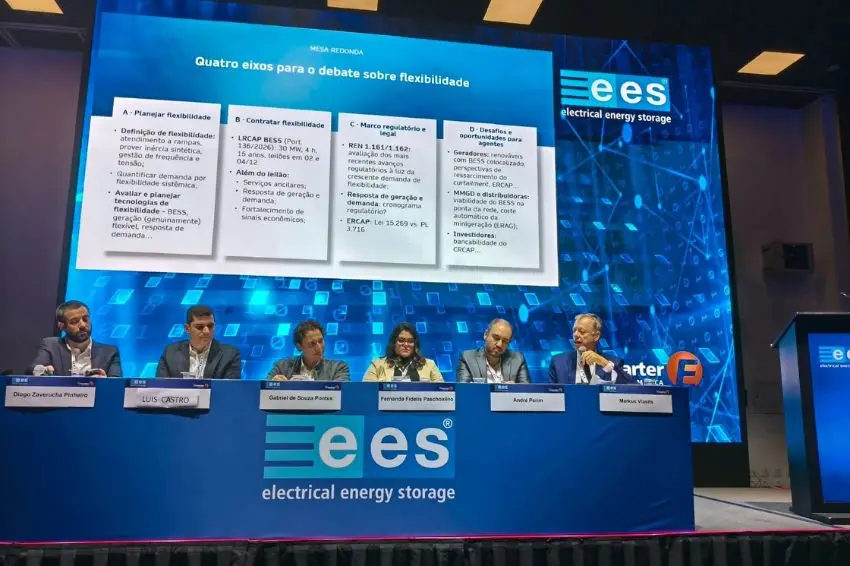
The topic was discussed this Wednesday (26) during the panel “Planning perspectives for the contribution of SAE to the SIN”, held at Intersolar South America, in São Paulo. The meeting brought together representatives from the MME (Ministry of Mines and Energy), EPE (Energy Research Company), ABSAE (Brazilian Association of Energy Storage Solutions) and companies in the sector.
The president of ABSAE, Markus Vlasits, highlighted that flexibility has become one of the main issues in the electricity sector. The concept involves the ability to accommodate load ramps, contribute to frequency and voltage control, provide synthetic inertia, and respond quickly to operational needs.
According to Vlasits, the contracting of these attributes does not need to be restricted to capacity auctions. Ancillary services, generation and demand response, and more appropriate economic signals can also contribute to remunerating the resources offered to the system.
The director of the Planning and Generation Grants Department at the Ministry of Mines and Energy (MME), André Perim, stated that the debate on flexibility has been gaining traction for several years. The first studies on the subject were developed by EPE in 2018, while the ten-year and long-term plans began to provide clearer indications of the future needs of the National Interconnected System (SIN).
According to Perim, different technologies can offer one or more attributes of flexibility. Batteries can meet three of these dimensions and, when combined with generation assets, can further expand their contribution to the system.
The representative from the Ministry of Mines and Energy (MME) pointed out that the Capacity Reserve Auctions held since 2021 have already incorporated flexibility requirements, especially for thermoelectric power plants. These criteria are being improved to allow projects to respond more quickly to operational needs.
The next step, however, will be to further define what the SIN (National Interconnected System) actually needs, how these attributes will be measured, and how they can be included in future contracts. This evolution follows the process initiated in 2019, when planning began to more explicitly consider the contracting of power, in addition to energy.
For the first battery auction, the government opted to concentrate the remuneration of the projects into a fixed revenue. The measure seeks to simplify the design of the bidding process, reduce uncertainties, and offer greater predictability to investors, considering that the technology is not yet installed on a large scale in the country.
As regulation advances and the market gains more experience, other remuneration models may be evaluated. Perim also advocated for recurring and periodic auctions, both to provide long-term signals to the market and to allow the government to organize the auctions further in advance.
EPE projects increased power requirements.
EPE analyst Fernanda Paschoalino explained that the expansion of variable renewable energy sources modifies the system's operating profile and increases power and flexibility requirements over the next ten years.
With the increased participation of solar and wind power sources, net load ramps are expected to become more pronounced. Projections presented by EPE indicate power requirements of around 20 GW to 30 GW in 2030. Intraday variability could reach approximately 50 GW and advance to approximately 70 GW in 2035.
Since 2018, EPE has been developing specific studies on flexibility. In 2023, the company presented a methodology for estimating the requirements and supply of this attribute and is currently working on deepening the criteria that can guide planning.
Energy storage is analyzed as one of the solutions to meet the growth in consumption, integrate renewable sources, and fulfill new systemic requirements, especially given the difficulties in expanding conventional hydroelectric generation. The studies consider not only batteries but also technologies such as reversible hydroelectric plants.
The PDE 2035 indicates the possibility of approximately 7 GW of energy storage technologies in the Brazilian electrical system. The applications evaluated include isolated systems, transmission-connected assets, and projects contracted in the Capacity Reserve Auctions.
The reduction in equipment costs has also become more apparent in recent studies. Even so, the lack of large-scale projects in Brazil and uncertainties related to taxation make it difficult to develop projections.
Investors are preparing.
The companies participating in the panel believe that contracting for batteries could open a new cycle of investments in the Brazilian electricity sector. Gabriel Pontes, Director of New Business at Elera Renováveis, stated that the company is evaluating flexibility at different points in the system, including centralized generation and consumption.
The strategy also involves engaging with consumers capable of making their loads more flexible. For the company, this characteristic should guide a new frontier of investments and allow the creation of synergies between generation, storage, and demand.
Luis Castro, engineering and development manager at Casa dos Ventos, described the advancement of flexibility as an opportunity to integrate storage systems into generation projects that are already in operation. The main challenge for investors will be to correctly assess risks and prices amidst regulatory, operational, and commercial uncertainties.
Meanwhile, the director of Brasol's storage unit, Diogo Zaverucha, highlighted that the demand for batteries has become concrete, although doubts remain about the volumes that will actually be contracted. The company has registered more than 4 GW in projects and intends to participate in the auctions.
Zaverucha observed that the manufacturers' activity during Intersolar itself demonstrates the industry's rapid response to the signal given by the government. Foreign companies, mainly Chinese, are considering installing production units in the country, with announcements totaling a potential capacity of approximately 10 GW per year.
Despite investor interest, battery projects outside of public auctions still face difficulties in becoming viable in Brazil. Brasol's assessment is that storage will need to find additional revenue sources for the market to develop more broadly.
In distributed generation, for example, the compensation model still offers few economic incentives for installing batteries. Energy injected during the day generally has the same compensation value as that available at other times, reducing the benefit of shifting solar generation to nighttime.
In more mature markets, a significant portion of projects are able to move forward outside of centralized contracting mechanisms. In Brazil, however, the first auction should serve as an initial impetus for the technology, while regulation evolves to recognize other applications and services.
Price ceilings and margin for sale are among the next steps.
The Ministry of Mines and Energy (MME) is now working on defining the ceiling price, the flow margin, and the volume to be contracted in the two tenders. The quantity of the flow margin should be released on September 30th.
The timeline anticipates the approval of the tender by... ANEEL (National Electric Energy Agency) on October 27 and its publication on October 29. After the auctions, the homologation, adjudication and issuance of concessions stages will still need to be completed, which is expected to take up to six months.
It will also be necessary to make the winning projects compatible with the PNAST (National Policy for Access to the Transmission System). Although the projects do not need to compete for margin within the access seasons, they will have to meet the requirements established for obtaining the prior access document.
Schedule and supply chain are a concern for companies.
Among the risks pointed out by investors are the definition of the cost allocation among the paying agents, the new charges associated with network access, and the penalties foreseen for the projects. Although the remuneration has been structured as fixed revenue, its receipt will depend on the fulfillment of contractual obligations and performance indicators.
Operational preparation will also require attention. Because this technology has different characteristics from conventional dispatched power plants, storage systems will need to undergo specific pre-operational procedures from the ONS (National System Operator).
Another critical point will be the supply chain, especially the availability of domestically produced transformers and equipment within the established timeframe for the projects to become operational in 2028.
To participate in one of the auctions, projects will need to use certain components produced or assembled in Brazil. According to Brasol, despite the presence of several manufacturers at Intersolar and announcements of national production, suppliers are still unable to provide definitive prices for this equipment.
Uncertainty also affects the formation of partnerships between investors and manufacturers. For Casa dos Ventos, contracts will have to be negotiated up until the auctions take place, which will require a high degree of confidence in the suppliers' ability to deliver the equipment on time and under the agreed conditions.
Despite the challenges, the panelists assessed that the publication of the guidelines represented progress towards the integration of energy storage into the Brazilian electrical system. The expectation is that the December auctions will mark the beginning of a permanent agenda for contracting flexibility, accompanied by the development of new business models for batteries in the country.
all the content of Canal Solar is protected by copyright law, and partial or total reproduction of this site in any medium is expressly prohibited. If you are interested in collaborating or reusing part of our material, please contact us by email: redacao@canalsolar.com.br.


Comments
Comments are moderated before publication.Comments should be respectful and contribute to a healthy debate. Offensive comments may be removed. The opinions expressed here are those of the authors and do not necessarily reflect the views of the author. Canal Solar.