

Contracting the supply of subscription solar energy Who growing year after year in Brazil as it is a way of circumventing the value of the electricity bill and easing the pockets of consumers who wish not to invest in the installation of a photovoltaic plant itself.
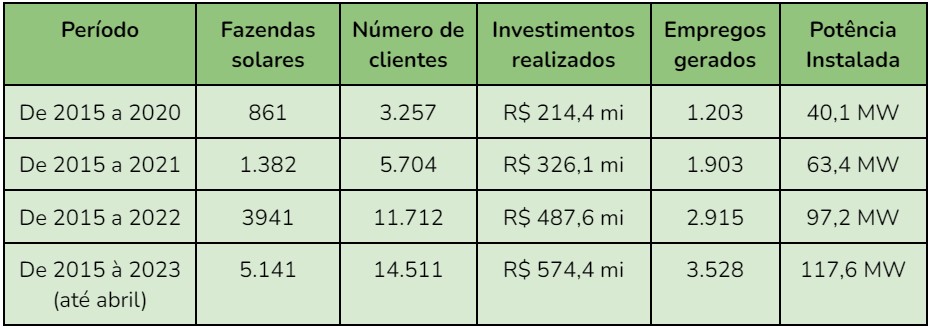
Data obtained by Canal Solar in partnership with ABSOLAR (Brazilian Photovoltaic Solar Energy Association) show that the number of solar farms practically in operation sextupled in Brazil in less than four years: 861 enterprises in 2020 all with 5.141 in april 2023.
Consequently, the number of clients who joined the modality also increased in the same period, jumping from 3,2 thousand to 14,7 thousand consumers receiving credits generated from solar farms.
“Shared generation is the path that allows people, for technical or economic reasons, to have access to solar energy in a very democratic way”, explains Guilherme Susteras, coordinator of the entity's distributed generation working group.
According to him, this is a rapidly growing market and will continue to be prosperous for many years, especially because there are still a large number of solar farms under construction. “There was a huge volume of requests for access opinions before the end of the Law 14.300 deadline and now these projects will start to come to fruition”, he highlighted.
Investments, jobs and power
The data collected also reveals that the solar farms have already been responsible for attracting more than R$574 million in investmentsBy installation of more than 117,6 MW of power e more than 3,5 jobs created since the beginning of the expansion of the sport in Brazil.
The Solar energy subscription started in 2015when ANEEL (National Electric Energy Agency) regulated shared generation, allowing the energy generated to be sold to third parties through credits, through which the customer contracts the company's subscription services.
Check below the cumulative data on shared generation in Brazil:
How does a solar farm work?
A solar farm is a photovoltaic plant included in the distributed generation, intended for sale or rental of lots of solar panels all with people and companies in the captive market who wish to generate their own energy to reduce their electricity bills without their own system.
As solar farms receive this name because they are built on soil, rather than roofs, and usually in regions far from city centers. counting on hundreds of photovoltaic modules to generate energy that will be sold to customers in other locations and distributed through transmission and distribution lines.



Comments
Comments are moderated before publication.Comments should be respectful and contribute to a healthy debate. Offensive comments may be removed. The opinions expressed here are those of the authors and do not necessarily reflect the views of the author. Canal Solar.