
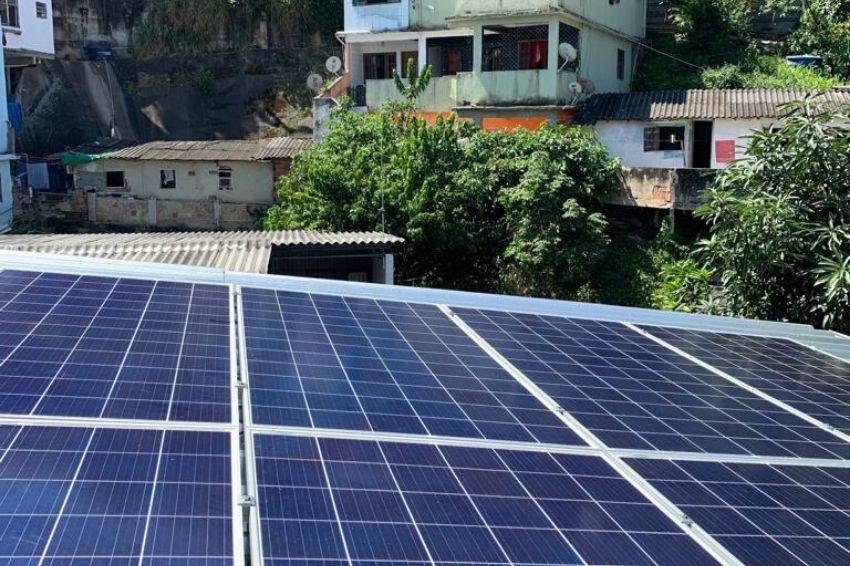
The communities of Babilônia and Chapéu Mangueira, located in Rio de Janeiro (RJ) will be the first Brazilian favelas to implement a solar energy cooperative. The project is being developed by NGO Revolusolar.
According to Eduardo Avila, executive director of Revolusolar, this is a pilot project that should extend throughout the country. “It will be the installation of a 26 kWp plant on the roof of the residents’ association, which will serve 30 families. It is a pilot project, because we understand the importance of validating operations, people's perception and shaping the form of communication, to then replicate. The implementation should employ around ten people, including solar installers and community ambassadors, all of whom are residents of the community.”
The implementation of the plant will have a positive impact on the two communities located in the capital of Rio de Janeiro, as the energy tariff in the state of Rio de Janeiro is one of the most expensive in the country. And, according to Avila, the implementation of this project is in tune with the reality of those who live in Rio de Janeiro communities.
“We realized that this shared generation solution solves many of the technical and economic problems that exist in expanding the solution. Furthermore, it harmonizes with this sense of community, of cooperation, which is traditional in the favela. LONGi and GoodWe are partnering in this project, donating the equipment and we are planning the next steps”, explained Eduardo Avila, executive director of Revolusolar.
Avila also highlights that the cost reduction of more than 80% in photovoltaic energy in the last decade and the sustainability of the solar source are the main factors that motivated the realization of this and other Revolusolar projects.
“The idea that solar energy is for rich people is a myth. Solar energy is a much more important tool for the poorest layer. While the upper class spends around 3% to 4% of their income on energy, the low income spends up to 30% to 40%. So, it is a very important tool for economic issues to reduce energy expenses”, highlights Avila.
Cooperative
According to Revolusolar, the model adopted will be Shared Generation in a cooperative format, where the energy generated by the solar system will be credited to residents who are cooperative members. The NGO will be the owner of the asset, and will lease the equipment to the cooperative, which will pay a monthly amount calculated on top of the maintenance fee for those cooperating with the cooperative.
Eduardo explains how the fee will be calculated. “The cooperative will pay this asset lease to Revolusolar, and the members pay the cooperative a maintenance fee that is 50% of the savings they had on their electricity bill. For example, if a person saved R$200 through energy credits, then they will pay R$100 as a fee to the cooperative and the other R$100 will be their net savings”, explains Avila.
The resources received by the NGO for this lease will form a Community Fund. These resources will be used to pay local workers who work on the project, and finance the expansion of the generation plant in the community.
Project partners
The project has the contribution of the companies LONGi and GoodWe, which will donate the equipment necessary for the implementation of the plant in the community. In addition, it has the support of ABSOLAR (Brazilian Solar Energy Association) and the Canal Solar.
According to Nelson Falcão, Vice President of Production Chain at ABSOLAR, this type of project strengthens the solar sector, employs and helps those who need it most. Falcão also highlights the partnership with Revolusolar.
“We have established, within the ABSOLAR, a process of supporting entities such as Revolusolar, we recently made this formal agreement. And in this way, we can expose these initiatives to all our associates, generating presence of these entities in large shows, symposiums and congresses in the solar area, so that they have financial support, publicity and technical support”.
For the director of Canal Solar, Bruno Kikumoto, this project model is fundamental, as it highlights the social benefits provided by photovoltaic solar energy. “Many discussions were held, mainly in the review process of 482, where for internal reasons, the technical staff of ANEEL decided not to take into account the social benefits that solar energy brings. The sector took action, led by associations, and brought this point to a broader discussion, involving the Executive and Legislative branches, which were in favor of considering this very important benefit”.
Rafael Normanton, marketing manager at LONGi, highlights that the company is honored to participate in this project. “We are passionate about the project because it’s not just about there and installing energy, you’re not just delivering cheap energy to the community, it’s much more than that.”, comments Normanton.
He also highlights Revolusolar’s work in educational projects. “The educational aspect that the project brings to the communities is a great benefit. Solar energy has a very striking characteristic, which is the fact that you can train people to work within the [production] chain in an easy way”.
Sérgio Carvalho, national manager of GoodWe Brasil, highlights the sensitivity of the project as a whole. “We have a strong awareness of the project. We were looking for an action in this format and this project fell from the sky, because the objectives are undoubtedly the noblest”, he comments.
To implement the plant, GoodWe will provide an inverter model GW20K-DT. Carvalho states that he is eager to see the project come to fruition. “I see this project as something extraordinary. We want to see this system working soon, as quickly as possible so that we can replicate this, because this is the company’s philosophy.”
Fund-raising
Companies and people who want to contribute to this project, and other actions of the entity, you can access the NGO's fundraising page clicking here. A crowdfunding campaign should be launched in the coming weeks to help with the construction of the photovoltaic plant.
According to Avila, the resources from the donation collection campaign will be used to establish the cooperative, covering administrative, personnel and construction costs.





Comments
Comments are moderated before publication.Comments should be respectful and contribute to a healthy debate. Offensive comments may be removed. The opinions expressed here are those of the authors and do not necessarily reflect the views of the author. Canal Solar.