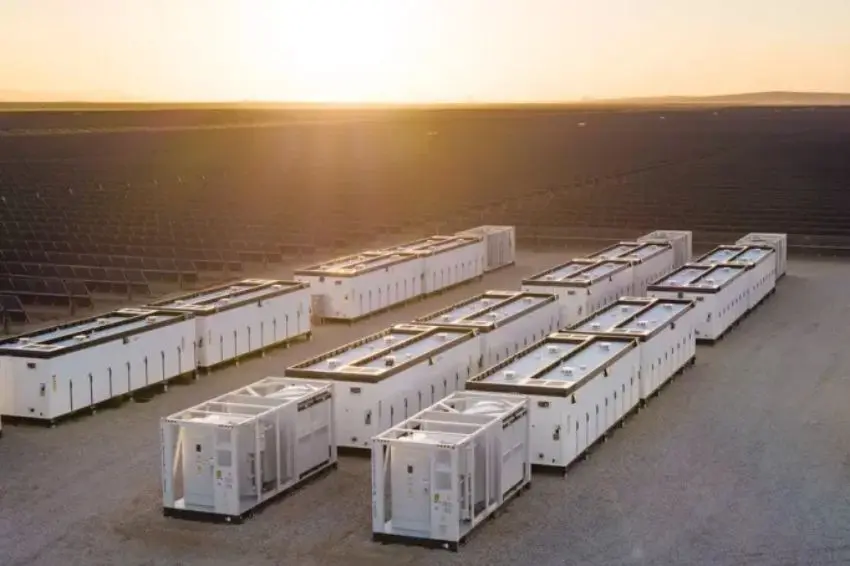

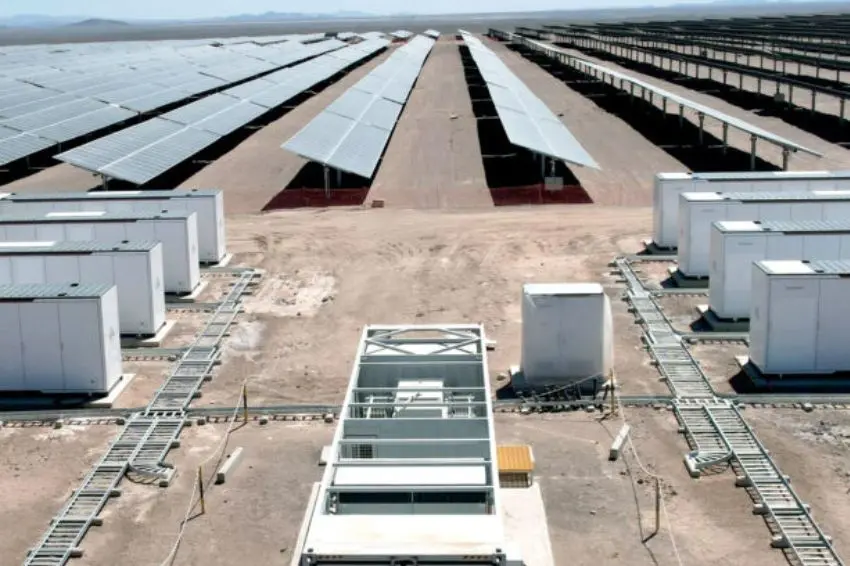
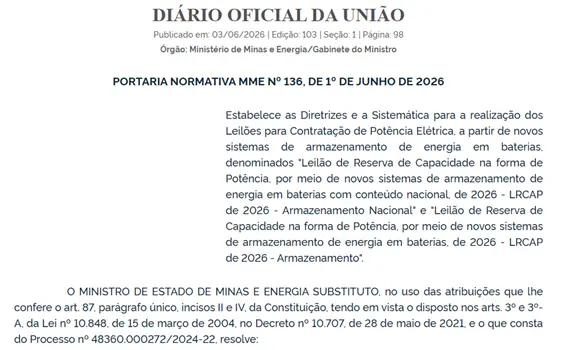
The MME (Ministry of Mines and Energy) published the Normative Ordinance No. 136/2026, which establishes the guidelines for the first auction of reserved capacity dedicated exclusively to new battery energy storage systems in Brazil.
A portaria – publicada no DOU (Diario Oficial da União) desta quarta-feira (3) – oficializa a contratação de BESS no setor elétrico brasileiro e define o desenho técnico, comercial e regulatório do certame. Pela portaria, o governo realizará dois LRCAPs (leilões de Reserva de Capacidade na forma de Potência).
The first will be the LRCAP of 2026 – National Storage, aimed at the 2028 Storage Power Product, intended for systems that meet the minimum nationalization requirements foreseen in the CFI System (Computerized Supplier Accreditation) of BNDES (National Bank for Economic and Social Development).
This system is used to register and enable manufacturers and their products to receive financing. Through this platform, the bank assesses whether equipment and services meet technical and operational criteria and nationalization rules.
The second auction will be the 2026 LRCAP – Storage, with the 2028 B Storage Power Product, open to other eligible systems. The regulation also stipulates that the national bidding process must take place before the open auction.
Auction schedule
The schedule foresees the start of registration and submission of documents to EPE (Energy Research Company) on June 15th, ending on July 31st, 2026. The technical note on the quantities of remaining capacity of the SIN (National Interconnected System) for outflow should be published by September 30th.
The auctions themselves were scheduled for December 2nd, in the case of the product with national content, and December 4th, in the case of the open-ended product. The contracts will have a term of 15 years, with supply beginning on August 1st, 2028.
Among the technical requirements, the ordinance establishes that the projects must have a minimum power of 30 MW, a continuous discharge capacity of four hours, and a maximum full recharge time of six hours.
The minimum required overall efficiency will be 85%, referenced to the individual measurement point. The standard also limits operation to up to two complete cycles per day, with a ceiling of 366 cycles per year.
The contracted systems must operate with a Variable Unit Cost (VUC) equal to zero, use new batteries, and fully comply with the recharge and discharge dispatches determined by the ONS (National System Operator).
In practice, the requirement for zero variable cost of ownership (CVU) indicates that projects cannot declare variable costs for their dispatch, as is the case with thermal power plants. This means that the project's remuneration will be concentrated in the Fixed Revenue of the contract, while the developer assumes the risk associated with the operational use of the asset by the system.
Another key point is the requirement for grid-forming functionality throughout the entire contract period. This obligation reinforces the role the government intends to assign to storage systems, not only as a resource for shifting energy throughout the day, but also as a tool to support the stability and reliability of the grid.
In the case of Product 2028 A, the signing of the LRCAP will be conditional upon proof, before the ANEEL (National Electric Energy Agency), regarding the accreditation of the system in the BNDES CFI, observing the nationalization criteria in force on the date of publication of the ordinance.
The entrepreneur may choose any of the four accreditation routes foreseen in Stage 1 of the sector regulation. The regulation also makes it clear that accreditation does not obligate the use of BNDES financing, but failure to meet the minimum nationalization requirements may lead to the termination of the contract.
Project remuneration will be provided through a Fixed Revenue, in reais per year, paid in twelve monthly installments and adjusted annually by the IPCA (National Consumer Price Index).
According to the ordinance, this revenue must be sufficient to cover investment, connection, use of the transmission or distribution system, operation and maintenance, taxes, insurance, decommissioning, and any reinvestments, such as replacing battery modules and acquiring new compatible inverters.
The risk related to dispatch uncertainty will be entirely borne by the developer. The energy used for charging and injected by the systems will be settled in the short-term market at the PLD (Price of Energy in the Spot Market), with positive and negative results allocated to CONCAP (Power Account for Capacity Reserve).
Any surplus energy consumed above the limit recognized by the system will be paid for by the developer. The ordinance also provides for locational bonuses for projects connected to busbars considered strategic, listed in Annex II.
In these cases, the power availability price will receive a β factor of 0,9, compared to 1,0 for other connection points, which increases the competitiveness of these projects in the auction. In the technical qualification stage, the ordinance waives the requirement for prior environmental, installation, or operating licenses, leaving the definition of the deadline for obtaining licenses for the winning projects to the tender notice.
Also waived, in some cases, is the prior submission of an access opinion for projects connected to the Basic Network, to DITs (Other Transmission Installations) and to ICGs (transmission system structures used to connect projects to the SIN). Therefore, these projects can enter the auction without submitting this document in the initial phase.
Background of the topic
The contracting of batteries through auctions had been discussed by the government and industry stakeholders as a response to the need to increase the operational flexibility of the National Interconnected System (SIN), in a context of greater participation of variable renewable energy sources. With the publication of Ordinance No. 136/2026, the topic moves from the expectation phase to having rules, a schedule, and objective criteria for contracting energy storage in the country.
all the content of Canal Solar is protected by copyright law, and partial or total reproduction of this site in any medium is expressly prohibited. If you are interested in collaborating or reusing part of our material, please contact us by email: redacao@canalsolar.com.br.