
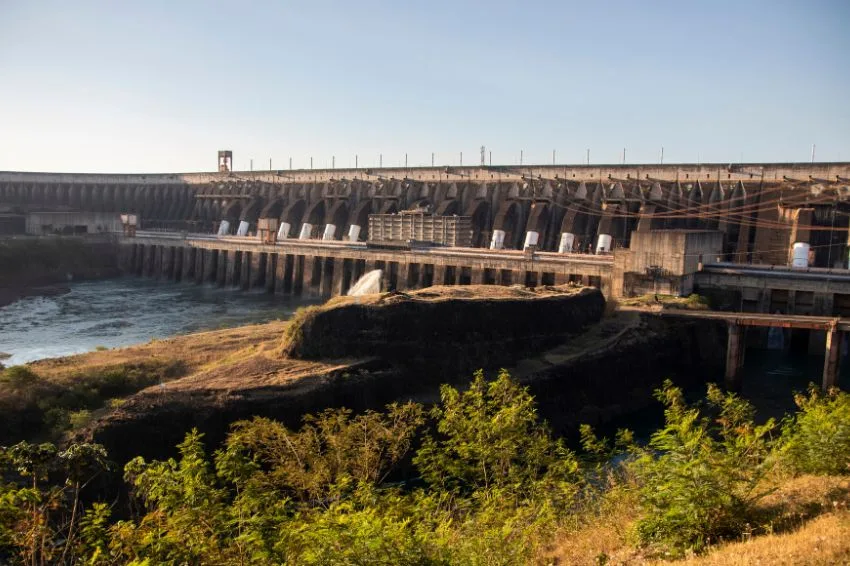
As reported by Canal Solar, Itaipu Binacional has begun installation of its first floating solar plant on the Paraguayan side of the reservoir. The project will occupy an area of almost 10 m² and will feature approximately 1500 solar panels, totaling 1 MWp—enough energy to power approximately 650 homes.
The project will be executed by the binational consortium Sunlution-Luxacril, winner of the bid, and will have a deadline of 150 days for completion, plus an additional 180 days for technical assistance, training and final acceptance.
In an exclusive interview to Canal Solar, Rogério Meneghetti, superintendent of Renewable Energy at Itaipu Binacional, explained the details of the project.
The executive highlighted that the plant will use 86 concrete buoys, with an estimated total weight of 430 tons, to anchor the floating structure in the reservoir. Steel cables connect the floats to the buoys, ensuring stability even under the influence of winds and water level fluctuations.
The system will also feature photovoltaic modules from JA Solar with 705 Wp each (model JAM66D46-705/LB). The energy conversion will be done by Huawei SUN2000-330KTL-H1 inverters, recognized for their efficiency and reliability in large photovoltaic plants.
The floats will be Hydrelio models, supplied by the French company Ciel et Terre, which specializes in solutions for floating solar plants. The electrical connection will be made through a branch line from the Itaipu MD Substation, allowing the generated energy to be directly used to power the plant's internal loads.
To facilitate maintenance and monitoring, Meneghetti said that an access walkway will be installed between the ground and the floating platform, allowing periodic visits with safety and less logistical impact.
Because the project is located in a sensitive and strategic area of the reservoir, it is still undergoing environmental licensing analysis, with several studies underway. Criteria that will be monitored include:
- Water trophic state index
- CCME index (water quality);
- Abundance and diversity of aquatic species;
- Presence of non-native species;
- Reproductive activity of fish;
- Impact on turbidity and oxygenation;
These parameters aim to assess the impact of floating power plant on the region's aquatic ecosystem and guide future expansions or adjustments in the technology used.
Meneghetti also said that the initiative also includes the development of a research project with Itaipu Parquetec and Itaipu Technological Park – PY, including scholarships for universities.
This research would evaluate the generation comparison between the floating plant and other solar plants on land, analyze business models for Brazilian and Paraguayan legislation, assess impacts on Itaipu's internal energy grid (if any), and perform simulations for possible expansion of the floating plant and inclusion of battery systems.
Furthermore, the superintendent revealed that the project was based on references such as the EPE (Energy Research Company) Technical Note on floating solar systems, expanding the national body of knowledge on this promising alternative for diversifying the energy matrix.
all the content of Canal Solar is protected by copyright law, and partial or total reproduction of this site in any medium is expressly prohibited. If you are interested in collaborating or reusing part of our material, please contact us by email: redacao@canalsolar.com.br.





Comments (1)
Comments are moderated before publication.Comments should be respectful and contribute to a healthy debate. Offensive comments may be removed. The opinions expressed here are those of the authors and do not necessarily reflect the views of the author. Canal Solar.
On the Sobradinho side, a floating solar power plant was inaugurated in the first week of August 2019. It was reported that this was the first study in Brazil of this type of solar power plant on the water.