
• Mon, May 25, 2026
Facebook X-twitter Social media coordinator Youtube LinkedIn Spotify
  • GC Solar: 22,33 GW
  • GD Solar: 47,97 GW
  • advertise here
  • About us
  • Expedient
logo site solar channel
  • News
    • Market & Investments
    • International market
    • Politics & Regulation
    • Projects & Applications
    • Renewable
    • Sustainability & ESG
    • Technology & Innovation
    • Electric Vehicles
  • Articles
    • Opinion Article
    • Manufacturer's Article
    • Technical Article
  • Latam
  • Batteries
  • Blog
  • Solar Energy Companies
    • Integrators
  • Magazine
    • Magazine Canal Solar
    • Conecta Magazine
  • Consultancy
  • Courses
  • News
    • Market & Investments
    • International market
    • Politics & Regulation
    • Projects & Applications
    • Renewable
    • Sustainability & ESG
    • Technology & Innovation
    • Electric Vehicles
  • Articles
    • Opinion Article
    • Manufacturer's Article
    • Technical Article
  • Latam
  • Batteries
  • Blog
  • Solar Energy Companies
    • Integrators
  • Magazine
    • Magazine Canal Solar
    • Conecta Magazine
  • Consultancy
  • Courses
  • News
    • Market & Investments
    • International market
    • Politics & Regulation
    • Projects & Applications
    • Renewable
    • Sustainability & ESG
    • Technology & Innovation
    • Electric vehicles
  • Articles
    • Opinion
    • technicians
    • Manufacturer Items
  • Latam
  • Blog
  • Solar Energy Companies
  • Integrators
  • Magazine
    • Conecta Magazine
  • About Us
  • Advertise Here
  • CS Consulting
  • Courses
  • International market
  • News
    • Market & Investments
    • International market
    • Politics & Regulation
    • Projects & Applications
    • Renewable
    • Sustainability & ESG
    • Technology & Innovation
    • Electric vehicles
  • Articles
    • Opinion
    • technicians
    • Manufacturer Items
  • Latam
  • Blog
  • Solar Energy Companies
  • Integrators
  • Magazine
    • Conecta Magazine
  • About Us
  • Advertise Here
  • CS Consulting
  • Courses
  • International market
logo site solar channel
Home / Articles / Opinion Article / Distributors face challenges in applying ICMS reductions on energy

Distributors face challenges in applying ICMS reductions on energy

In practice, the context of uncertainty is as great as possible with the publication of Complementary Law No. 194/2022
Follow on Whatsapp
  • Photo by Lefosse Lefosse
  • July 6, 2022, at 10:41 am
3 min 46 sec read
06-07-22-canal-solar-Distributors face challenges in applying ICMS reductions on electricity
Complementary Law No. 194/2022 brings changes to the tax treatment to be given to electrical energy operations. Photo: Envato Elements

João Paulo Muntada Cavinatto and Rafaela Canito*

Complementary Law No. 194/2022 (LC 194), published by the National Congress on June 23, among other things, substantially reduces the ICMS levied on electrical energy operations.

The reductions result from the recognition of two fundamental conditions: the essentiality of the sector, which obliges states to reduce the state tax on the sale of energy to general rates (between 17% and 18%) and the non-incidence of ICMS on Tariffs of Use of the Transmission and Distribution System (TUST and TUSD), linked to these operations.

In theory, if the constitutional text is followed to the letter, the federative units are immediately obliged to apply the reduction in ICMS rates established by complementary law.

Despite the constitutional determination, the topic is far from a secure definition, especially for electricity distributors, who are usually responsible for collecting ICMS on energy supplied to consumers and, as such, are linked to regulatory criteria for tariff definition – which presupposes the transfer of tax benefits to the final consumer and, at the same time, to current state tax legislation, not yet formally adapted to the precepts of LC 194.

In practice, the context of uncertainty is as great as possible and quite challenging for distributors who need to decide whether to comply with LC 194 (and their respective obligation to pass on tax reductions to consumers) and reduce ICMS on electricity bills or, if continue to apply the rates provided for in current state tax legislation.

Until July 04, 2022, among the 27 units of the federation, only Rondônia opted to enact laws in a strict sense to adhere to the effects of LC 194 on all essential goods, including electrical energy.

Rio de Janeiro, Minas Gerais, Santa Catarina, Espírito Santo and the Federal District fully welcomed the reduction in the ICMS ceiling, but, to achieve this, they chose to issue normative acts within the Governor's jurisdiction, such as decrees or provisional measures.

The states of the Northeast, accompanied by Mato Grosso do Sul and Rio Grande do Sul, filed a Direct Action of Unconstitutionality before the Federal Supreme Court, questioning the reduction in ICMS promoted by LC 194. For this reason, Paraíba, Rio Grande do Norte and Alagoas published decrees fully accepting the reduction in the tax rate, but only during the validity of LC 194. Rio Grande do Sul reduced ICMS rates temporarily until July 31, 2022.

For now, São Paulo, Paraná, Goiás and the Governments of Ceará, Pernambuco, Sergipe, Amazonas and Pará have informally signaled via newsletters, interviews or social media their intention to accept the reduction of the ICMS ceiling. Meanwhile, the tax authorities of the other federative units remain without a formal statement on the reduction of the ICMS rate on electricity operations.
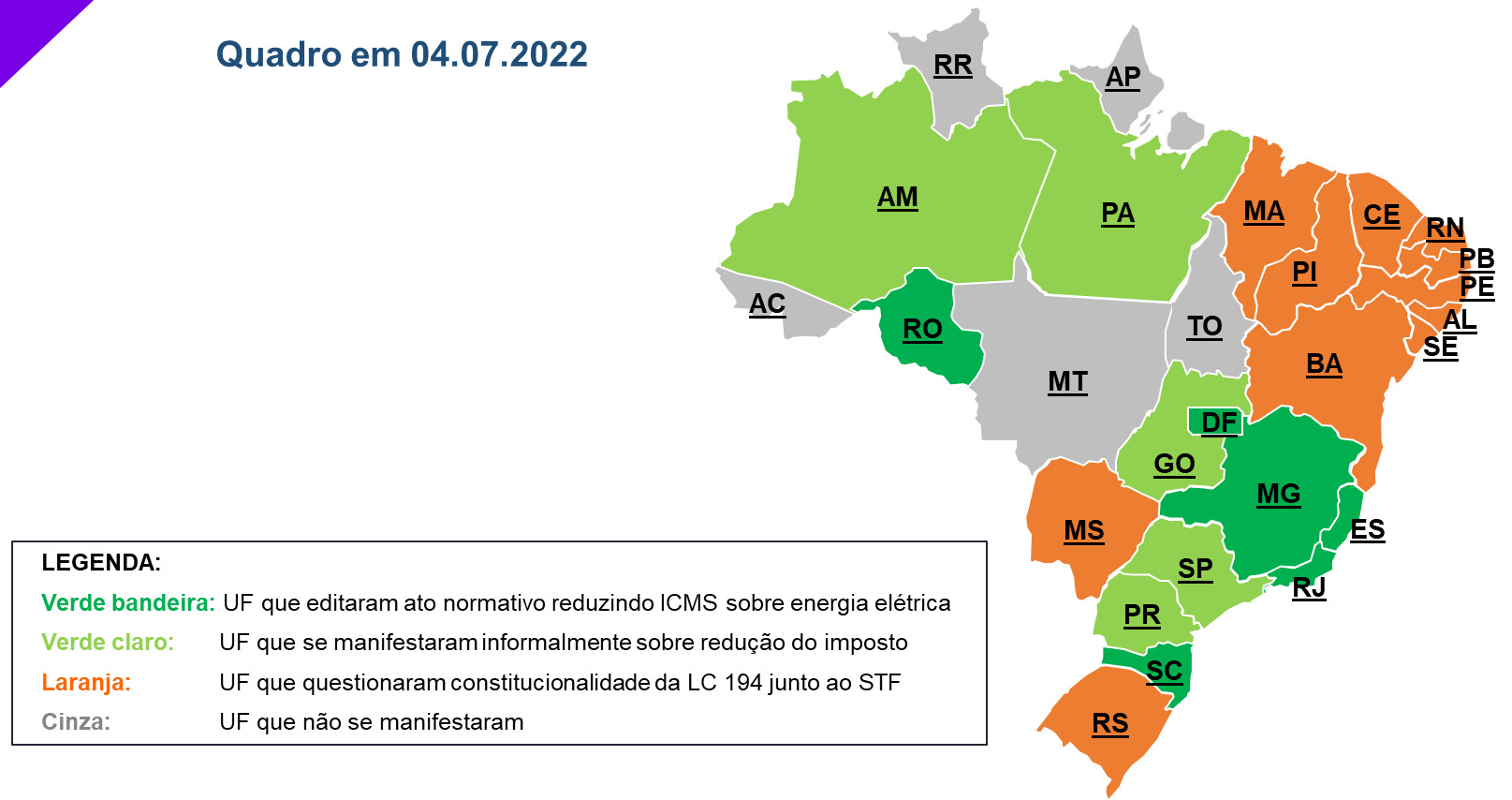
Even in the States that have already supported the reductions imposed by LC 194, important doubts remain about the delimitation of the application of the new rates, especially if we consider that LC 194 came into force on the date of its publication (on 23.06) and many of the The activities it achieves are billed based on monthly measurement criteria (not only electricity, but also natural gas and unmetered telecommunications services), which raises questions about the need or not for proportional application of the new rates.

The climate in the affected sectors is one of uncertainty, especially for taxpayers such as electricity distributors, who are simultaneously subject to tax, regulatory and consumer standards.

In addition to being attentive to the developments of the Direct Action of Unconstitutionality and the manifestations of the states on the subject, it is important that the electricity distributors and other taxpayers carefully evaluate the scope of the reductions already implemented by the states and study multidisciplinary legal strategies – whether administratively or judicially, to minimize risks not only from tax, but also from regulatory and Consumer Law points of view.


*João Paulo is the partner responsible for the Indirect Taxes and Customs Law area at Lefosse

*Rafaela is a senior lawyer in the Indirect Taxes and Customs Law area at Lefosse

Grounding and SPDA Course Tax course distributors electricity electric sector
Photo by Lefosse
Lefosse
Lefosse is a full-service law firm, offering specialized consultancy in all legal practices, with solid experience in sophisticated legal services in the national and international scenarios.
PreviousPrevious
NextNext

Leave a comment Cancel reply

Your email address will not be published. Required fields are marked with *

Comments should be respectful and contribute to a healthy debate. Offensive comments may be removed. The opinions expressed here are those of the authors and do not necessarily reflect the views of the author. Canal Solar.

News from Canal Solar in your Email

Posts

Canal Solar - Battery auction in Brazil: the answer the electricity sector can no longer postpone.

Battery auction in Brazil: the answer the electricity sector can no longer postpone.

Relationship as a business strategy

Relationship as a business strategy

More news

Read More
How does the electricity sector work in the Dominican Republic?

How does the electricity sector work in the Dominican Republic?

How does the electricity sector work in Paraguay?

How does the electricity sector work in Paraguay?

Debate on risk aversion in the electricity sector gains political pressure.

Debate on risk aversion in the electricity sector gains political pressure.

It is a news and information channel about the photovoltaic solar energy sector. Channel content is protected by copyright law. Partial or total reproduction of this website in any medium is prohibited.

Facebook X-twitter Social media coordinator Youtube LinkedIn Spotify

Site Map

Categories

  • News
  • Articles
  • Interviews
  • Consumer Guide
  • Authors
  • Videos
  • Projects
  • Magazine
  • Electric Vehicles

Channels

  • About Us
  • Contact
  • Privacy
  • Quality Policy
  • Work with us
  • Expedient
  • advertise here

Membership and certifications

Copyright © 2026 Canal Solar, all rights reserved. CNPJ: 29.768.006/0001-95 Address: José Maurício Building – Mackenzie Avenue, 1835 – Floor 3, – Vila Brandina, Campinas – SP, 13092-523
Receive the latest news

Subscribe to our weekly newsletter

Fill in the information above and receive your free copy of Canal Solar magazine.