
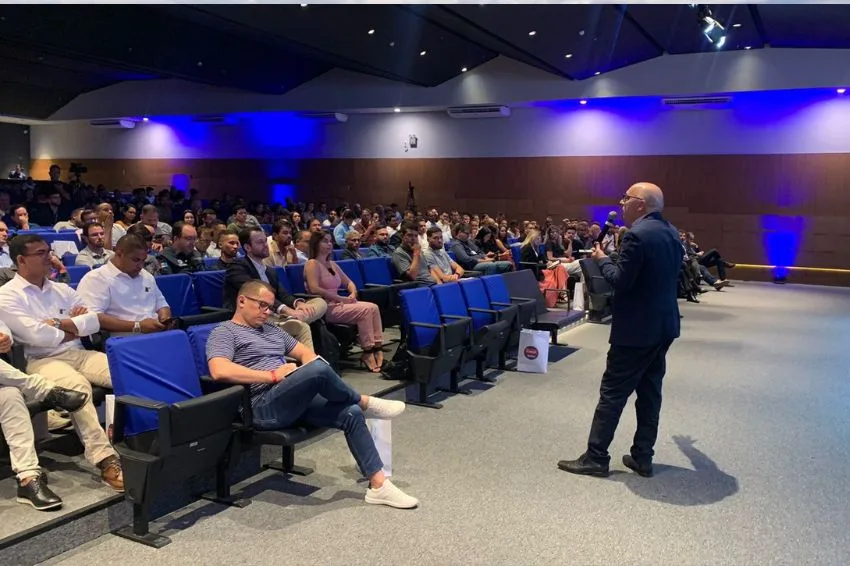
Energy storage systems can make renewable generation more stable and also reduce expenses with the implementation of transmission lines.
This was the summary of the lecture “Limitation of flows from the NE to the South and Southeast”, given by the president of Marangon Consultoria & Engenharia, José Marangon, in the 3rd edition of Canal Connect, carried out at the FPS (Faculdade Pernambucana de Saúde), in Recife (PE).
The first part of the talk focused on blackout occurred in Brazil on August 15, 2023, caused by a power failure in wind and solar farm equipment in the Northeast region. At the time, there was a cut of 22,5 GW, leaving around 29 million Brazilians without energy.
After this event, the ONS (National System Operator) increased the technical criteria for the transport of renewable energy, which reduced the flow margin from the North and Northeast regions to the South and Southeast/Central-West, impacting the generation of wind and solar plants.
According to Marangon, there is a prospect of improvement in the flow margin with the planned expansion of the transmission system, mainly with the implementation of the bipole from Graça Aranha (MA) to Silvânia (GO), which will increase the energy flow capacity by 5 GW.
“What we observe is that all 500 kV trunks alone cannot significantly alter this energy transport. So, the direct current link is what will make the big difference, going from 17 GW to 23 GW of exports from the Northeast region”, said the specialist.
A solution to reducing investments in transmission lines and increasing the proportion of renewable generation are energy storage systems, also known as BESS (Battery Energy Storage System). “Storage can also provide new services due to the intermittency of wind and solar,” she said.
The government is studying, in an unprecedented way, allowing BESS to participate in the next Capacity Reserve Auction. Scheduled for August 30th, this topic remains undefined.
According to Marangon, the market and associations are trying to convince the MME (Ministry of Mines and Energy) that this is a good start to start the development of this technology in Brazil. “We verified that both the ONS and the EPE (Energy Research Company) have no objections to the entry of this technology”, he stated.
The MME's resistance is justified by the lack of BESS regulation. “It is not possible to regulate a technology that is in its infancy. But if we don’t test, there’s no point in this regulation moving forward”, said the expert.
For Marangon, Failure to use this technology results in harm to the consumer, as batteries reduced the need for contracting thermoelectric plants and expanding the transmission system.
O Canal Connect is being carried out on May 14th and 15th. The event has more than 16 hours of content, divided into lectures and panel discussions, given by renowned professionals in the sector.
all the content of Canal Solar is protected by copyright law, and partial or total reproduction of this site in any medium is expressly prohibited. If you are interested in collaborating or reusing part of our material, please contact us by email: redacao@canalsolar.com.br.



Comments (2)
Comments are moderated before publication.Comments should be respectful and contribute to a healthy debate. Offensive comments may be removed. The opinions expressed here are those of the authors and do not necessarily reflect the views of the author. Canal Solar.
Is it possible to access a recording of this talk?
Or was it restricted to event participants only?
Thank you.
In wind and photovoltaic plants that seem to have more difficulty in providing primary regulation than hydraulic or thermal plants, in the Blackout of 15/08, these Generation Agents were asked to prove, through field tests, the effectiveness of their speed controllers within the first 15 seconds of the underfrequency occurrence.
Also learn about technologies to improve the use and efficiency of transmission networks with strong support from the ONS and EPE. GETs are network enhancement technologies that are hardware and/or software that increase the capacity, efficiency, reliability, or security of existing transmission lines. GETs can reduce congestion costs, improve renewable energy integration, increase capacity and provide grid service applications. If you are curious to know but contact me