
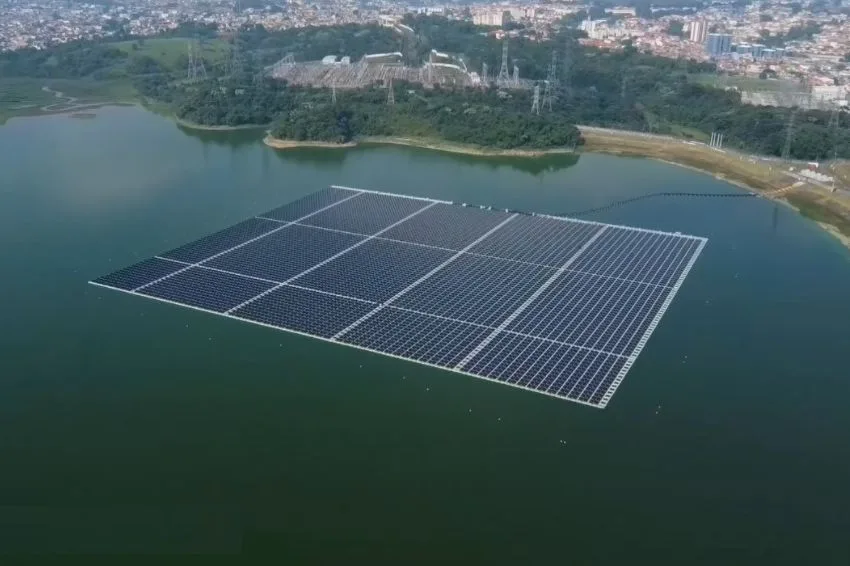
According to a new study published in Solar Energy, federal reservoirs could help meet America's solar energy needs.
Evan Rosenlieb and Marie Rivers, geospatial scientists at the U.S. Department of Energy's National Renewable Energy Laboratory (NREL), and Aaron Levine, NREL's senior legal and regulatory analyst, have quantified for the first time exactly how much energy could be generated from floating solar plants installed on federally owned or regulated reservoirs.
And the potential is staggering: the reservoirs could house enough floating solar panels to generate up to 1.476 TWh, or enough energy to power approximately 100 million homes per year.
“That’s a technical potential,” Rosenlieb said, meaning the maximum amount of electricity that could be generated if each reservoir contained as many floating systems as possible. “We know we won’t be able to develop all of that. But even if you could develop 10 percent of what we’ve identified, that would be a long way off.”
Levine and Rosenlieb still need to consider how human and wildlife activities might impact the development of floating panels in specific reservoirs. But they plan to address this limitation in future work.
This study provides much more precise data on the potential for floating solar in the United States. And that precision could help developers more easily plan projects on U.S. reservoirs and help researchers better assess how these technologies fit into the country’s broader energy goals.
“But we haven’t seen any large-scale installations, like on a large reservoir,” Levine said. “In the United States, we don’t have a single project above 10 megawatts.”
Floating solar to grow significantly worldwide, says WoodMac
Other projections
Previous studies have tried to quantify how much energy the country could generate from floating solar panels. But Levine and Rosenlieb are the first to consider which water sources have the right conditions to support these types of power plants.
In some reservoirs, for example, ship traffic causes wakes that can damage mooring lines or impact floating infrastructure. Others are too cold, too shallow or have sloping bottoms that are too steep to secure solar panels in place.
And yet, some hydropower reservoirs could be ideal locations for floating power plants. A hybrid system that relies on both solar and hydropower could provide more reliable and resilient power to the grid.
If, for example, a drought depletes a hydroelectric plant's reservoir, solar panels can generate power while the plant pauses to allow water to replenish.
To build new pumped-storage hydropower projects — which pump water from one reservoir to another at a higher elevation to store and generate power as needed — some developers create entirely new bodies of water.
These new reservoirs are disconnected from naturally flowing rivers, and no humans or animals depend on them for recreation, habitat, or food (at least not yet).
In the future, the researchers plan to review which sites are close to transmission lines or electricity demand, how much development might cost in specific locations, whether a site should be avoided to protect the local environment, and how developers can navigate state and federal regulations.
The team would also like to evaluate even more potential sites, including other smaller reservoirs, estuaries and even ocean locations.
The research was funded by the Solar Energy Technologies Office and the Water Energy Technologies Office of DOE’s Office of Energy Efficiency and Renewable Energy (EERE).
Access study to learn more about the immense potential of floating solar farms in the United States or visit the AquaPV to analyze data on specific reservoirs.
all the content of Canal Solar is protected by copyright law, and partial or total reproduction of this site in any medium is expressly prohibited. If you are interested in collaborating or reusing part of our material, please contact us by email: redacao@canalsolar.com.br.



Comments
Comments are moderated before publication.Comments should be respectful and contribute to a healthy debate. Offensive comments may be removed. The opinions expressed here are those of the authors and do not necessarily reflect the views of the author. Canal Solar.