
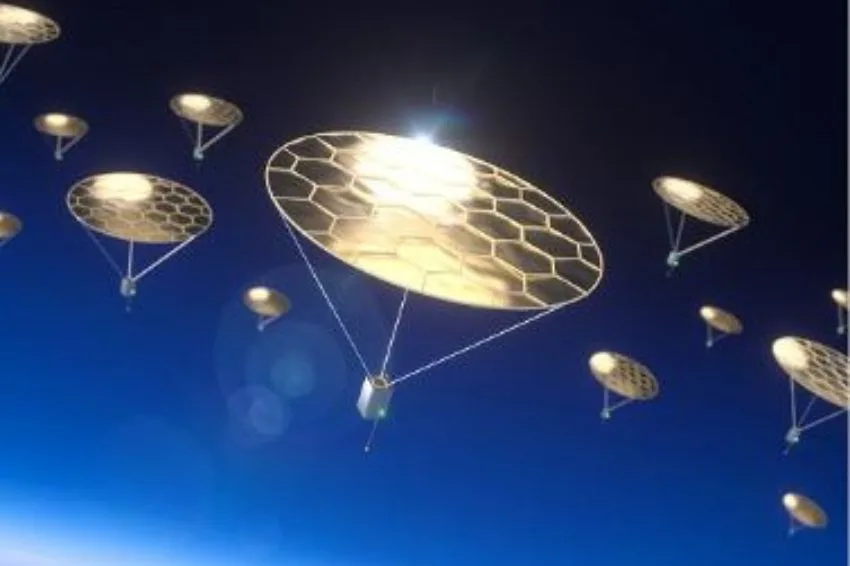
Researchers and scientists from Harvard University (USA) and UFPR (Federal University of Paraná) have developed a new type of ultralight device that can float in the Earth's atmosphere for months using only solar energy.
The technology, which does not use engines, propellers or gas-filled balloons, has small, extremely thin metal plates that function as flying sensors, capable of reaching altitudes between 50 and 100 km, in a region close to the edge of space.
This area, known as the mesosphere, is one of the least explored areas of the atmosphere, precisely because it is difficult to reach: planes and balloons do not reach that high, while satellites orbit much higher.
How works
The “flying plates” are made of a lightweight ceramic material with a metallic coating and take advantage of a phenomenon called photophoresis, a force generated when light heats one side of the plate more than the other.
This causes gas molecules to collide more forcefully on the hot side, generating enough lift to keep them aloft.
According to Ben Schafer, researcher and project leader, the team managed to build structures so light that this normally insignificant force is capable of making them float in low-pressure environments such as the Earth's mesosphere or even the atmosphere of Mars.
In tests, a structure just one centimeter wide was able to levitate at a simulated altitude of 60 km, with a pressure equivalent to that of Earth's upper atmosphere with only 55% of the total sunlight.
These structures could be equipped with sensors to measure wind, pressure, and temperature in largely unexplored regions of the atmosphere. This could significantly improve weather forecasting models and climate change studies.
Furthermore, there's potential for use in telecommunications. A fleet of these "floating plates" could form a high-altitude antenna network, with performance similar to that of low-orbit satellites, but at a lower cost and with lower data transmission latency.
“This is the first time that it has been demonstrated that it is possible to build these larger structures and actually make them fly,” explained Professor David Keith, also involved in the project.
According to him, this paves the way for “a new class of passive devices, powered only by sunlight and ready to explore both Earth and other planets,” he concluded.
all the content of Canal Solar is protected by copyright law, and partial or total reproduction of this site in any medium is expressly prohibited. If you are interested in collaborating or reusing part of our material, please contact us by email: redacao@canalsolar.com.br.

Comments
Comments are moderated before publication.Comments should be respectful and contribute to a healthy debate. Offensive comments may be removed. The opinions expressed here are those of the authors and do not necessarily reflect the views of the author. Canal Solar.