
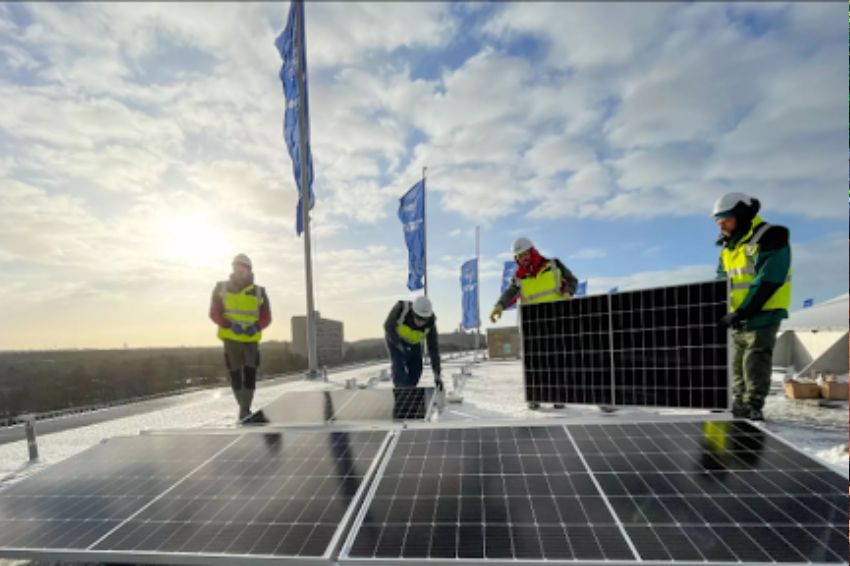
SAARBRÜCKEN, GERMANY. With the growing demand for photovoltaic systems in Germany, the importance of qualifications in the area has become increasingly relevant. Qualification, technical control and investment in your career. In September 2022, IRENA (International Renewable Energy Agency), in collaboration with the ILO (International Labor Organization), published a new report on the growing number of job creation in the renewable energy sector.
In 2021, the sector generated 12,7 million new jobs. According to the document, the solar market is the fastest growing, reaching a total of 4,3 million jobs in 2021, more than a third of the workforce in the global renewable energy scenario.
The report shows how much some countries have invested and created more jobs in the renewable energy sector. China stands out with 42% of the world's total employment in the sector, followed by the European Union and Brazil, both with 10%, and by the United States and India, with 7% each.
According to the graph published in June 2022 by The report of Statista, a German online statistics platform, in 2021 the solar market in Germany reached around 58.500 jobs, 19.000 more vacancies after the sector's decline in 2017. One of the factors for the growing increase in demand for qualifications in the solar sector is also due to the new laws defined by some German states, such as Berlin.
In June 2021, the solar law came into force in the state of Berlin determining that, from 2023, all new constructions must contain a photovoltaic system, with exceptions, which accelerates not only the country's climate transition but, in parallel, expands the solar technician qualification sector, as demand for the system has increased exponentially.
Qualifications and functions of a photovoltaic system installer in Germany
In Germany, the expression “solarteur" is used to refer to professionals who work with photovoltaic system installations. However, the word is just an expression to define the specialist who works in this area, but it is not officially a specialization, and is even a patented word protected by trademark law, German Patent and Trademark Office (Deutsche Patent- und Markenamt- DPMA)
According to the information on the website, German Federal Employment Agency, the course for specialist in solar technology or solar technician is a legally regulated further training and can be offered as a qualification by institutions such as the chamber of professionals in the construction sector (Handwerskammer), as well as in commercial and professional associations or educational institutions private.
Solar technicians are mostly installers, electricians or roofers who specialize in the solar sector. For those who want to work in the construction of solar systems, the option is to train in the Solar Technology Specialist or Ecological Energy Technologies Specialist courses – both of which train professionals not only to carry out installations, but also functions that range from planning, installation and maintenance of the system.
Despite the term solar installers or technicians, these professionals are also qualified to work with thermal heating systems. There are two ways to become a solar energy technician in Germany. When you already have professional training in the construction sector and want to specialize in the solar industry, or when you have no experience and it is possible to start your studies from scratch.
Specialization for those who already have training and experience in the construction sector requires some prerequisites such as being a construction professional, a master builder, a roofer, a glazier, an electrician and/or a metalworker. In this case, the recommended course is a specialization or additional training to become a solar energy installation technician, with a course duration that can vary from 4 to 9 months.
For those who want to enter the market as a solar installer or technician but do not have any training in the construction area, it is necessary to start a new training course that, depending on the institution, can take from 1 to 3 years. To enter this type of training, a high school diploma is mandatory as a prerequisite. After training, the salary of a solar technician can vary between 3.840 and 4.280 euros per month.
What content is offered in a solar technician course?
The role of a solar technician or solar installer goes far beyond just manual work – he needs to master some functions that are part of this professional's work. Therefore, during the courses, professionals learn everything from communicating with customers about the economic efficiency of solar systems, how to supply electricity to the grid and even how to provide information about subsidy programs.
On the technical side, a solar technician needs to master the concepts, techniques and design standards, as well as the sizing of equipment and components. In addition, they learn how to calculate component and installation costs, electricity or thermal energy yields, as well as prepare offers and budgets.
By executing the project, they learn how to order materials and system components, as well as the concepts of supervision, installation, testing and how to put the system into operation.
In the course offered by Handwerkskamer, for example, content such as fundamentals of energy technology, fundamentals of heating technology, fundamentals of electrical engineering, as well as solar thermal systems and photovoltaic systems are part of the curriculum.
Marketing is also part of the course content, with the aim of preparing professionals to master the market, customer demand, sales and advertising concepts.




Comments (1)
Comments are moderated before publication.Comments should be respectful and contribute to a healthy debate. Offensive comments may be removed. The opinions expressed here are those of the authors and do not necessarily reflect the views of the author. Canal Solar.
I am a Solar Electrician and Telecommunications technician. I have been working in the area for 4 years. I am a self-employed service provider. I would like to know how I can get the chance to work abroad?