
• Wed, April 8, 2026
Facebook X-twitter Instagram Youtube LinkedIn Spotify
  • GC Solar: 22,31 GW
  • GD Solar: 46,07 GW
  • advertise here
  • About us
  • Expedient
logo site solar channel
  • News
    • Market & Investments
    • International market
    • Politics & Regulation
    • Projects & Applications
    • Renewable
    • Sustainability & ESG
    • Technology & Innovation
    • Electric Vehicles
  • Articles
    • Opinion Article
    • Manufacturer's Article
    • Technical Article
  • Latam
  • Batteries
  • Blog
  • Solar Energy Companies
    • Integrators
  • Magazine
    • Magazine Canal Solar
    • Conecta Magazine
  • Consultancy
  • Courses
  • News
    • Market & Investments
    • International market
    • Politics & Regulation
    • Projects & Applications
    • Renewable
    • Sustainability & ESG
    • Technology & Innovation
    • Electric Vehicles
  • Articles
    • Opinion Article
    • Manufacturer's Article
    • Technical Article
  • Latam
  • Batteries
  • Blog
  • Solar Energy Companies
    • Integrators
  • Magazine
    • Magazine Canal Solar
    • Conecta Magazine
  • Consultancy
  • Courses
  • News
    • Market & Investments
    • International market
    • Politics & Regulation
    • Projects & Applications
    • Renewable
    • Sustainability & ESG
    • Technology & Innovation
    • Electric vehicles
  • Articles
    • Opinion
    • technicians
    • Manufacturer Items
  • Latam
  • Blog
  • Solar Energy Companies
  • Integrators
  • Magazine
    • Conecta Magazine
  • About Us
  • Advertise Here
  • CS Consulting
  • Courses
  • International market
  • News
    • Market & Investments
    • International market
    • Politics & Regulation
    • Projects & Applications
    • Renewable
    • Sustainability & ESG
    • Technology & Innovation
    • Electric vehicles
  • Articles
    • Opinion
    • technicians
    • Manufacturer Items
  • Latam
  • Blog
  • Solar Energy Companies
  • Integrators
  • Magazine
    • Conecta Magazine
  • About Us
  • Advertise Here
  • CS Consulting
  • Courses
  • International market
logo site solar channel
Home / News / International market / How the Russia-Ukraine war is changing energy markets

How the Russia-Ukraine war is changing energy markets

President and chief analyst at Wood Mackenzie highlights that the conflict is a “reinforcement shot for the energy transition”
Follow on Whatsapp
  • Photo by Mateus Badra Mateus Badra
  • March 1, 2023, at 08:55 AM
4 min 47 sec read
01-03-23-canal-solar-How the Russia-Ukraine war is changing energy markets
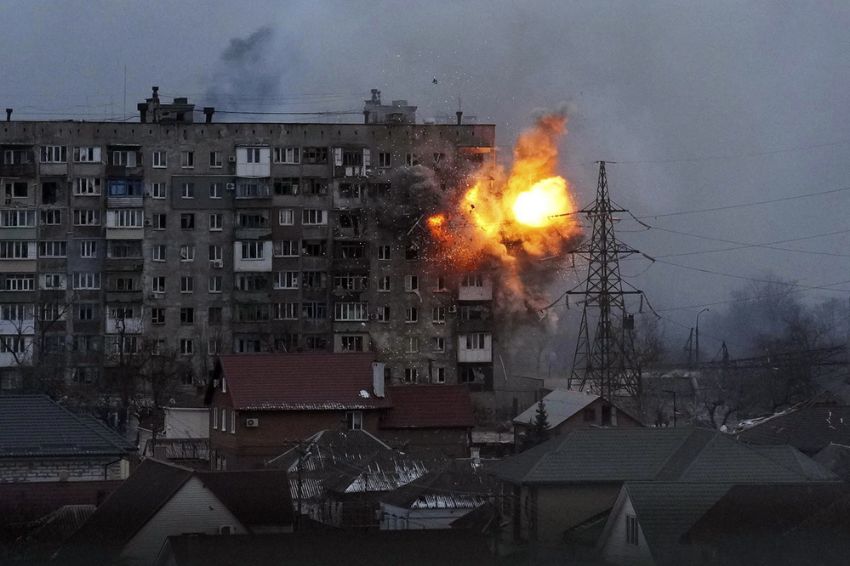
An explosion is seen after a Russian tank fires on a building in Mariupol, Ukraine, on March 11, 2022. Photo: Evgeniy Maloletka

A war between Russia and Ukraine turned one year old last Friday (24). Several lives were lost and millions of people had to leave their homes to live in other countries.

For many, February 24, 2022 is a date that will forever be remembered. In addition to the impact on the lives of Ukrainians, the conflict also affected other countries, mainly with regard to global energy markets.

Rising prices and supply chain disruption have led to a fuel affordability crisis and fueled inflation that is affecting the global economy.

In view of this scenario, Simon Flowers, president and chief analyst of wood mackenzie, spoke about how the war changed energy markets. According to him, no country can again afford to depend on imported electricity from a single supplier.

“In the future, energy security will be based on the diversity of fuels and sources and the primacy of domestic resources”, emphasized the executive.

A booster shot for the energy transition

In Flowers' view, self-sufficiency, at a reasonable price, will define energy security in the future – low-carbon energy produced domestically, using domestically owned technology and supported by domestic supply chains.

“Many countries are far from that today, and dependence on China for critical transition metals and hardware is a widespread concern. But most countries have already planned to make the long-term journey as they move towards net zero. The war just made it happen faster,” he reported.

For him, the United States is off to a great start, introducing game-changing tax incentives in the Inflation Reduction Act of 2022. “One example – we have since increased our forecasts for the installation of wind, solar and energy storage capacity in the US between 50% and 100%”.

“We also anticipate a similar acceleration of investment in other low-carbon technologies, including CCUS (carbon capture and storage), hydrogen, next-generation nuclear technologies and advanced battery chemistries,” he said.

The European Union also moved last month to bolster incentives to secure capital flows to Europe to help meet its own low-carbon targets. “So perhaps temporarily higher CO2 emissions before much faster reductions.”

Limitations of energy markets

Another point emphasized by the analyst is that the extreme conditions revealed the limitations of energy markets based on marginal prices in Europe.

“A combination of rising input fuel costs and extended power supplies has led to very high wholesale prices across the continent. Some generators made huge margins when consumer bills hit the ceiling,” he explained.

According to Simon Flowers, governments were forced to temporarily subsidize bills to deal with an affordability crisis, and regulators intervened with the aim of reforming wholesale markets at regional and national levels.

“The challenge is to use a means of setting prices that is 'fair' and still encourages the industry to invest in new generation capacity and supporting technologies. Energy markets around the world will follow with interest. The expansion of the network infrastructure, cross-border and domestic, is also imperative”, he pointed out.

Europe can live without Russian gas

Still according to Flowers, the global market adapted remarkably quickly. High prices reduced demand in Europe and Asia and reduced available supply for the European market. “There is growing confidence that Europe can muddle through over the next three years, albeit with relatively high and volatile prices.”

“New supply volumes, mainly US and Qatari LNG, arrive from 2025, helping prices return to 'normal'. In the long term, LNG (liquefied natural gas) growth is still centered in Asia,” he commented.

The war, however, for him, fundamentally changed the market forever – it is now a more global, flexible and fungible market, but probably more volatile, as Europe competes with Asia for the same LNG cargoes.
“Could Europe buy Russian gas again in the future? Maybe, but it will still take time, requiring a change of regime and, even then, in our opinion, no more than 15% of its needs”, highlighted the president of Wood Mackenzie.

Who has done well?

According to Flowers, there are, for example, investors in low-carbon technologies and associated supply chains, as well as gas producing countries, particularly those connected by gas pipelines in Europe, and oil and gas producers, particularly integrated companies with commercial capacity. , along with US refineries.

Who did badly?

In his view, gas and electricity consumers in many parts of the world, and gas importers, including some in Europe who have demanded government bailouts. “Last but not least, Russia.”

“The country has lost 130 billion cubic meters of annual gas exports to Europe, worth more than $30 billion a year in pre-war revenues, and will likely never be replaced by alternative export options. It has also lost its credibility as a reliable commercial partner”, concluded the executive.

War in Ukraine energy markets Russia
Photo by Mateus Badra
Mateus Badra
Journalist graduated from PUC-Campinas. He worked as a producer, reporter and presenter on TV Bandeirantes and Metro Jornal. He has been following the Brazilian electricity sector since 2020.
PreviousPrevious
NextNext

Leave a comment Cancel reply

Your email address will not be published. Required fields are marked with *

Comments should be respectful and contribute to a healthy debate. Offensive comments may be removed. The opinions expressed here are those of the authors and do not necessarily reflect the views of the author. Canal Solar.

News from Canal Solar in your Email

Posts

Canal Solar - Mega solar power plant with storage and AI starts operating in China.

Mega solar power plant with storage and AI starts operating in China.

Canal Solar - Solar accounts for 75% of new additions and leads renewable energy growth in 2025.

Solar accounts for 75% of new additions and leads the growth of renewables in 2025.

More news

Read More
According to LRCAP, in 2026 it contracts 501,3 MW and registers an average discount of over 50%.

According to LRCAP, in 2026 it contracts 501,3 MW and registers an average discount of over 50%.

Challenges in Self-Production through Equivalence after the transition of Law No. 15.269/2025

Challenges in Self-Production through Equivalence after the transition of Law No. 15.269/2025

With 3 GW in grid-forming, Kehua says it's ready for the LRCAP.

With 3 GW in grid-forming, Kehua says it's ready for the LRCAP.

It is a news and information channel about the photovoltaic solar energy sector. Channel content is protected by copyright law. Partial or total reproduction of this website in any medium is prohibited.

Facebook X-twitter Instagram Youtube LinkedIn Spotify

Site Map

Categories

  • News
  • Articles
  • Interviews
  • Consumer Guide
  • Authors
  • Videos
  • Projects
  • Magazine
  • Electric Vehicles

Channels

  • About Us
  • Contact
  • Privacy
  • Quality Policy
  • Work with us
  • Expedient
  • advertise here

Membership and certifications

Copyright © 2026 Canal Solar, all rights reserved. CNPJ: 29.768.006/0001-95 Address: José Maurício Building – Mackenzie Avenue, 1835 – Floor 3, – Vila Brandina, Campinas – SP, 13092-523
Receive the latest news

Subscribe to our weekly newsletter

Fill in the information above and receive your free copy of Canal Solar magazine.