
A problem that has been occurring in the photovoltaic market, but which is still difficult for customers to identify, is called Fake Power. Are you familiar with this term? We treat a module as Fake Power when it has a nominal power below that stipulated in the datasheet, on its identification label.
For example, a panel that has a datasheet stating 555 Wp, but when testing it, still new, reaches powers in the order of 535 Wp, 540 Wp. This is done by manufacturers of ill-intentioned people in search of supposed “lower prices” in a sector as competitive as Brazil.
O Canal Solar has already published some articles where we comment on this problem and the risks that those involved in the supply chain of counterfeit products run when agreeing to sell and install this type of equipment on customers.
However, in this report we will address from a technical point of view how a photovoltaic module with these characteristics is built, mainly in terms of the quality of the photovoltaic cells used in manufacturing.
Cell gradient
According to Thiago Mingareli, technical manager at Amara NZero Brasil, the first point concerns the quality of the cells used in the solar panel. “Hypothetically, no matter how perfect the entire manufacturing process of a module is, if a poor-quality cell is used, the final product will still be poor. It would be similar to hiring the best construction company in town to renovate my house, but buying low-quality products.”
“It won’t be good, it won’t be durable. And since the poor quality of the cell is often not noticeable to the naked eye, they are used by manufacturers acting in bad faith (and accepted by some distributors, it’s important to emphasize) in the manufacture of modules without fear of harming the end customer, who cannot identify this poor quality just by looking at the technical documentation sent,” he explained.
But how are cells defined and classified according to their quality? According to Mingareli, the problem is that there is no international standard that regulates exactly how this classification should be done, but there is a certain consensus (at least among the main players) of four quality levels (which are broken down into other sublevels, depending on the manufacturer):
- Grade A cells: perfect cells, without any manufacturing problems;
- Grade B cells: cells that have some visual imperfection, but which does not affect their electrical characteristics and performance at first;
- Grade C cells: cells that have some electrical damage, but not necessarily visual imperfection;
- Grade D cells: broken and/or unusable cells.
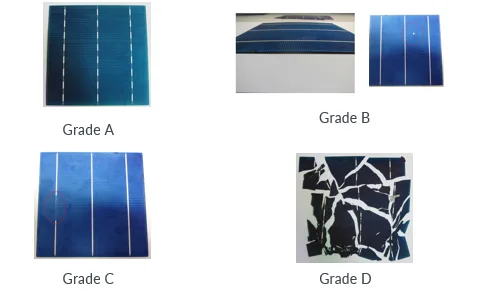
“The big problem, as mentioned earlier, is that there is no official regulation on this matter. Some manufacturers divide their classification into A+, A-, B+, B-, etc., and this analysis is subjective. Wouldn’t an A- cell actually be a grade B cell?” he asked.
When working with grade B cells, even though they may initially be electrically ok, there is a chance that, over time, they may present damage characteristic of a cell defect such as hotspots, among others. And C grid cells will bring lower power/quality modules right from the start.
“In other words, unless the manufacturer uses high-quality, grade A cells, the plant will inevitably perform worse over time and, more than that, it will also pose risks to the safety of those involved,” said the expert.
Quality “chess” module
According to Amara's technical manager, the second point relating to quality (or lack thereof) in the manufacturing process of a photovoltaic module is again in relation to the quality of the cells used.
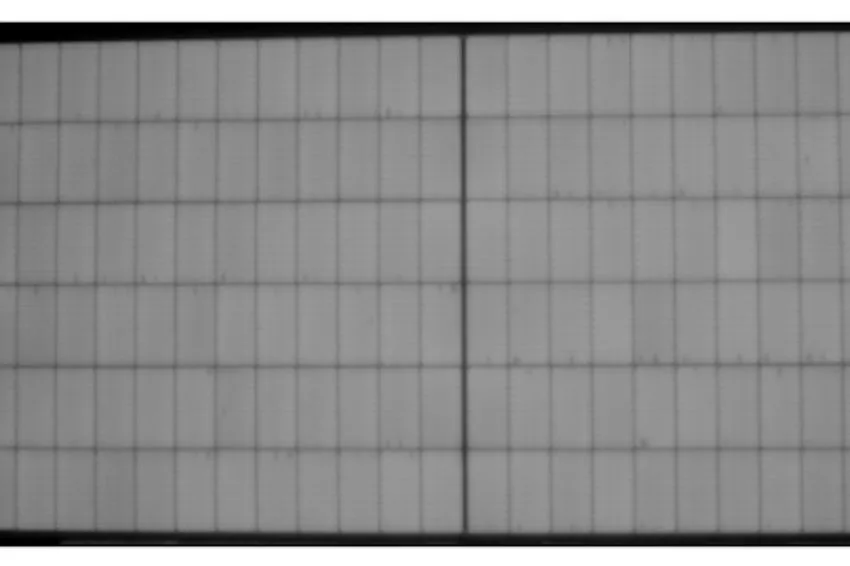
“What we mentioned previously regarding the cell gradient is also verified in another test, called EL – Electroluminescence. Basically – it consists of performing an 'X-ray' of the panel to check for any damage that is invisible to the naked eye, such as microcracks, burned cells or even differences in cell quality (remember what we mentioned earlier about gradients?)”, he reported.
Below is an example of an EL test with cells of the same quality, without imperfections or damage to them. This represents a module with quality cells.
The next image, below, shows a module that, despite not showing any visible damage or microcracks in the cells, presents a very large difference in quality between them.
“In these cases, there is not only a generation problem in this equipment, but we can make a correlation by assembling a string of modules in series and using modules with different electrical characteristics – we know that this is not allowed, which will cause a mismatch and, in more serious cases, damage to the system. This is exactly what will happen with a module like the one in the illustration below”, pointed out Thiago Mingareli.
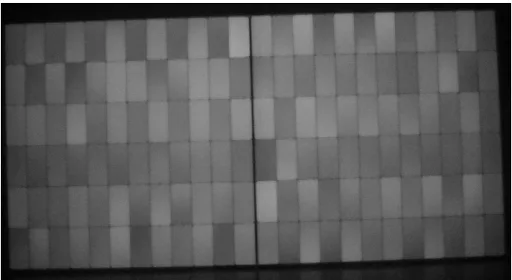
Just as was mentioned when discussing the topic of cell grids, there is no regulation here either. Each manufacturer defines, at its own discretion, what the acceptable difference in hue between them will be. 10%? 30%? 50%? The more uniform the hue between the cells, the better the photovoltaic module will perform.

“As you can imagine, lower quality cells (grade B, C, etc.) have a lower price compared to a grade A cell, of excellent quality. In a market where the main players have very similar prices, a product with a price below the average will inevitably indicate that the cells used in the manufacture of this product are of lower quality than expected, even if we do not visually see anything wrong with them,” he said.
And how can you prevent yourself from falling into this trap? Check out some tips listed by the expert below:
- Choose manufacturers that have the main international certifications in the sector, certified by major institutions, such as Bloomberg (Tier1), PVEL, PVtech, RETC, PVBL, etc.);
- Look for manufacturers and distributors with global, not just local, operations. Check whether these modules are present in more demanding markets such as the USA and Europe;
- Request a flash test of the panels you purchased from your supplier. This is something that everyone has and, if you have any difficulty in sharing the information, be suspicious;
- Finally, be suspicious of prices that are much lower than the market average. As mentioned above, low-quality products are most likely being used and will result in liability for your company.
“It is worth remembering: the Consumer Protection Code is clear in holding the entire supply chain (manufacturer, distributor and integrator) responsible in the event of erroneous or false information being provided to the end customer, which may result in fines, replacement of the product and even detention if fraud is proven. The saying that 'you get what you pay for' remains extremely pertinent in this case,” he concluded.
all the content of Canal Solar is protected by copyright law, and partial or total reproduction of this site in any medium is expressly prohibited. If you are interested in collaborating or reusing part of our material, please contact us by email: redacao@canalsolar.com.br.




Comments
Comments are moderated before publication.Comments should be respectful and contribute to a healthy debate. Offensive comments may be removed. The opinions expressed here are those of the authors and do not necessarily reflect the views of the author. Canal Solar.