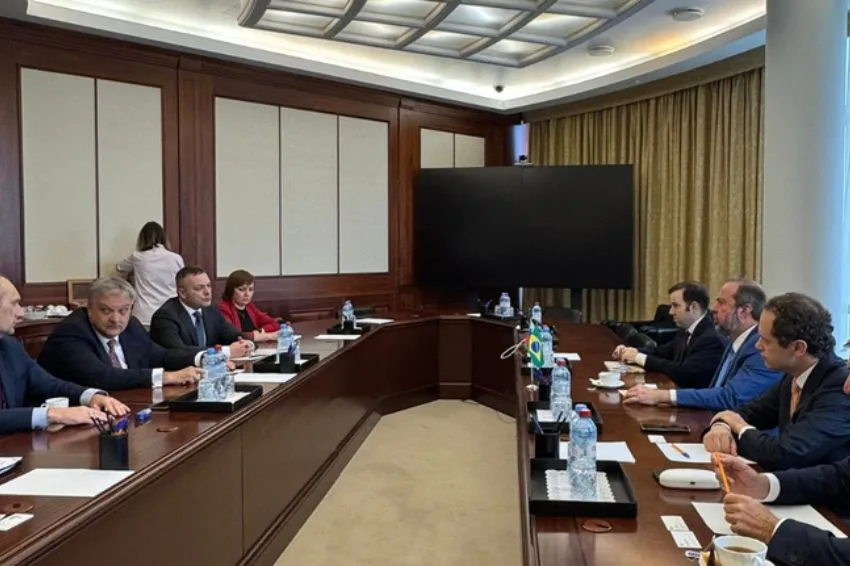
The MME (Ministry of Mines and Energy) signed an agreement with Tenex, a subsidiary of the Russian state-owned company Rosatom, with the aim of mapping Brazil's potential for uranium exploration and the development of small nuclear power plants.
During an official mission to Russia, Minister Alexandre Silveira highlighted that nuclear energy must be analyzed from a global perspective, especially in the context of energy security and transition.
According to him, investing in the uranium chain is strategic, since Brazil holds one of the largest reserves in the world — estimated at around 280 thousand tons — in addition to being among the six main global producers of lithium and having the eighth largest reserve of the mineral in the world.
The agreement also includes the study and development of modular nuclear reactors, known by the acronym SMR (Small Modular Reactors). With power ranging from 10 to 300 MW, these reactors are designed for both industrial use and electricity generation.
“It is an energy that will undoubtedly be fundamental for the electrical system, especially because it contributes to reducing transmission costs — one of the main parts of the price of energy in Brazil,” said Silveira.
The minister also highlighted the potential of SMRs to replace oil-fired power plants in the Amazon region. “With small nuclear reactors, we will be able to produce energy directly in electro-intensive industries. In the Amazon, it is much more viable to transport nuclear fuel, which is safe and represents a clean source of energy,” he added.
Silveira also reported that the Russians have already begun planning to identify Brazil's potential in the nuclear sector for peaceful purposes. "They will help us diagnose what we have in our territory and have made themselves available to begin discussions on a possible partnership in the development of modular reactors," he concluded.
SMRs are gaining relevance as a safe and sustainable solution for the energy transition. Compact, versatile and with lower operational risk, they offer flexibility and reliability in clean energy generation. Produced in factories, they can be transported and installed in different regions, including remote locations, which reduces costs and facilitates the expansion of energy infrastructure.
In addition to generating electricity, SMRs have multiple applications: they can be used in cogeneration systems, district heating, water desalination, industrial steam production and hydrogen generation.
all the content of Canal Solar is protected by copyright law, and partial or total reproduction of this site in any medium is expressly prohibited. If you are interested in collaborating or reusing part of our material, please contact us by email: redacao@canalsolar.com.br.