

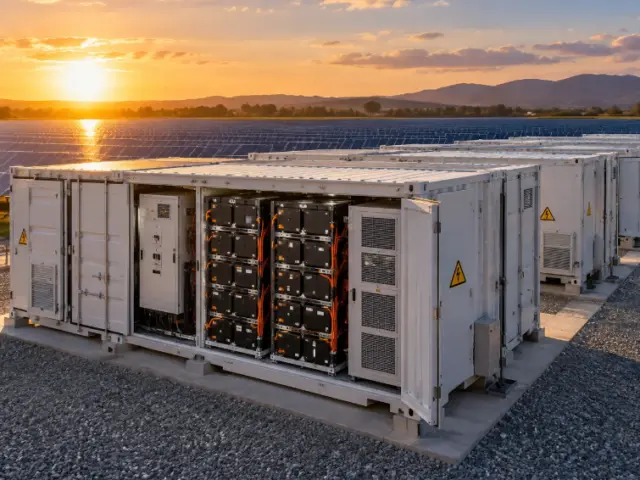
The ONS (National Electric System Operator) published, in conjunction with the ANEEL (National Electric Energy Agency) and EPE (Energy Research Company), the technical note that presents the remaining capacity of the electrical system for connecting new battery energy storage projects in the 2026 capacity reserve auctions.
Released this week, the document is available for consultation on the official websites of the three institutions. The study compiles the connection margins and restrictions that must be observed by projects participating in energy storage tenders.
The analysis covers facilities of the Basic Network, DITs (Other Transmission Facilities) and ICGs (Transmission Facilities of Exclusive Interest to Generation Plants for Shared Connection). It also considers projects indirectly connected to transmission through distribution networks.
According to the technical note, the available capacity results from the combination of three assessments: the existence of physical space for connection in the facilities, the electrical performance of the system, and short-circuit limitations.
Performance studies verify compliance with electrical criteria both during battery discharge, when equipment supplies power to the system, and during charging, when it draws energy from the grid. For each condition, the ONS (National System Operator) considers distinct operational scenarios.
The document presents a consolidated table with the capacity limits in megawatts per busbar, sub-area, and area. Following this, it details the physical availability of the facilities, the connection points in the distribution network, and the results of the studies by state or group of states.
Regional analyses identify the factors that limit connectivity margins. The report also links substations with restrictions resulting from short circuits and installations that may be impacted by projects participating in the auctions.
Access Season considered in the calculation
According to the ONS, the analyses also incorporated the amounts of capacity reserved in the first Access Season of the PNAST, when they represented a more restrictive condition for the calculation of margins. Projects that requested the return of guarantees associated with participation in the season were excluded from this consideration.
The measure aims to maintain consistency between capacity allocation processes and prevent the same network availability from being accounted for in more than one procedure.
The study uses as a reference the basis of the Medium-Term Electricity Operation Plan of the SIN (National Interconnected System), cycle 2027–2031, with adjustments to represent the expansion of transmission and generation according to the assumptions applicable to the auctions.
The storage tenders are scheduled for December 2nd and 4th, 2026, respectively. In both cases, the start of supply is scheduled for August 1st, 2028.
The technical note can be accessed by clicking here.
all the content of Canal Solar is protected by copyright law, and partial or total reproduction of this site in any medium is expressly prohibited. If you are interested in collaborating or reusing part of our material, please contact us by email: redacao@canalsolar.com.br.


Comments
Comments are moderated before publication.Comments should be respectful and contribute to a healthy debate. Offensive comments may be removed. The opinions expressed here are those of the authors and do not necessarily reflect the views of the author. Canal Solar.