
With the collaboration of the journalist Ericka Araújo
On holidays, cargo patterns change significantly: families gather in one place, some businesses reduce their activity, and industry slows down or halts production. As a result, net cargo also decreases.
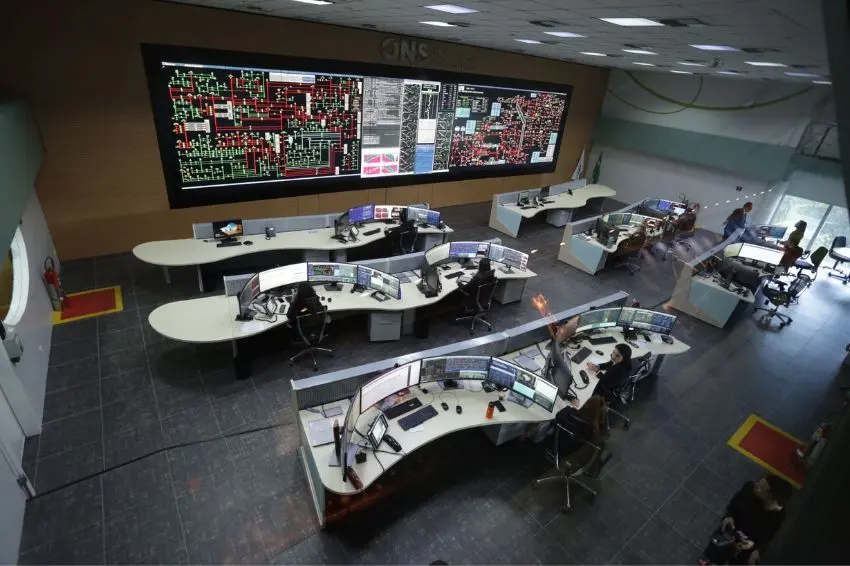
The lower the net load, the greater the challenge for the ONS (National Electric System Operator) to balance supply and demand in real time without compromising the security of the system.
On August 10, 2025, Father's Day Sunday, "the Operator needed to issue a command to completely reduce centralized photovoltaic and wind power generation," as indicated in... PARPEL Magazine 2025.
Given this scenario, the report from Canal Solar questioned ONS about the possibility of cuts in energy generation on Mother's Day, this Sunday (11), due to excess energy and reduced net load.
In a statement sent to the news outlet, the operator said:
“The National Electric System Operator (ONS) clarifies that the Emergency Plan for Managing Surplus Energy in the Distribution Network can be activated when energy production exceeds public demand and it is no longer possible to reduce centralized generation under the Operator's responsibility. In this sense, the possibility of activation on weekends and holidays is not ruled out. However, the ONS emphasizes that this is an exceptional action that will only be adopted as a last resort and aims to prevent risks to the stability of the National Interconnected System and avoid loss of system controllability during periods of very low load, ensuring the continuity of energy supply to society.”
The Emergency Plan for Managing Surplus Energy in the Distribution Network foresees that, in exceptional situations, generation cuts may be made at Type III power plants (connected to distribution but not dispatched by the ONS). as reported by Canal Solar.
The response confirms that activating the plan is not ruled out on dates of reduced consumption, although the ONS (National System Operator) emphasizes that this is an extreme measure aimed at preserving the stability of the system.
According to José Wanderley Marangon, advisor to ABGD (Brazilian Association of Distributed Generation) and honorary member of ABSAE (Brazilian Association of Energy Storage Solutions), the risk of very low net load was already expected for this time of year.
According to him, although solar distributed generation usually loses performance compared to the summer due to lower solar irradiance, the drop in consumption tends to be even more intense in the period closer to winter.
"Normally, with lower temperatures, both refrigeration and air conditioning require less energy, decreasing the overall load on the National Interconnected System (SIN) and causing the net load to reach lower values," said Marangon.
The expert also points out that the ONS has already been alerting agents of power plants classified as Type III about the possibility of requests for power cuts in situations critical to system operation..
How to solve this problem?
According to him, the advancement of distributed generation tends to amplify this challenge in the coming years, requiring structural changes in the electricity sector.
According to Marangon, one of the main responses to this new context will be the increased use of batteries associated with distributed generation, which will allow shifting some of the generated energy to peak consumption times and reducing the mismatch between supply and demand.
He believes that the Father's Day episode has come to be treated by industry stakeholders as a milestone in this new stage of Brazil's energy transition.
According to him, on the one hand, the country is rapidly expanding its decentralized renewable generation capacity. On the other hand, pressure is increasing on the system's operation during periods of low demand, when the operator has less room for maneuver.
In this context, Marangon emphasizes that the discussion about emergency generation cuts is no longer just a regulatory hypothesis, but is becoming a concrete part of the debate on electrical security, modernization of regulation, and the need for new technologies to provide flexibility in the system.
all the content of Canal Solar is protected by copyright law, and partial or total reproduction of this site in any medium is expressly prohibited. If you are interested in collaborating or reusing part of our material, please contact us by email: redacao@canalsolar.com.br.