
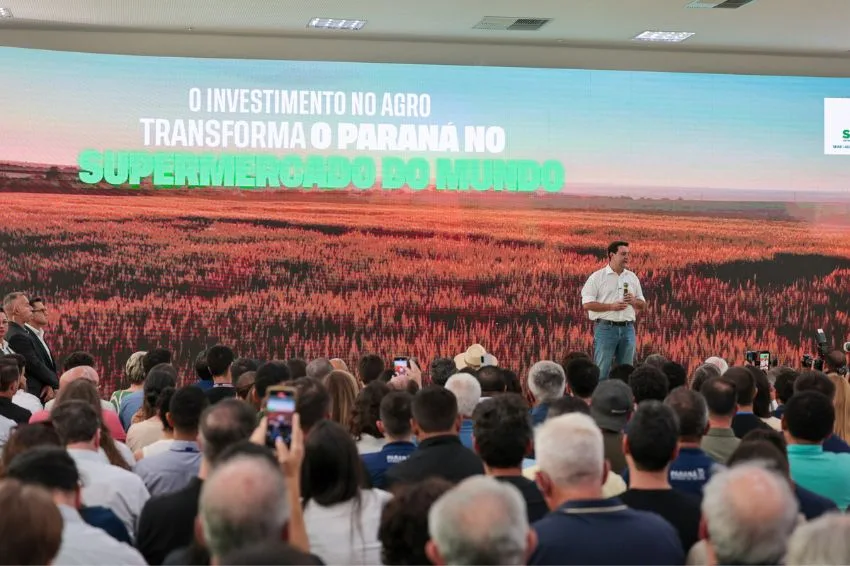
The Paraná State Government launched two programs on Monday (26) aimed at strengthening electrical infrastructure and connectivity in rural areas: Se Liga Aí Paraná and Paraná Conectado. The initiatives seek to improve the quality of energy supply, expand internet access and reduce inequalities between urban and rural areas, creating better conditions for the development of agricultural production.
The "Se Liga Aí Paraná" program focuses on encouraging rural properties to switch to a three-phase electrical grid, which offers greater stability, load capacity, and quality in energy supply. According to the State, currently a large part of Paraná's rural properties still use single-phase or two-phase networks, adequate only for basic consumption and insufficient for productive activities that require continuous operation.
The average investment for installing a three-phase power grid is approximately R$ 32. Under the program, Copel covers half of this amount, while the remainder is financed by the State Government through the Banco do Agricultor (Farmer's Bank), with zero interest.
According to the state secretary of Agriculture and Supply, Márcio Nunes, the goal is to benefit 12,5 properties in the next five years, since the model was "designed to fit the producer's budget," he said.
“In a connection that costs around R$ 32, Copel pays half. The other R$ 16 is financed by the State Government. For family farmers enrolled in Pronaf, this means five years to pay, without interest. In practice, it amounts to about R$ 200 per month to switch from a single-phase to a three-phase network,” he emphasized.
Herlon Almeida, CEO of IDR-Paraná (Rural Development Institute of Paraná), states that the three-phase power grid, by guaranteeing a more stable supply, ends up becoming fundamental for sectors highly sensitive to supply interruptions, such as milk production and poultry farming.
Furthermore, the State announced that it will subsidize part of the interest on rural credit to encourage participation in the program. “The State will subsidize five percentage points of the interest rate on rural credit. For family farmers, this means zero interest. The average producer, who pays an average of 10%, will now pay 5%,” Almeida emphasized.
Connected Paraná
The Paraná Conectado Program was structured to expand access to the internet and mobile telephony in rural areas through two complementary approaches. The first involves expanding fixed internet access, via fiber optics or radio, especially in regions where private investment is limited.
To this end, the State Government will open a process to accredit providers operating in the field. Companies will be able to access financing with interest subsidies, enabling the expansion of coverage in communities, settlements, and properties that currently lack adequate connectivity.
According to Governor Ratinho Junior, the initiative will allow for greater use of agricultural technologies. “Today, many modern pieces of equipment end up being underutilized due to a lack of connectivity. We want to guarantee internet access in the countryside so that producers can utilize the full potential of their machinery, access information, learn new techniques, and issue electronic invoices,” he stated.
The second aspect of the program is the expansion of 4G coverage through the installation of new radio base stations. The state has been divided into 22 regions, which will undergo bidding processes. The pilot project will be implemented in the Vale do Ivaí region, covering 33 municipalities.
Before the bidding process, a technical mapping of areas with little or no coverage will be carried out using software and satellite imagery. The winning companies will be those that present the lowest implementation cost and the best tariff conditions for rural users.
After the towers are installed and the signal is validated, the State will make payments to the responsible operators, who will then sell SIM cards and provide services in the areas covered. The focus is on prioritizing regions with the greatest social impact and higher population density, ensuring that the investment reaches where it is most needed.
all the content of Canal Solar is protected by copyright law, and partial or total reproduction of this site in any medium is expressly prohibited. If you are interested in collaborating or reusing part of our material, please contact us by email: redacao@canalsolar.com.br.



Comments
Comments are moderated before publication.Comments should be respectful and contribute to a healthy debate. Offensive comments may be removed. The opinions expressed here are those of the authors and do not necessarily reflect the views of the author. Canal Solar.