
The expansion of the Brazilian photovoltaic market has brought significant advances in technology, productivity, and competitiveness. As a consequence, the sector's attention has focused mainly on the quality of equipment, the efficiency of photovoltaic modules, and the performance of inverters.
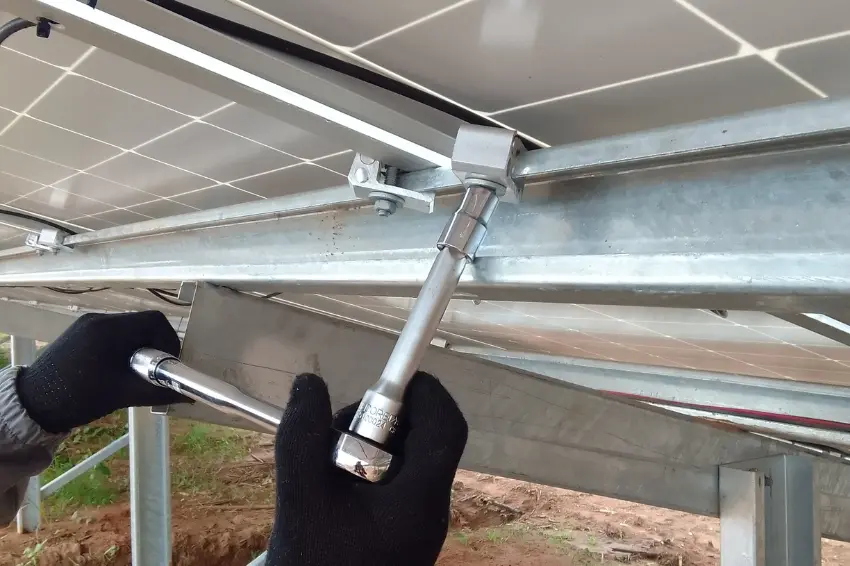
However, a fundamental element for the reliability of any power plant still receives little attention after the completion of the work: the supporting structure.
It is common that, after the power plant is delivered, the structure is considered a "permanent" component that does not require monitoring throughout its lifespan. This perception, although widespread, can lead to failures that compromise safety, energy generation, and even the durability of the entire project.
Like any engineering system continuously exposed to the elements, metal structures are subject to stresses that vary over the years. Strong winds, temperature variations, humidity, corrosive environments, and even minor ground movements can gradually alter the structural behavior of the installation.
Most of the time, these changes occur slowly and silently, making periodic inspection the main tool for identifying problems before they evolve into more serious failures.
Among the aspects that deserve attention are the tightness of bolted connections, the integrity of structural elements, the presence of permanent deformations, the occurrence of corrosion, the stability of foundations, and the condition of surface protection systems.
Minor defects, when identified early, are usually simple and inexpensive to correct. On the other hand, when neglected, they may require more complex interventions and result in significantly higher costs.
Another important aspect is that the loads acting on a structure do not remain constant throughout its service life. Severe weather events, which are becoming increasingly frequent in various regions of the country, can subject it to stresses close to the limits considered in the design.
Although a properly dimensioned structure is designed to withstand these conditions, a subsequent inspection allows verification that the expected structural behavior has been maintained and that no damage has occurred that could compromise its load-bearing capacity.
The inspection also represents an opportunity to assess aspects that go beyond structural resistance. Misalignments, differential movements of the foundations, interference caused by vegetation, inadequate drainage systems, and even modifications made after installation can influence the plant's performance and reduce its operational reliability.
In highly aggressive environments, such as coastal regions, industrial areas, or locations subject to intensive fertilizer use, this monitoring becomes even more important.
The rate of corrosion processes can vary significantly depending on environmental conditions, making it essential to adopt a preventive maintenance strategy based on periodic inspections.
It is important to highlight that a structural inspection should not be seen merely as a visual verification. Depending on the characteristics of the plant, it may include measurements, photographic records, evaluation of structural connections, analysis of foundations, and comparison of the observed conditions with the assumptions adopted in the original project.
This historical record allows us to track the evolution of the structure's condition over the years and to support decisions related to maintenance and any necessary interventions.
Another important benefit is the preservation of the investment made. A photovoltaic plant is designed to operate for decades, and the structure is the element responsible for ensuring that the modules remain securely positioned throughout this period. Investing in periodic inspections means protecting assets, reducing operational risks, and increasing the predictability of maintenance costs.
As the photovoltaic sector matures, so does the need to incorporate more structured maintenance practices. Just as modules are monitored and inverters receive preventative maintenance, the structures themselves must also be integrated into this asset management process.
Ultimately, it's not enough for a structure to be well-designed and correctly installed; it's essential that it maintains its performance throughout the entire lifespan of the power plant.
More than just fulfilling a technical need, structural inspection represents an engineering culture based on prevention, reliability, and responsibility.
In an increasingly competitive market, ensuring the integrity of the structure means guaranteeing that the entire photovoltaic system continues to deliver safety, efficiency, and performance throughout its entire lifespan.
The opinions and information expressed are the sole responsibility of the author and do not necessarily represent the official position of the author. Canal Solar.


Comments
Comments are moderated before publication.Comments should be respectful and contribute to a healthy debate. Offensive comments may be removed. The opinions expressed here are those of the authors and do not necessarily reflect the views of the author. Canal Solar.