
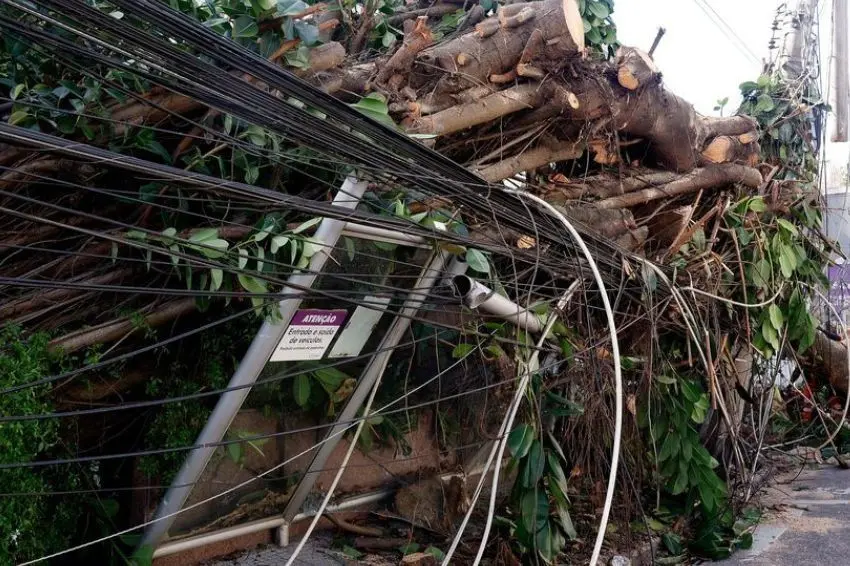
Electricity companies are preparing to face a challenging period with the possible arrival of a Super El Niño. Storms, droughts, floods, and higher temperatures are expected, with different impacts in each region of the country.
According to the Director of Regulation at ABRADEE (Brazilian Association of Electric Energy Distributors), Carlos Brandão, distributors are reinforcing team training and investments in equipment and vehicles to deal with incidents that may occur in the second half of the year.
He believes that with the arrival of the wet season, which begins in October in the Southeast and Midwest regions, more intense weather events than those experienced in the past may occur.
Companies in the sector have increased investments in electricity grids in recent years with the goal of making them more resilient. Brandão states that R$ 41 billion was invested in 2025, compared to R$ 18 billion in 2021. Of the total invested last year, more than 40% was allocated to the modernization, digitization, and automation of the grids.
In interview with Agency BrazilBrandão acknowledged that these measures do not prevent power outages when a tree falls on the power lines, but they do expand the response capabilities of the utility companies.
"The distributor is able to make maneuvers to isolate this problem in certain areas, without having to shut down, for example, an entire neighborhood," he explained.
The modernization of distribution networks also includes real-time monitoring, the deployment of smart grids, preventive inspections, risk-based maintenance, structural reinforcement of equipment and, where feasible, the burying of wiring.
Communication between utility companies and public agencies, such as city halls, Civil Defense, and the Fire Department, is also considered fundamental to speeding up the restoration of the system. This coordination can facilitate, for example, the removal of trees that have fallen on the overhead power lines.
Some experts argue that utility companies should expand the undergrounding of power lines, which could reduce power outages caused by storms and gales.
Brandão, however, argues that these investments should be conducted by the public sector, in accordance with the urban planning of each city. According to him, when a neighborhood receives underground wiring at the initiative of the distributor, the cost is divided among all consumers in the concession area.
"This is an investment that doesn't make sense to be made with the distributor's own resources, because the impact on the tariff is very high," he stated.
Another strategy that could be adopted this year is the sharing of teams between dealerships. This mechanism allows companies not affected by weather events to send professionals, vehicles, and equipment to assist distributors in other regions.
“When one distributor is affected and the others around it are not, assistance comes from companies in other regions of the country, as happened in Rio Grande do Sul, which received teams and vehicles to help rebuild the destroyed network,” said Brandão.
According to the director of Abradee, the strategy was also used last week in São Paulo, although on a smaller scale. Because the storm affected neighboring distributors, there were greater limitations on the deployment of teams. "But this is foreseen in Aneel's regulations and will be important in these times of crisis," he concluded.
all the content of Canal Solar is protected by copyright law, and partial or total reproduction of this site in any medium is expressly prohibited. If you are interested in collaborating or reusing part of our material, please contact us by email: redacao@canalsolar.com.br.

Comments
Comments are moderated before publication.Comments should be respectful and contribute to a healthy debate. Offensive comments may be removed. The opinions expressed here are those of the authors and do not necessarily reflect the views of the author. Canal Solar.