
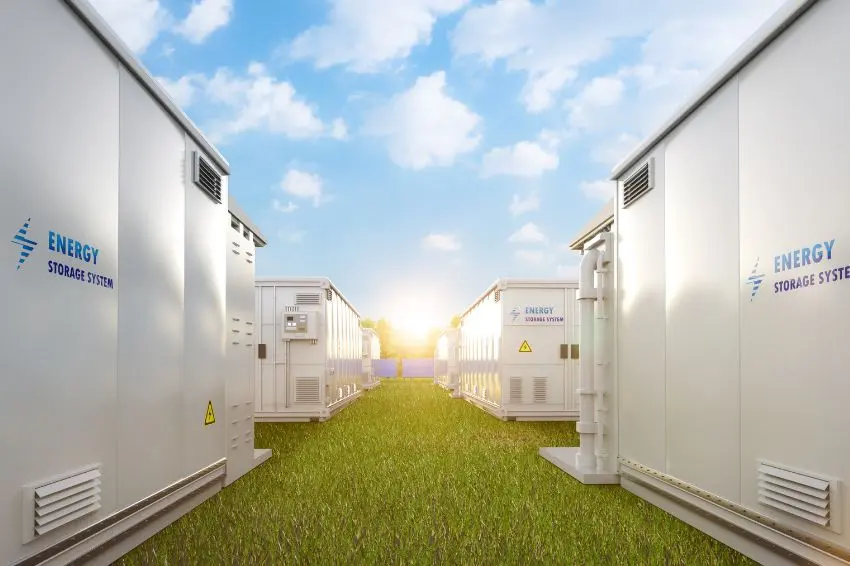
Brazil's installed solar power capacity recently surpassed 72 GW – consolidating this source as the second largest in the national electricity matrix, behind only hydropower.
This figure represents more than 25% of Brazil's installed capacity, a significant advance for a country that until a few years ago viewed solar energy as supplementary. Diversifying the energy matrix is positive, but it also imposes new technical requirements.
As photovoltaic generation advances, expanding its presence in large power plants and hybrid systems, it becomes urgent to deal with a technical side effect: intermittency.
Ensuring that the electrical grid absorbs this energy in a stable way is one of the sector's biggest challenges today – and it is precisely at this point that battery energy storage systems (BESS, Battery Energy Storage Systems) come into play as structural solutions.
Since 2022, specific rules have been in effect for hybrid power plants, allowing the combination of sources, such as solar and batteries, under the same permit. Law No. 15.269 / 2025The law, approved by the Federal Government, modernized the regulatory framework of the electricity sector and created the basis for regulating the storage of electrical energy through batteries.
In June of this year, the Ministry of Mines and Energy published the Normative Ordinance No. 136/2026, which established the guidelines for the first auctions of reserved capacity dedicated exclusively to new battery energy storage systems.
And recently, at the end of July, the ANEEL (National Electric Energy Agency) opened a public consultation for analysis of the preliminary drafts of the bidding documents for Storage Capacity Reservation Auctions National and General Storage.
Meanwhile, innovative use cases are popping up: from pilot projects that connect solar and wind farms to battery banks, to isolated systems on islands and in remote communities that reduce the use of diesel generators.
This scenario shows that Brazilian solar growth cannot be sustained simply by adding more panels – it is necessary to ensure that the storage infrastructure keeps pace, meeting rigorous quality criteria.
This is where certifications come in as guardians of trust and technical excellence, ensuring that every installed battery, every storage container, and every associated inverter meets high standards of performance and safety.
Certification for BESS systems
Unlike conventional components, large batteries present technical challenges and risks – from the possibility of thermal events to the complex interaction with inverters and control systems.
In this context, certifying a BESS system goes far beyond fulfilling bureaucratic requirements: it involves attesting, through independent entities, that the set of equipment has reached a recognized level of safety, performance, and compliance.
Certified products and projects adhere to rigorous international standards that guarantee electrical and operational safety, efficient performance, proper environmental integration, and interoperability with the electrical grid.
From a technical standpoint, BESS certifications cover a complete chain – from the battery cell level to the grid-integrated power system level. Each stage has specialized standards.
At the cell and module level – the chemical “heart” of storage – standards such as IEC 62619 and IEC 63056 define safe design criteria for industrial lithium-ion batteries, including tests against short circuits, overcharging, and overheating.
These standards ensure that individual cells are intrinsically safe, reducing the risk of explosion or thermal leakage. Furthermore, transport protocols such as UN 38.3 are mandatory for lithium batteries, requiring them to withstand vibrations, impacts, and altitude variations without incident – a prerequisite for any manufacturer wishing to move batteries within Brazil or export them.
Moving up the scale, to the battery pack level, other standards complement the scope of safety and performance. IEC 62619 itself applies here, as does UL 1973 – the North American standard for stationary batteries – and IEC 62485-5, which focuses on the safety of large-scale battery installations.
These standards evaluate the system as a whole: they verify whether the BMS (Battery Management System) reacts correctly to defective cells (for example, by isolating them), whether there is redundancy in overcurrent protection, and whether the thermal conditions of all modules remain within safe limits during field operation.
Reaching the level of an integrated system in a container or electrical room, other requirements come into play: electromagnetic compatibility, such as IEC 61000-4-X standards, to ensure that the battery electronics do not cause interference or suffer from external noise; ventilation and fire suppression systems – NFPA 855 and EN 50272-2 define distances, sensors, and fire mitigation measures in battery installations; and grid connectivity protocols. Here, the inverters and converters coupled to the batteries need to meet standards such as IEC 62109-1/2 (solar inverter safety) and distributed connection standards.
Brazil tends to follow these international steps, adapting them to the local context. While official standards for on-grid storage are still being developed, it is expected that they will be aligned with global IEC and IEEE standards to allow technologies and solutions that are widely tested abroad to be adopted here without delays.
For the national solar sector, this means shortening the learning curve by adopting already established best practices: certifying batteries according to IEC 62619/63056, testing hybrid inverters according to IEC 62109 and grid access rules, and observing fire safety guidelines such as UL 9540A/NFPA 855 for large-scale projects.
This regulatory convergence not only facilitates the import of certified equipment from abroad, but also puts Brazilian manufacturers on an equal footing to export internationally recognized storage solutions.
BESS Certification as a Strategic Differentiator
In this highly regulated market, BESS system certification has become a strategic differentiator for projects seeking operational safety and access to demanding markets.
Certification covers the entire project cycle, from conception and component selection to final performance and integration testing. This process ensures that batteries, battery management systems (BMS), inverters, and interfaces are comprehensively evaluated based on updated international technical standards. In addition to ensuring compliance, the process functions as a preventative technical audit, capable of identifying potential failures before the system enters commercial operation.
In the market, this technical recognition adds immediate value. Projects with independent certifications tend to attract better financing conditions, facilitate acceptance by insurance companies, and enable the internationalization of products through multilateral homologation schemes.
Certification also strengthens companies' reputations with customers, investors, and communities by demonstrating a clear commitment to quality, safety, and environmental responsibility. In a sector like renewable energy, where trust is paramount, this type of technical validation becomes a strategic asset.
The expansion of solar energy in Brazil is already a well-established reality. The challenge now is to ensure that this growth is sustainable, safe, and technically robust.
In this new scenario, energy storage systems – and, above all, their certification – play a central role in the architecture of the energy transition. They are what enable grid stability, predictability for operators, and efficiency for investors.
Therefore, certifying a BESS is more than just validating a set of equipment: it's about establishing a standard of technical excellence that protects the electrical system, enhances the investment, and strengthens the confidence of the entire ecosystem involved, from the manufacturer to the end consumer.
For the Brazilian solar sector, which is increasingly emerging as a key player in the national electricity matrix, investing in certifications means investing in sustainability, reputation, and technological maturity.
You might be interested!
Canal Solar and Fox ESS will have BESS G-MAX Plus for hands-on professional training.
The opinions and information expressed are the sole responsibility of the author and do not necessarily represent the official position of the author. Canal Solar.


Comments
Comments are moderated before publication.Comments should be respectful and contribute to a healthy debate. Offensive comments may be removed. The opinions expressed here are those of the authors and do not necessarily reflect the views of the author. Canal Solar.