
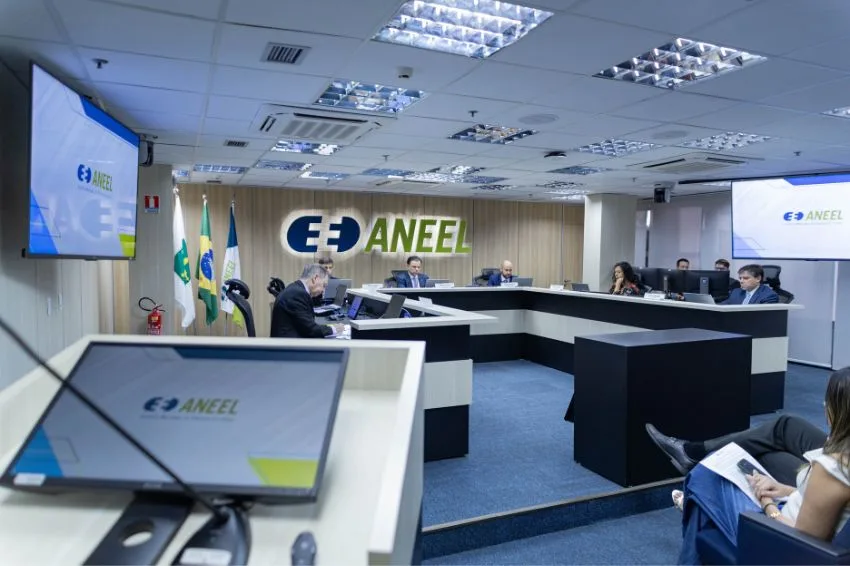
The Director-General of ANEEL (National Electric Energy Agency), Sandoval Feitosa, validated the understanding of the ONS (National Electric System Operator) that distributors have “not only the power, but the duty” to carry out generation cuts when necessary in their concession areas.
The document, the Official Letter No. 553/2025-GDG/ANEEL, signed by Feitosa on October 14, mentions that the measure is supported by law and regulatory standards, including Modules 3 and 4 of PRODIST (Procedures for the Distribution of Electric Energy in the National Electric System). According to ANEEL, the objective is to guarantee the reliability and operational safety of the national electrical system in risk situations.
The agency's statement comes after the validation of the emergency plan proposed by the ONS, which authorizes temporary cuts to generation connected to distribution networks, including those classified as Type III. In the letter, the Agency claims that distributors have a legal and contractual role in executing ONS orders.
“Both Law No. 8.987 of 1995, which establishes the provision of adequate service, and Law No. 9.648 of 1998, which establishes the responsibilities of the National Electric System Operator – ONS, give the transmission and distribution system operators the authority and responsibility to act in favor of their security and stability,” the document informs.
According to the Agency, generation agents must follow the instructions of distributors. “The ANEEL ratifies the understanding that distributors have not only the power, but the duty to cut not only load, but also generation that accesses the distribution system in their concession areas, in response to commands from the ONS,” the letter states.
Read also Everything you need to know about solar energy..
Distributed generation
The document also highlights that consumers who have DG (distributed generation) would also be exposed to possible generation cuts. “Regarding consumer units, including those with MMGD, Module 4 of PRODIST establishes that consumers have the obligation to respond to the distributor when load shedding is requested in situations of system need,” the note stated, continuing:
"In turn, the distributor is responsible for selecting the consumer units, substations, and feeders that will be subject to transient load control actions, based on the prioritization guidelines and load shedding amounts determined by the ONS. Direct disconnection of the consumer unit (manual or automatic) is defined as one of the PRODIST load control actions."
Want to know everything about solar energy laws and news in the country? We've compiled it. news and updates Essential for anyone following the sector and wanting to understand new investment and economic opportunities!
Contradiction
Despite the publication of the letter, when examining the referenced documents, it is noted that the cuts in GENERATION are not explicitly mentioned in Item 48 of module 4 of PRODIST – used as a basis by ANEEL for the publication of the letter.
Item 48 of the Module only explains that consumers have “responsibilities in controlling LOAD”, therefore it is not explicit that the control/cut would also be applicable to GENERATION
The load control topic was added to Module 4 of PRODIST before the regulation of DG through REN 482, in April 2012. At the time, the objective of load control was related to the context of lack of energy resources, with the risk of blackouts.
Click here and check out the official document published in full by ANEEL.
| Learn all about solar energy in our articles. |
all the content of Canal Solar is protected by copyright law, and partial or total reproduction of this site in any medium is expressly prohibited. If you are interested in collaborating or reusing part of our material, please contact us by email: redacao@canalsolar.com.br.


Comments (3)
Comments are moderated before publication.Comments should be respectful and contribute to a healthy debate. Offensive comments may be removed. The opinions expressed here are those of the authors and do not necessarily reflect the views of the author. Canal Solar.
I confess that distributed generation customers would be virtually impossible to control, since the inverter is located on the property, and the utility company could only cut off generation by disconnecting the inverter through unauthorized access to the customer's home. If the utility company cuts off the power, it would be an illegal cut, since the bills are up to date and the customer shouldn't be cut off. I can't see how a distributed generation customer's generation would be cut off.
You will have to prove that you cut Isaac, if you don't prove it you will receive a fine, or another solution ANEEL They will launch a box for you to connect to your system so they can give a command and turn off your system online. They will give you 90 days to install your LL26 magic box or you may be charged with the crime of attempting to cause instability in the electrical network.
trust the government, trust me, silly.
Isaac… maybe this is simpler than we imagine…
I imagine this will happen with Smart Meters... Blocking the Injection with remote access only to the meter itself!!!.
Sergio – Aracaju/Se