
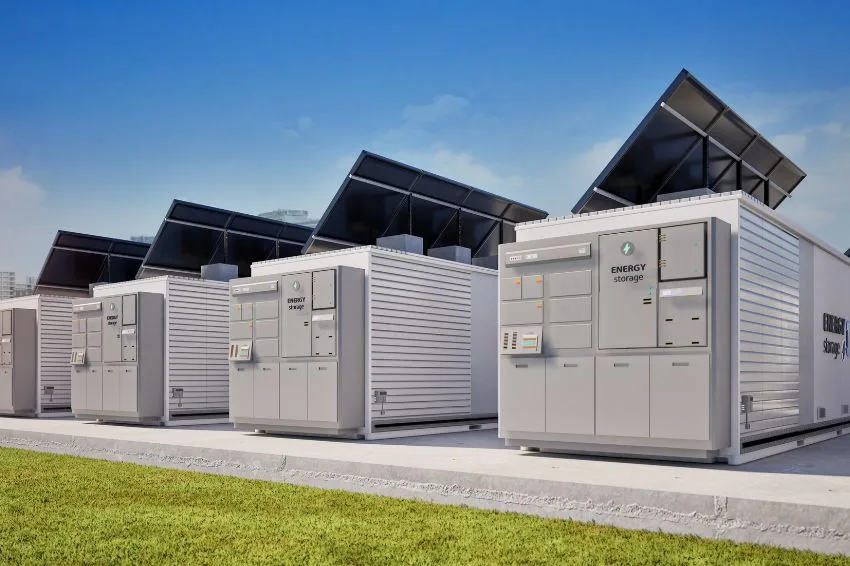
ABSAE (Brazilian Energy Storage Association), in partnership with Aurora Research, commissioned a study to compare the costs of meeting capacity reserves through open-cycle gas-fired power plants and battery systems.
According to the study, Brazil will need approximately 47 GW by 2045 to meet its power demand. In this scenario, considering the costs of both technologies to meet this demand, battery systems would cost between R$3,5 billion and R$4,6 billion less than open-cycle gas-fired power plants.
To learn more about the energy storage market, we interviewed Markus Vlasits, president of ABSAE. Check out the key excerpts from the interview.
What was the main objective of this study?
Mark: Of course. Before delving into the study, it's worth providing some context. The Brazilian electricity system will face two problems in the coming years: a power deficit to meet peak demand at night and, at the same time, an excess of renewable generation in the middle of the day. This happens because micro and mini solar generation injects a lot of energy in the afternoon, creating the famous "duck curve." We've even seen critical episodes, such as on Father's Day, when the ONS (National Health System) nearly lost control of the operation.
The objective of the study was to identify the lowest overall cost solution for this power deficit. For simplicity, we did not include indirect benefits of batteries, such as energy recovery or ancillary services. Even so, the conclusion was clear: batteries offer significantly lower overall costs than open-cycle thermal power plants, which are the most flexible and, therefore, the ones we used for comparison.
So, in numbers, what did you project?
The estimated deficit is 47 GW by 2045—slightly higher than the 38 GW that EPE forecasts by 2034. When we compared, we saw that, even without accounting for additional benefits, batteries (BESS, with 4 hours of autonomy) are much more competitive than thermal plants. The difference is stark.
This isn't surprising: thermal plants require fuel and infrastructure, while batteries only require initial investment. With the significant drop in battery prices in recent years, this result was expected.
How much have the cost of batteries fallen?
Over the past ten years, costs have fallen by about 50%, and we continue to decline. Today, CAPEX is between R$1.000 and R$1.400 per kWh of capacity. We forecast that within five years, this figure will fall below R$1.000 per kWh, even while maintaining the current tax burden—which, by the way, is extremely high.
What is the tax burden on batteries?
If you import a complete, turnkey system, the burden reaches 70%. Producing and integrating it locally drops it to 55%. Still, it's much heavier than other technologies in the sector, such as wind and solar, which have always received special treatment. It seems as if storage is taxed as a luxury item—almost as if it were a "Cuban cigar."
You've also mapped Brazil's storage potential. What's the figure?
Today we have less than 1 GWh installed, something insignificant compared to the 200 GWh of new projects planned globally in 2025 alone. In Brazil, our study indicates a potential of 72 GWh by 2034, with investments close to R$80 billion.
This market is divided into three segments:
- 40% in capacity reservation and system services – dependent on auctions and public policies;
- 40% in commercial and industrial consumer projects, and in the future also residential ones;
- 20% in off-grid applications, for isolated locations, mining and even rural electrification.
Speaking of public policies, how is the regulation of ANEEL about storage?
Much progress has been made, but there are still critical points. The most sensitive is the network usage fee (TUSD/TUST). ANEEL even proposed that autonomous storage systems pay like consumers, which makes no sense. Recently, they backtracked and suggested charging twice: once for loading and once for unloading. This is outdated and has been abandoned in countries like Germany for over 20 years.
We advocate something simple: if the battery has a generation license, it should pay a generation fee. Otherwise, the cost will be passed on to society through charges. And note the contradiction: gas-fired power plants, which participate in the auctions, don't pay the equivalent for the use of gas pipelines. Batteries, which are modern and clean, would be penalized. It's incoherent.
Another point raised in the industry is the dependence on lithium-ion batteries and China. Is this bottleneck a concern?
It's a valid question. But we need to differentiate. Today, in stationary storage, nickel, manganese, and cobalt (NMC) batteries, which rely on critical minerals like Congo cobalt, are rarely used. Lithium iron phosphate (LFP) batteries, which are much less problematic in terms of materials, predominate.
Furthermore, alternatives are under development, such as sodium batteries, which already have a lower cost per cell, although they still need to evolve in energy density. There are also flow technologies. In other words, we're not doomed to lithium.
Some people advocate hydrogen as an alternative to battery storage. How do you see this?
In the case of hydrogen, we believe it will make more sense for applications such as aviation, maritime shipping, and industrial sectors that are difficult to decarbonize. For stationary storage, the round-trip efficiency is low (around 40%), compared to 85% to 95% for batteries. Therefore, batteries are better suited for daily system balancing.
Finally, do you have a final message?
Yes. We urgently need to consider capacity reserve auctions. The Ministry of Mines and Energy (MME) has opened consultations for thermal auctions for gas, oil, and even coal. Thinking about contracting 30th- and XNUMXth-century technologies in the XNUMXst century, in the year of COPXNUMX, is absurd. We have record renewable generation and high spill rates. Contracting thermal power plants would be tragic. Brazil needs specific auctions for batteries.
all the content of Canal Solar is protected by copyright law, and partial or total reproduction of this site in any medium is expressly prohibited. If you are interested in collaborating or reusing part of our material, please contact us by email: redacao@canalsolar.com.br.