
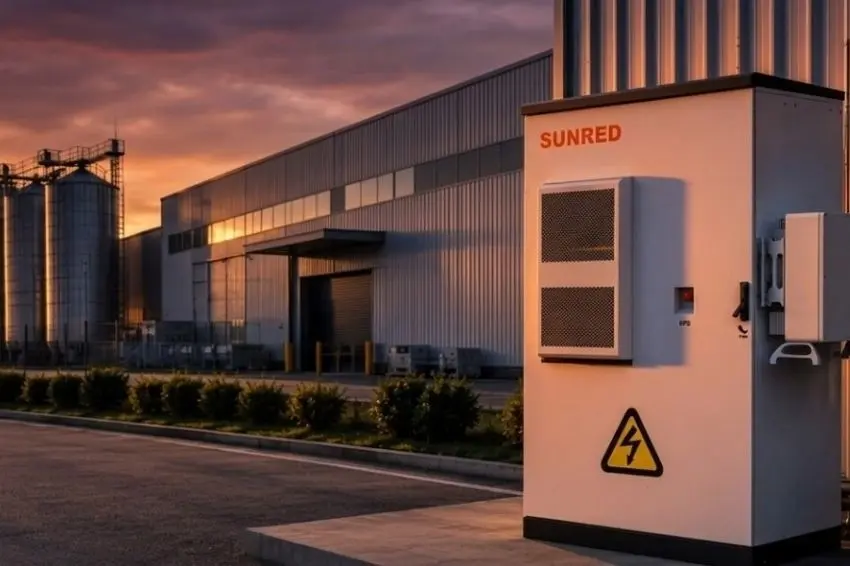
A 241 kWh energy storage system designed by Sunred aims to reduce electricity costs and enhance energy security for a supermarket. The solution incorporates applications such as consumption shifting, demand control, solar power generation utilization, full load backup, and microgrid operation.
According to the company, the project was developed to simultaneously meet different needs of the consumer unit. In addition to reducing network usage during peak hours, when tariffs are higher, BESS can act on demand peaks and keep loads running during supply interruptions.
“Storage has ceased to serve only a backup function. In the same installation, BESS can contribute to cost reduction, demand management, solar energy management, and operational continuity,” says Sunred.
Energy stored for peak hours
One of the applications foreseen in the project is time shift. During periods of lower cost, the batteries can be charged with energy from photovoltaic generation or the electrical grid itself. The stored energy is used later during peak hours.
This strategy allows companies to shift some consumption to more favorable tariff periods, reducing their exposure to higher rates.
The system also performs peak shaving, providing power during periods when the installation's load increases. In this way, BESS helps to limit peak loads and improve the management of contracted demand, thus avoiding overages and penalties.
According to Sunred, the economic benefits should be evaluated individually, considering factors such as consumption profile, tariff type, contracted demand, and battery operating strategy.
"It's not just about installing a battery. It's necessary to understand how the unit consumes energy and define when the system should charge, discharge, or preserve capacity for a possible power outage," the company explains.
Direct integration with solar power generation.
The project utilizes a direct current architecture, connecting the photovoltaic generation to the storage system via DC-DC modules with MPPT.
In this configuration, solar energy can meet the supermarket's needs during the day and charge the batteries when there is surplus generation. Subsequently, the stored energy can be used during peak hours or periods of higher consumption.
According to Sunred, direct current integration reduces conversion steps and concentrates the management of photovoltaic generation and storage in a single architecture.
“DC-DC coupling allows for better use of solar energy and reduces the amount of equipment involved in the project. During the day, generation meets operational needs, and the surplus can be stored for later use,” the company highlights.
PCS grid forming enables microgrid operation.
BESS features a 125 kW grid-forming PCS, capable of establishing its own voltage and frequency references when the installation is disconnected from the utility grid.
In the event of a power outage, the system can take over the supply of critical loads and form a local network to ensure operational continuity. The configuration also allows for maintaining photovoltaic generation available during stand-alone operation, respecting technical limitations and the project's control strategy.
“PCS grid forming allows BESS to form its own electrical grid. In practice, this makes it possible to keep important loads running and use solar generation even when the utility grid is unavailable,” reports Sunred.
The configuration transforms the facility into a microgrid during external power outages, increasing the supermarket's energy resilience.
The transfer takes place in approximately 20 milliseconds.
The transition between the power grid and the storage system is performed by a 300 kW static transfer switch (STS). According to specifications provided by Sunred, the transfer time is approximately 20 milliseconds.
The equipment also isolates the installation during off-grid operation, preventing energy from flowing back into the utility grid.
The solution also incorporates a galvanic isolation transformer, responsible for electrical separation between circuits. According to the company, this component increases safety, reduces interference, and contributes to the quality of power delivered to loads.
Components concentrated in one cabinet
The system integrates, in a single industrial cabinet, the batteries, the PCS, the photovoltaic connection modules, the STS, the transformer, and the management resources.
According to Sunred, concentrating the components reduces the amount of equipment and connections required in the field. The configuration also simplifies installation and commissioning steps, since the assembly is pre-assembled and tested at the factory.
"Integrating the components into a single piece of equipment reduces installation complexity and deployment time. The system arrives ready to bring together different applications within the same architecture," the company emphasizes.
The equipment has an IP55 protection rating and weighs approximately 3 tons. The batteries use lithium-iron-phosphate (LiFePO₄) technology, with a lifespan reported by Sunred of up to 6 cycles, considering a depth of discharge of 80%.
The estimated lifespan is approximately 15 years, although performance over that period depends on conditions such as temperature, number of cycles, discharge depth, and management strategy.
Project features
Storage capacity: 241 kWh;
PCS grid forming: 125 kW;
DC-DC photovoltaic integration: 240 kW;
STS: 300 kW;
Transfer time: approximately 20 ms;
Isolation transformer: 125 kW;
Battery technology: LiFePO₄;
Service life: up to 6 cycles at 80% depth of discharge;
Estimated lifespan: approximately 15 years;
Degree of protection: IP55;
Approximate weight: 3 tons.
According to Sunred's assessment, projects with this architecture can serve consumers with critical loads, high peak-hour costs, or recurring network quality and availability issues.
Applications include supermarkets, industries, agribusinesses, logistics centers, mining companies, and other operations seeking to combine cost reduction, greater use of solar power generation, and operational safety, as well as partial or total reduction of diesel generators.
"Companies gain more control over when, how, and for what purpose they use energy. This flexibility is one of the main advantages of energy storage," concludes Sunred.
all the content of Canal Solar is protected by copyright law, and partial or total reproduction of this site in any medium is expressly prohibited. If you are interested in collaborating or reusing part of our material, please contact us by email: redacao@canalsolar.com.br.




Comments
Comments are moderated before publication.Comments should be respectful and contribute to a healthy debate. Offensive comments may be removed. The opinions expressed here are those of the authors and do not necessarily reflect the views of the author. Canal Solar.