
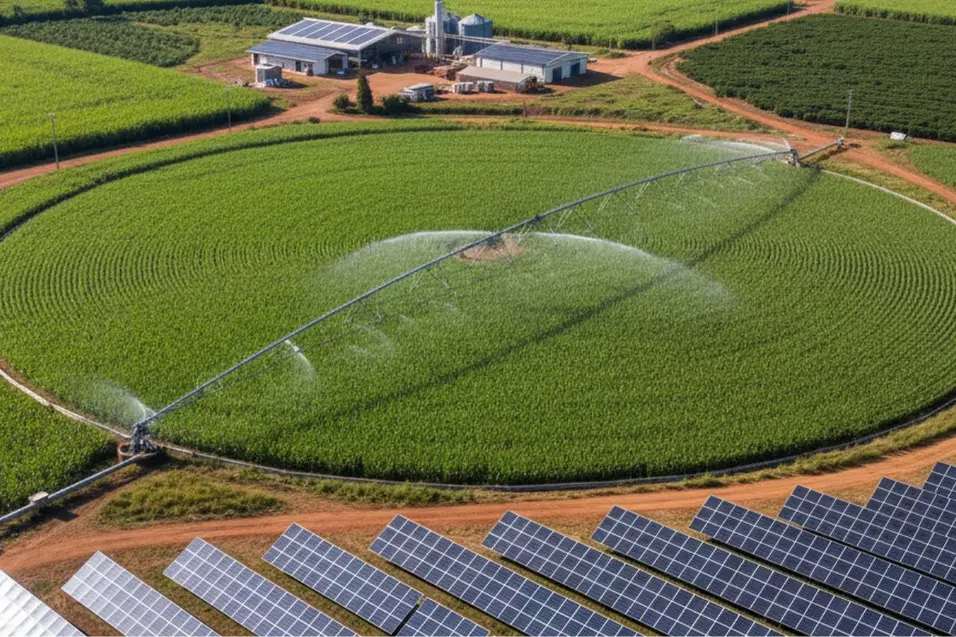
Agribusiness accounted for approximately 60% of all renewable energy supplied in Brazil in 2025, according to a study by the Observatory of Knowledge and Innovation in Bioeconomy of the Getulio Vargas Foundation (FGV). Bioenergy from agricultural, agro-industrial and forestry activities reached 97,8 million tons of oil equivalent (toe), the highest volume in the historical series analyzed.
Between 2021 and 2025, the supply of bioenergy associated with the sector grew by approximately 16%, increasing from 84,2 million to 97,8 million tons of oil equivalent (toe). During the same period, the total supply of renewable energy in the country increased from 136,7 million to 162,3 million toe.
The data shows that the contribution of agribusiness goes beyond the production of food and raw materials. The sector also provides energy to power industry, drive transportation, and contribute to electricity generation.
Bioenergy represents almost 30% of the energy matrix.
According to a survey by FGV, bioenergy linked to agribusiness represented 29,8% of Brazil's domestic energy supply in 2025. This means that almost three out of every ten units of energy supplied in the country originated from sources associated with agricultural, agro-industrial, and forestry chains.
Among the main sources are bagasse and other sugarcane byproducts, ethanol, biodiesel, firewood from planted forests, vegetable oils, and biogas produced from agricultural waste.
The survey also considers industrial byproducts, such as bleach, generated in the paper and pulp manufacturing process and used to produce energy.
The share of these sources has increased over the last few decades. In 1970, bioenergy associated with agribusiness accounted for 9,7% of the country's domestic energy supply. This growth was driven, among other factors, by the expansion of ethanol production, the adoption of flex-fuel vehicles, biodiesel, and the energy recovery from industrial waste.
Industry and transportation are among the main consumers.
Bioenergy from agribusiness has a significant presence in industrial sectors that demand large amounts of heat and steam. The food and beverage, paper and pulp, ceramics, and metallurgy industries utilize biomass and byproducts of their processes as energy sources.
In transportation, ethanol and biodiesel are increasing the share of biofuels in the Brazilian energy matrix. Meanwhile, in the sugarcane and ethanol industries and in paper and pulp mills, the use of waste allows for the production of electricity and heat for self-consumption and, in certain cases, the supply of energy to the grid.
This diversity of applications helps explain why the contribution of agribusiness represents such a significant portion of Brazil's renewable energy supply.
Dependence on fossil fuels remains a challenge.
Despite its importance in renewable energy production, agribusiness still depends on fossil fuels for part of its operations.
FGV's consumption analysis, based on 2022 data, indicates that 73% of the energy used directly by Brazilian agriculture came from fossil fuels, mainly diesel. This percentage was slightly above the world average of 70%.
Among the alternatives highlighted by the study are expanding the use of biodiesel, ethanol, and biomethane in heavy vehicles, electrifying operations in the field, and improving energy efficiency.
However, the expansion of these solutions depends on investments in rural electrical infrastructure, technological advancements, and conditions to utilize agricultural waste on a commercial scale.
The results show that agribusiness plays two roles in Brazil's energy transition: it is an important supplier of renewable energy, but it also has opportunities to reduce the use of fossil fuels in its own production chain.
all the content of Canal Solar is protected by copyright law, and partial or total reproduction of this site in any medium is expressly prohibited. If you are interested in collaborating or reusing part of our material, please contact us by email: redacao@canalsolar.com.br.




Comments
Comments are moderated before publication.Comments should be respectful and contribute to a healthy debate. Offensive comments may be removed. The opinions expressed here are those of the authors and do not necessarily reflect the views of the author. Canal Solar.