
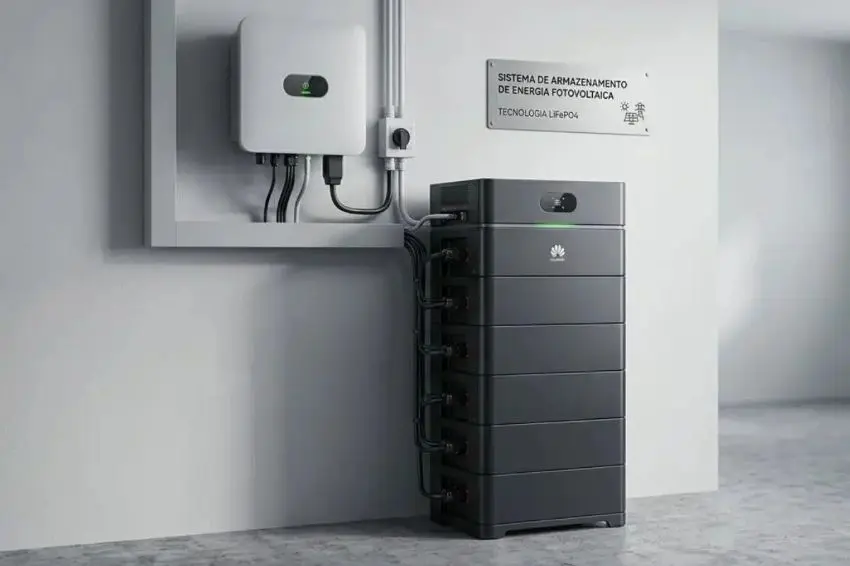
Battery energy storage systems (BESS) can help companies reduce electricity costs, control peak demand, and keep equipment running during power outages.
These benefits, however, depend on the chosen application. Among the main strategies are load shifting, which allows shifting energy consumption to more advantageous times; peak shaving, aimed at reducing peak demand; and backup, which seeks to keep essential loads running during power grid failures.
For integrators and companies working with storage, understanding customer needs is fundamental to choosing the application, sizing the battery, and evaluating the economic viability of the project.
Energy arbitrage (load shifting)
Energy arbitrage, also known as load shifting, involves storing electricity during periods of lower cost in order to use it later, when grid energy is more expensive.
The battery can be charged from the grid during cheaper hours or by harnessing surplus solar generation. The stored energy is used at a later time, reducing the need to purchase electricity during periods of higher costs.
When does this application make sense?
This strategy could be interesting for consumers who face significant differences in energy prices throughout the day or who have surplus solar generation that could be better utilized.
A company that consumes electricity during peak tariff hours, for example, can use previously stored energy to reduce some of its purchases during those periods.
In installations with solar power generation, the battery can store the surplus produced during the day for use at night, when the panels stop generating energy.
What does the integrator need to investigate?
Before proposing a solution, it is important to analyze the customer's consumption curve, the contracted tariff, the times of greatest use, and the availability of surplus solar energy.
It is also necessary to calculate whether the potential savings offset the investment, considering losses during charging and discharging, system efficiency, and battery degradation over time.
Arbitration is not automatically advantageous for every consumer. Its viability depends on the tariff conditions and consumption profile of each installation.
Peak shaving
Peak shaving, or peak reduction, uses the battery to reduce the power drawn from the grid during peak consumption periods.
This strategy can benefit companies that operate multiple pieces of equipment simultaneously and experience peak demand that can increase electricity costs.
When does this application make sense?
Industries, supermarkets, shopping centers, and other facilities with high loads may experience peak demand periods. Depending on the contract and tariff structure, these peaks may increase contracted demand costs or result in overage charges.
With a storage system, the battery provides some of the power needed during these times, reducing the demand placed on the grid.
A factory that has high demands during sporadic periods, for example, can use the battery to supplement the supply during periods of higher electrical demand.
What does the integrator need to investigate?
The first step is to identify when peak demand occurs, how long it lasts, and what power reduction would be necessary. It is also important to check the contracted demand, the amounts charged by the distributor, and any penalties for exceeding the contracted demand.
This data helps determine the system power and storage capacity required to meet the installation's needs.
A battery capable of delivering a lot of power for a short period can handle quick peak loads. However, prolonged situations may require greater storage capacity.
The design should consider the frequency of peak loads, their duration, and the savings that can be achieved by reducing demand.
Backup
Unlike applications primarily focused on cost reduction, backup aims to keep essential equipment and operations running during power outages.
The battery provides power to priority circuits, helping to reduce the impact of a power outage on business operations.
When does this application make sense?
Backups can be crucial for businesses where an outage represents lost production, disposal of goods, service disruptions, or security risks.
In a supermarket, for example, the system can power selected loads, such as refrigeration equipment, emergency lighting, checkout counters, and computers.
In a clinic, it can help keep certain equipment and support systems operational, provided the design meets applicable technical and safety requirements.
The solution can also be considered in industrial facilities, offices, and operations that rely on electronic equipment or continuous processes.
What does the integrator need to investigate?
The analysis should begin with the impacts of a power outage. Which equipment cannot be stopped? For how long do they need to remain powered on? What power is required to keep them running?
It is also important to check the frequency and duration of power outages, as well as the existence of generators or other contingency sources.
Not all grid-connected battery systems offer automatic backup. To function during an outage, the installation needs to have equipment and controls compatible for this purpose, including mechanisms for safe isolation from the grid, when necessary.
The sizing must consider both the power of the critical loads and the desired autonomy.
How to identify the most suitable application?
Although all three strategies may utilize similar storage systems, each addresses a specific consumer need.
- Energy arbitrage (load shift): This is especially recommended for consumers with a significant difference between energy tariffs during peak and off-peak hours. The greater this difference, the greater the potential for savings by storing energy during cheaper periods and using it during more expensive times.
- Peak shaving: Recommended for consumers who need to reduce peak electricity demand. In addition to avoiding charges for exceeding contracted demand, this strategy can allow for a reduction in the amount contracted with the distributor, decreasing a fixed monthly cost, provided that the system's operation allows for this reduction safely.
- Backups: Recommended when power outages could compromise equipment, production processes, or the continuity of operations.
The functions can also be combined in the same system, provided that the design takes into account the available battery capacity, the power of the equipment, and the operating priorities.
A battery used to mitigate peak loads, for example, needs to maintain enough energy to meet priority loads if it is also intended for backup.
Similarly, using the system for arbitrage purposes can limit the energy available for other functions at certain times. Therefore, the commercial proposal should start from the problem the client wants to solve, and not just from offering a piece of equipment.
Canal Solar conducts workshop on battery-powered systems.
For professionals who wish to deepen their knowledge of energy storage applications, the Canal Solar will hold an online and live workshop on October 31st at 9 am.Hybrid Systems with Batteries.
The training will be given by Geraldo Silveira, Engineering Manager at CS Consultoria and postgraduate professor at PUC Minas, and will cover the sizing, installation, configuration, and monitoring of residential hybrid systems.
The program also includes backup applications, energy export control, and homologation requirements with distributors. During the class, participants will be able to clarify doubts and discuss practical situations directly with the instructor.
Check out the schedule and find out how to participate in the workshop..
all the content of Canal Solar is protected by copyright law, and partial or total reproduction of this site in any medium is expressly prohibited. If you are interested in collaborating or reusing part of our material, please contact us by email: redacao@canalsolar.com.br.



Comments
Comments are moderated before publication.Comments should be respectful and contribute to a healthy debate. Offensive comments may be removed. The opinions expressed here are those of the authors and do not necessarily reflect the views of the author. Canal Solar.