
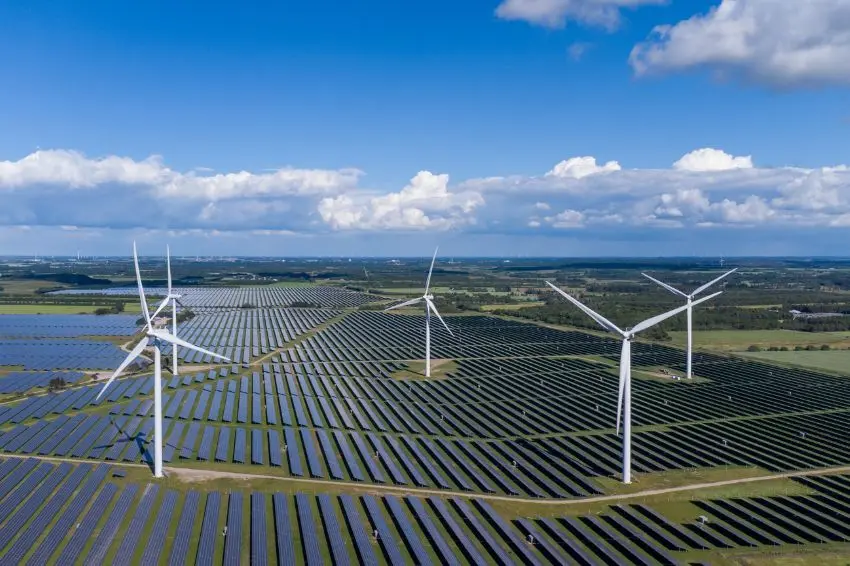
By 2025, clean energy alone will supply all of the global growth in electricity demand, and renewables will surpass coal for the first time in 100 years.
While China and India have reduced fossil fuel production and Chile, Australia, and California have integrated batteries on a large scale, Brazil, a historical leader in clean energy, has expanded gas-fired power plants to compensate for declining hydropower. The window for energy storage is open. For how long?
The closing of a 100-year cycle.
The most important takeaway from Ember's Global Electricity Review 2026 isn't the record numbers, it's what they entail. By 2025, low-carbon sources will have grown fast enough to absorb, on their own, all 849 TWh of the increase in global electricity demand.
It was the first year outside of recession, pandemic, or exceptional weather conditions in which this occurred — and the IMF estimates global economic growth of 3,2%, in line with the average of the previous decade. It's not a slowdown. It's structural decoupling.
Along with this, two milestones. Renewables (33,8%) surpassed coal (33,0%) in global generation for the first time in 100 years of the modern era of the electricity sector. And coal's share fell below one-third for the first time in history.
The IEA (STEPS) and BNEF (ETS) scenarios project a plateau in fossil fuels until the early 2030s, followed by a 10% to 20% decline by 2035. Even in an aggressive scenario with demand growing at 4% per year, driven by electrification, data centers, and cooling, with clean energy maintaining its recent pace of 7,6% per year, fossil fuel generation would grow only marginally until the turn of the decade.
In other words, the maturation curve for the "fossil fuel-based electricity generation" product has crossed its plateau. We are not yet seeing an absolute decline. We are already at the ceiling.
The turnaround happens where it's least expected.
For two decades, the prevailing expectation was that the energy transition would be led by Europe and the United States, with developing Asia pulling the global average down. 2025 reversed that premise.
China reduced its fossil fuel generation by 56 TWh (-0,9%), the first drop since 2015, even with demand growing by 5%. The big achievement: solar power grew by 336 TWh in a single year (+40% over 2024) and alone met two-thirds of the increase in Chinese demand.
By 2025, China will have installed 378 GW(DC) of solar, more than the entire combined solar capacity of the United States, and will account for 58% of global solar additions.
India has reduced fossil fuels by 52 TWh (-3,3%). More relevant than the aggregate number is the structural point that Ember dedicates an entire section to defending: India will not repeat China's carbon-intensive model.
When China surpassed India's current GDP per capita level of US$10 in 2010, solar energy cost ten times more than it does today. India is reaching this level with solar + battery power already cheaper than new coal in 24/7 auctions. The consequence: Ember projects that India will reach peak coal consumption at less than a third of the Chinese peak recorded in 2024.
This is the point that deserves emphasis. The historical argument for coal as the "cheapest base-load energy" has ceased to be purely technical. It has become political inertia.
Batteries: the technology that unlocks the second phase.
Here is the most relevant point of the report, and what justifies calling 2025 a turning point, not just another year of solar growth. The price of battery packs for stationary storage fell to US$70/kWh in 2025, a 45% drop in a single year, after already falling 40% in 2024. Global installed capacity grew by 46%, reaching approximately 250 GWh.
The game-changing number: dispatchable solar with battery power reached US$76/MWh in October 2025 — cheaper and faster to build than a new gas-fired power plant, especially in countries dependent on imported LNG. In India, solar + battery power supplying 24/7 with over 95% availability is already below the tariff of new coal-fired power plants. This is not a projection. It is a 2025 auction reality.
This requires some important calibration, because the popular narrative tends to confuse manufacturing with integration. China leads in battery manufacturing, with industrial capacity three times greater than global demand in 2024, but... deployment A network reorganization of electricity markets is happening elsewhere.
In Chile, installed battery capacity will double by 2025, reaching a volume sufficient to theoretically displace 76% of the new solar generation added that year.
In Australia, in the fourth quarter of 2025, batteries were price setter During 36% of peak nighttime hours (18 PM to 20 PM), double the equivalent quarter in 2024, average spot prices during the peak fell to around US$100/MWh, less than half the level of a year earlier.
In California, more battery than solar power has been added to the grid since 2021, and the increase in solar generation by 2025 is being delivered mostly at night.
China is building the factory. Chile, Australia, and California are building the operation. Globally, 14% of new solar generation in 2025 can already be replaced by batteries, up from 5% in 2022. The inflection point is that this is just the beginning: the addition of batteries is still lagging behind the pace of solar deployment.
What about Brazil?
Here, the report exposes an uncomfortable layer for those accustomed to treating Brazil as a virtuous exception. The facts of our 2025: solar generation surpassed fossil fuel generation for the first time in Brazil, jumping from 17 TWh in 2021 to 89 TWh in 2025, a fivefold increase in four years.
The country had the fourth-highest growth in solar and wind power worldwide. And 87% of the national mix is renewable, the undisputed leader in the G20, twenty percentage points ahead of second-placed Canada.
Now, what comes next. Hydropower generation fell for the third consecutive year (-25 TWh in 2025, -6%), pressured by recurring droughts and a new power plant predominantly lacking reservoirs to absorb variations.
The answer was gas-fired power plants: fossil fuel generation increased by 7,6% in 2025, driven by a 12% increase in gas. We are going against the trend in China and India. And we did this in the year that dispatchable solar with batteries became cheaper than new gas-fired power plants. There was no structural investment in energy storage.
The strategic risk is clear. Brazil's competitive advantage, stemming from a historically clean energy matrix, is being simultaneously eroded by the climate degradation of the hydroelectric pillar and poorly utilized because the institutional response is gas-fired thermal power, not storage.
Each new gas-fired power plant contracted today carries a 25- to 30-year contract. We are tying up long-term fossil fuel capacity at the very moment when the world is demonstrating that there is a cheaper and faster structural alternative.
The question for our sector planning is not whether we will buy Chinese batteries – everyone else will. It is whether we will integrate them into the grid at scale now, while we are the cleanest energy matrix in the G20, or whether we will only discover storage after consolidating two decades of gas-fired power plants operating at base load.
The first option keeps Brazil as a showcase for a transition that combines hydro, wind, solar, and storage. The second transforms a historical advantage into an archaeological curiosity.
The global inflection point of 2025 is not just good news for the climate. It's a silent deadline for countries that have always seen themselves in "another category." Chile, with a much more fossil fuel mix than ours, has decided what to do with its energy storage. The remaining question is whether Brazil will decide before the window closes.
Pig iron
Ember (2026). Global Electricity Review 2026: Solar surge halts fossil generation rise as clean power meets all demand growth and renewables overtake coal. Chapters 1, 2 and 4.7. Available at ember-energy.org.
The opinions and information expressed are the sole responsibility of the author and do not necessarily represent the official position of the author. Canal Solar.


Comments
Comments are moderated before publication.Comments should be respectful and contribute to a healthy debate. Offensive comments may be removed. The opinions expressed here are those of the authors and do not necessarily reflect the views of the author. Canal Solar.