
O blackout that affected 25 states and the Federal District caused power outages that caused inconvenience to Brazilians in public transport, leisure and the functioning of public bodies in several cities.
Others residents, businesses and institutions (public and private) were left without access to electricity due to a failure in the SIN operation network (National Interconnected System), as reported by the ONS (National Electric System Operator).
According to a hearing professionals by the Canal Solar, although what happened is something atypical these days, there are already solutions to prevent blackouts (even more serious than this) occur.
A Lithium battery, for example, which was recently approved by the INMETRO (National Institute of Metrology, Quality and Technology), is one of the alternatives that is already available and is safer than the current system in relation to this type of problem, as explained Lucas FreitasCEO of Genyx.
“One of the great differences in using lithium batteries is that they have greater storage capacity, as well as a longer useful life and much better warranties than lead batteries. The applications of hybrid systems, when the system has the ability to inject energy into the grid and also store it in batteries with the same equipment, allow homes and businesses to be immune to power outages like the one we saw today in the blackout, as they guarantee the availability of energy through batteries and solar energy panels”, he said.
For this reason, the executive highlights that companies and homes that have some type of critical equipment, such as refrigerators for cooling food, medicines or even business machinery such as servers or production lines, when they have this type of technology, are able to maintain their operations and have security in energy supply.
Read also
-
What is a hybrid solar inverter?;
-
Batteries for photovoltaic systems are already worth the investment;
-
Webinar: Solar energy systems with batteries (storage and backup).
Geraldo Silveira, engineer at Canal Solar also highlights the use of hybrid solar systems as a solution, especially for smaller consumers, who can keep the lights in a house on even in cases of power outages across the entire electrical grid.
“At the household level, a consumer who lives in a region affected by the blackout, if they have installed a hybrid solar system with batteries, will not be without electricity. This happens because the consumer would be able to prioritize emergency loads when configuring their system,” he said.
“This consumer could, for example, continue working on his computer as long as his socket is connected to the priority circuit, which is powered by the hybrid inverter, which will extract the energy necessary to power his priority loads from the storage system (battery).” , added the professional.
Hybrid inverters
O Canal Solar also spoke, this Tuesday (15), with Matheus Medeiros, electrical engineer and product specialist at Sunrow, to answer some questions about hybrid inverters. Check out the questions asked by the report and the answers given by the professional below:
What is the storage capacity of the inverters in case of blackouts?
Photovoltaic inverters do not have storage capacity, but they have features that help to stabilize the system in case of occurrences. To have storage capacity, battery storage systems would be necessary, which can be a strong ally of photovoltaic energy.
Is there interference in the photovoltaic system during these events?
Photovoltaic inverters remain connected to the grid during periods of time defined by the ONS (National System Operator) and have grid support functions in order to contribute to system stability. In this way, photovoltaic inverters act actively to avoid a cascade effect that would disconnect several plants.
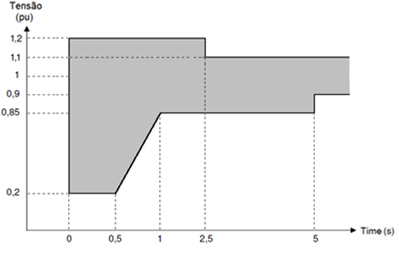
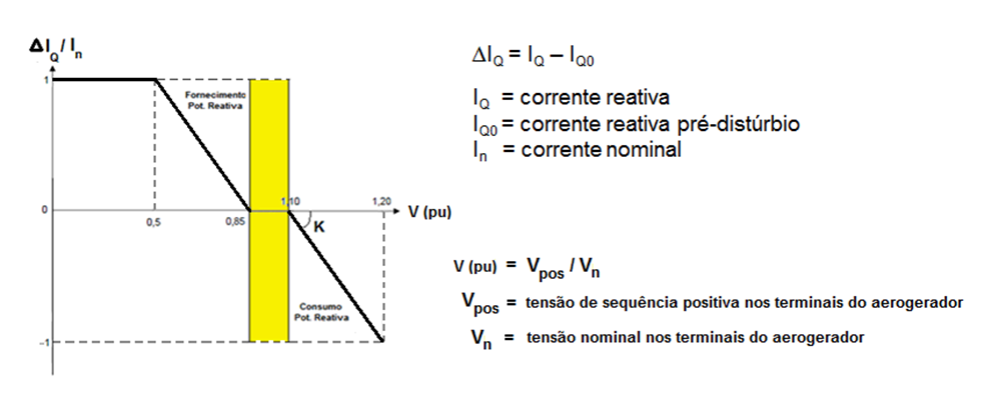
According to Submodule 2.10 of the ONS Network Procedures, there are certain parameters that the inverter must support, such as in undervoltage or overvoltage events or in the case of faulty reactive power injection (as illustrated in the images below).
Is there any preventative care for the equipment that can be taken when these situations occur?
Once the times determined by the ONS are exceeded, the inverters automatically protect themselves and disconnect from the system through protection called anti-islanding, thus ensuring that no current is injected into the electrical grid.
How does the photovoltaic plant behave when the system is restarted?
Once the system regains its stability, the photovoltaic plant will inject current into the electrical grid again, respecting a load ramp that guarantees the harmonious operation of the system.



Comments (7)
Comments are moderated before publication.Comments should be respectful and contribute to a healthy debate. Offensive comments may be removed. The opinions expressed here are those of the authors and do not necessarily reflect the views of the author. Canal Solar.
Goodnight. I find it interesting to share my experience. I have a hybrid system, consisting of 42 550W panels divided into 6 strings of 7 panels each. Each pair of strings (14 panels) feeds an 8kW hybrid inverter (12kW peak), there are three inverters in total (each one feeding a phase of my system). The entire system is connected to six 5kW Lithium batteries (30Kw total capacity) for back-up. Here in SP, the place where I live was without power for more than 50 hours last week, we were entering the third night when the power came back on and we were the only one (out of hundreds) with normal power, carrying out daily activities normally. For everyone who can invest in a hybrid system, whatever the capacity, I recommend it (highly).
But if we have anti-islanding and the inverter disconnects, how will the hybrid system work?
This was not very clear in the article.
The hybrid inverter, unlike the on-grid inverter, has a different grid connection structure, with one input exclusively for the grid and another for the load. In the case of anti-islanding, the grid connection is lost, but the load connection is powered by the photovoltaic system or by the energy stored by the battery bank (in this case at night). However, this type of inverter, although it has passed INMETRO tests, is not yet approved for use in homes, and is currently used (23/08/2023) in off-grid systems (disconnected from the grid).
Very good article, I am also engaged in work related to photovoltaic inverters, can the author contact me to write some articles about Solis inverters?
All that is missing is for this type of inverter to be approved in Brazil. I have been hearing for over 2 years that these inverters will be approved and still nothing. Unfortunately, I also understand the safety issue for distributor employees in the case of grid operation (anti-islanding). The ideal would be to immediately regularize grid-zero and for the distributors to thoroughly check each installation in which this type of inverter is chosen, as it can work independently of the grid, since the load is not in parallel with the inverter in relation to the grid, but at its output, separating the load from the grid, thus ensuring supply to the battery from the load and not injecting current into the grid. But this requires intense monitoring.
I have an invention for a power generator and the purpose is to act on this bottleneck precisely at night. My intention is to finish assembling the prototype by the end of this year or early next year. I would like to count on your support. I must say that I cannot reveal what makes the rotor move until I obtain the international patent. This project involves me and my son, who will manage the international patent, perhaps for royalties.
The theoretical project is ready.
Good night
Can systems using hybrid inverters already be approved? Are there any standards for ANEEL that authorize the use of these inverters?