
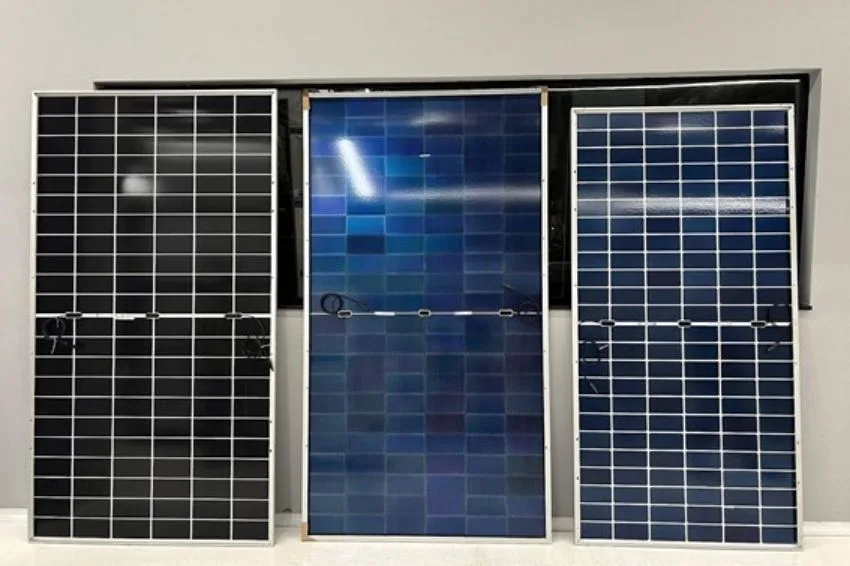
O Canal Solar received complaints that photovoltaic modules were being sold in Brazil as if they were HJT (heterojunction), although, in practice, they were not using this technology.
The information was passed on by sources linked to the equipment import chain who reported the entry into the country of modules classified as HJT, but which, technically, would present characteristics of other technologies, such as TOPCon.
According to reports, the objective would be to benefit from the tax exemption provided for by the ex-tariff regime, which reduces import tax by 25% for photovoltaic modules without equivalent production in Brazil.
How to differentiate TOPCon from HJT?
O Canal Solar heard from industry experts to clarify the technical differences between the technologies and understand the challenges in identifying these differences.
João Lucas de Souza Silva, PhD in Electrical Engineering from Unicamp (State University of Campinas), confirmed that researchers at the institution have also been receiving similar reports.
However, he warns that accurately identifying whether a module is HJT requires laboratory analysis. “Visual aspects, such as the shape or cut of the cells, are not decisive, as they can vary depending on the production line,” he explained.
To deepen the analysis, the Canal Solar also heard from Vanderleia Ferraz, product manager at Risen Energy for Latin America, a leading company in the manufacture of HJT cells and modules. The specialist highlighted that HJT technology differs from others, such as TOPCon, in several technical aspects — from cell topology to the manufacturing process.
These characteristics require a dedicated production line, and it is not possible to reuse manufacturing structures used for PERC or TOPCon. According to her, authentic HJT modules usually present:
- Open Circuit Voltage (Voc): around 50V (49,83–50,18V for 700–720 Wp modules);
- Linear degradation: 0,30% per year, maintaining 90,3% of power after 30 years;
- Pmax temperature coefficient: -0,24%/ºC;
- Bifaciality: 90% ± 5%.
Vanderleia further explained that HJT cells have a specific structure, with layers of hydrogenated amorphous silicon and an ITO (indium tin oxide) coating deposited on both sides of the cell, which makes it symmetrical.
According to Vanderleia, the HJT manufacturing process also requires specific care. “These cells are sensitive to high temperatures and do not tolerate conventional laser cutting and welding methods. Specific interconnection and assembly techniques are required,” he warned.
As a result of the differences in the manufacturing process of HJT cells and modules, it is possible to notice visual differences between HJT and TOPCon modules, especially in the shape of the cell corners and the coloring of the back of the modules.
“HJT cells have four chamfered corners to avoid exposing these cells to the high temperature of traditional cutting. Half-cell cutting is performed directly on the ingot, which receives the chamfers at the corners. In this way, the cells are formed on half-cell wafers with four chamfered corners. TOPCon cells have straight corners, as they are cut after the cells are manufactured,” explained Vanderleia.
The expert adds that, “regarding the visual aspect of the back of the module, there is a big difference between HJT and TOPCon modules. For true HJT modules, the back face has a dark and uniform color like the front face.”
According to Vanderleia, the dark and uniform color on both sides of the HJT cells is due to the symmetrical and uniform deposition of the ITO film, resulting in a uniform appearance on both the front and back sides.
“For TOPCon cells, the coating film deposition process occurs with the cells in a vertical position, causing irregularity in the color of the back of the cells. Therefore, the color of the back of the TOPCon module is different from the front and is not uniform, which is the main visual indication that the module is a fake HJT,” he added.
Vanderleia's explanations corroborate statements made by a source in the photovoltaic industry who preferred to remain anonymous. “The manufacture of HJT modules requires specific inputs and processes, different from those used in other technologies. stringers, the metal paste, the welding temperature and the encapsulation need to be adapted exclusively for HJT. It is not possible to use the same line that manufactures PERC or TOPCon”, he said.
“The visual difference is due to the presence of a continuous layer of ITO on the back of the HJT cells, which provides a dark and homogeneous color, while in TOPCon the spot metallization and the rear reflector provide a bluish color and visible mosaic,” the source added to the report. Canal Solar.
In addition to manufacturing process factors, the source also commented that there is currently not enough HJT cells available to meet Brazilian demand.
“There is not a large volume of HJT cells available on the market. This is because there are few manufacturers of HJT cells in the world. Among them are Risen and Huasun, which do not have the volume to meet the demand of the Brazilian market,” he highlighted.
“Global demand for HJT modules is still limited, with Brazil being one of the few markets with a significant volume of imports, driven mainly by the tax exemption provided for in the regime of ex-tariffs”, added the source heard by the report of Canal Solar.
all the content of Canal Solar is protected by copyright law, and partial or total reproduction of this site in any medium is expressly prohibited. If you are interested in collaborating or reusing part of our material, please contact us by email: redacao@canalsolar.com.br.





Comments (3)
Comments are moderated before publication.Comments should be respectful and contribute to a healthy debate. Offensive comments may be removed. The opinions expressed here are those of the authors and do not necessarily reflect the views of the author. Canal Solar.
Useful content.
from India
How can Brazil today, among the 10 largest PV generators in the world, be pulling the wagon for HTJ cells, and have difficulties in supplying transparent glass-glass bifacial modules?? There is simply no way to understand and accept a joke like this!!
This is a SERIOUS CRIME!!!!!! There are always smart people wanting to take advantage and commit illegal acts. Unfortunately, like everything in Brazil, it will come to nothing. No one will monitor it, no one will be punished except the end consumer, who buys one product and receives another.