

Electricity distributors are advocating for changes in how distributed solar generation (DG) is priced. Their argument is that the benefits granted to this modality generate additional costs for consumers who do not own their own generation systems and must bear part of these expenses.
To support the proposal, Abradee (Brazilian Association of Electric Energy Distributors) released, this Tuesday (10), a study commissioned from the consulting firms PSR and Daimon. The survey indicates that the tariff benefits associated with DG could represent an additional cost of R$ 20 billion for other consumers in 2026.
The association argues that the expansion of distributed solar generation (which went from less than 1 GW in 2018 to more than 55 GW currently) has brought financial and operational challenges to the electricity sector. "It's not about ending distributed generation, but about giving it a sustainable place in the system," Patricia Audi, president of Abradee, told Reuters.
Although the study also presents information on the contracting of thermoelectric power plants, it does not delve into the discussion of incentives granted to the fossil fuel supply chain, nor does it compare these values to the benefits attributed to distributed generation.
However, a survey released last week by Inesc (Institute of Socioeconomic Studies) expands this discussion by showing the volume of resources allocated to different energy sources and, especially, how these incentives are financed.
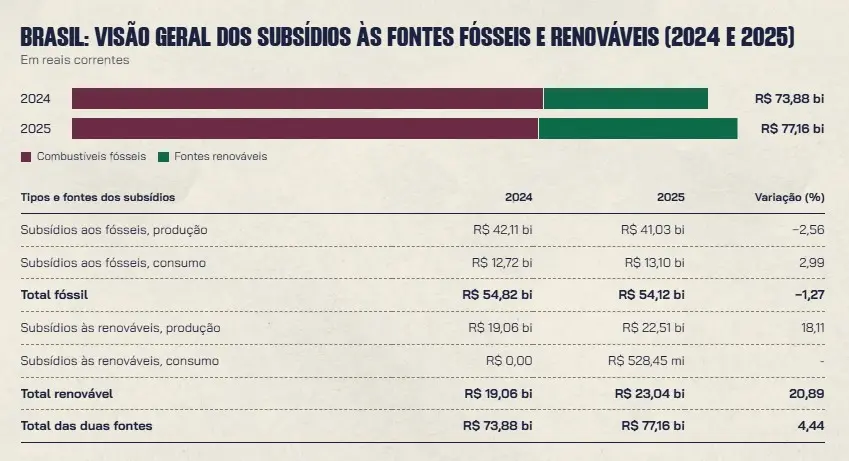
Fossil fuels received R$ 54 billion in subsidies.
The ninth edition of the Monitoring of Federal Subsidies to Energy Sources in Brazil by Inesc tracked 27 incentive mechanisms for the production and consumption of fossil fuels and renewable sources between 2024 and 2025.
Last year, the total volume of subsidies reached R$ 77,16 billion, a 4,44% increase compared to the R$ 73,88 billion recorded in 2024. Of this amount, R$ 54,12 billion (70,14%) was allocated to fossil fuels, while R$ 23,04 billion (29,86%) benefited renewables.
In an annual comparison, incentives for fossil fuels showed a reduction of 1,27%, going from R$ 54,82 billion in 2024 to R$ 54,12 billion in 2025. Subsidies for renewables, on the other hand, grew by 20,89%, rising from R$ 19,06 billion to R$ 23,04 billion.
In practice, for every R$1,00 allocated to renewable sources, approximately R$2,35 went to the fossil fuel supply chain. The survey also shows differences in the composition of the incentives.

- Source: Inesc
Electricity bills financed R$ 23,1 billion in subsidies for fossil fuels.
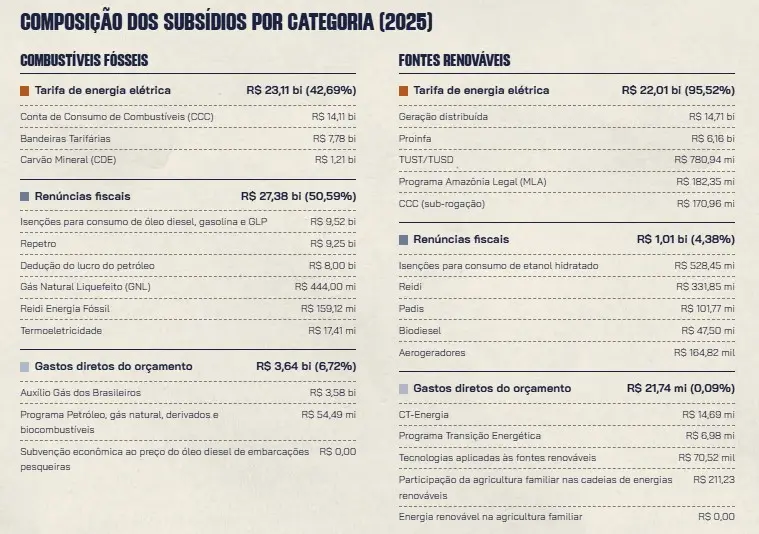
One of the most relevant points of the survey is the participation of electricity consumers in financing incentives for fossil fuels. In 2025, approximately R$ 23,11 billion of these subsidies were funded through electricity tariffs, equivalent to 42,69% of the total allocated to fossil fuels.
The amount represents an increase of approximately 42,8% compared to 2024, when these mechanisms totaled R$ 16,18 billion. Among the main components is the CCC (Fuel Consumption Account), which received R$ 14,11 billion in 2025, compared to R$ 11,15 billion in the previous year, an increase of 26,62%.
The charge finances the costs of energy generation in isolated systems, including the operation of thermal power plants fueled by fuels such as diesel. These expenses are shared among consumers connected to the SIN (National Interconnected System).
For comparison, the CCC alone made consumers pay practically the same amount as distributed generation in the year, totaling R$ 14,71 billion. This amount represents approximately 63,9% (about R$ 23 billion) of all subsidies allocated to renewable energy sources in the country.

- Source: Inesc
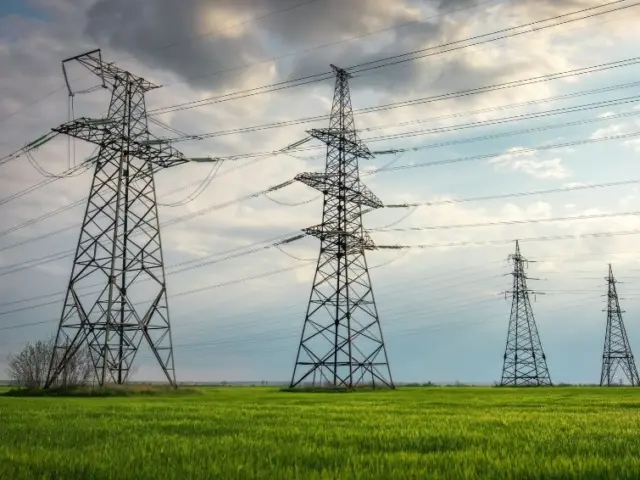
The debate over subsidies involves the entire electricity sector.
According to Inesc, the discussion about energy incentives needs to consider not only the amounts allocated to each source, but also who receives the resources, who finances the benefits, and how the costs are distributed among consumers.
The institute advocates for a review of subsidies, with special attention to incentives for fossil fuel production, reform of the CDE (Energy Development Account), and transparency regarding the resources granted.
The survey highlights that distributed generation represents a significant portion of subsidies for renewable energy sources and that its costs also need to be considered in tariff discussions.
However, it shows that incentives for the fossil fuel supply chain involve tens of billions of reais, and that a significant portion is also financed by consumers through their electricity bills.
Therefore, the discussion about tariff balance is not limited to reviewing the benefits granted to solar generation. It also involves evaluating the other subsidies that make up the cost structure of the electricity sector and their effects on consumers.
Check out the full Inesc study by clicking here. link.
all the content of Canal Solar is protected by copyright law, and partial or total reproduction of this site in any medium is expressly prohibited. If you are interested in collaborating or reusing part of our material, please contact us by email: redacao@canalsolar.com.br.


Comments
Comments are moderated before publication.Comments should be respectful and contribute to a healthy debate. Offensive comments may be removed. The opinions expressed here are those of the authors and do not necessarily reflect the views of the author. Canal Solar.