
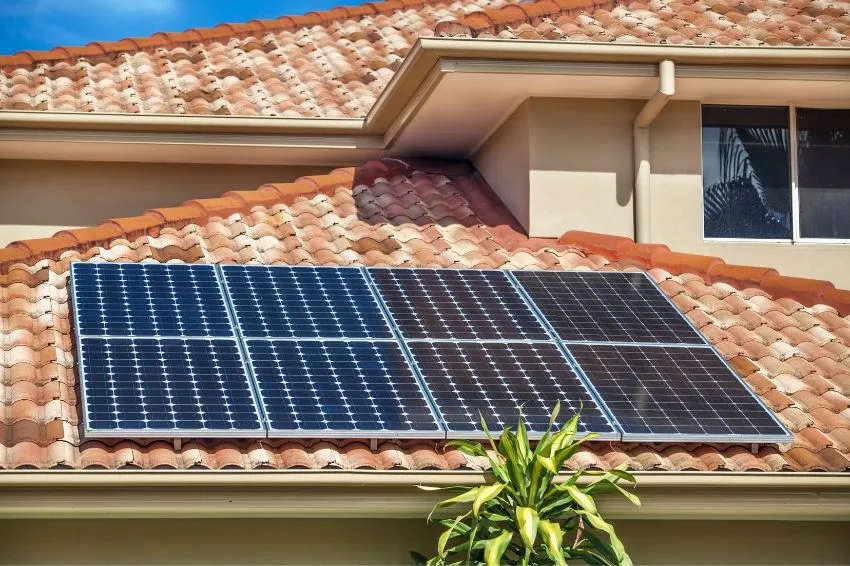
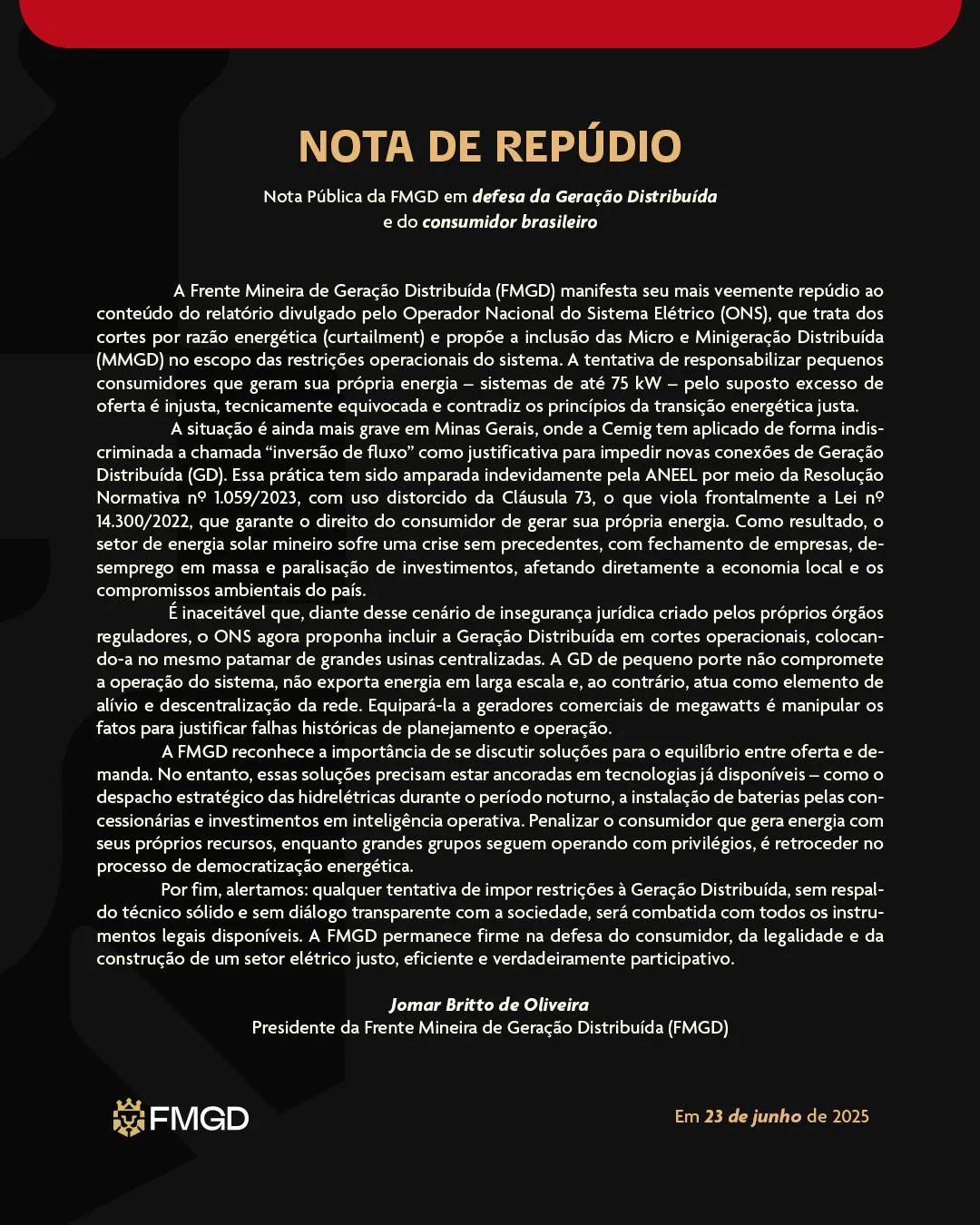
The FMGD (Frente Mineira de Geração Distribuída) released late on Monday night (23) a note of repudiation criticizing the content of the most recent technical report from the ONS (National Electric System Operator) – qwhich deals with the increase in power generation cuts in Brazil, a phenomenon known as curtailment.
According to FMGD, the document proposes the inclusion of MMGD (Micro and Mini Distributed Generation) systems within the scope of the system's operational restrictions in an attempt to hold small consumers who generate their own energy accountable.
The entity states that the claim about an alleged excess supply is “unfair, technically mistaken and contrary to the principles of fair energy transition”, highlights the FMGD note.
The document also drew attention to the specific situation in Minas Gerais – where, according to the association, Cemig would be indiscriminately applying the justification of “flow inversion” to block new GD (distributed generation) connections.
According to the Front, this practice has been inadequately supported by a distorted interpretation of Normative Resolution No. 1.059/2023 of the ANEEL, especially in the application of Article 73, which according to the entity, directly violates Law No. 14.300/2022, which guarantees the consumer the right to generate their own energy.
“The result is that the solar energy sector in Minas Gerais is experiencing pent-up growth, with companies closing, investments being suspended and a direct impact on the local economy and the country’s environmental commitments,” the statement said.
The FMGD also expressed concern about the legal uncertainty generated by the recent actions of regulatory bodies and criticized the possibility of the ONS including DG in the same operational cuts applied to centralized plants.
For the Front, small-scale DG does not compromise the operation of the system, as it does not export energy on a large scale. On the contrary, according to the note, it acts as an element of relief and decentralization of the network.
FMGD also highlighted that it argues that equating GD to commercial MW generators, as proposed, would be a way of “manipulating the facts” to justify historical failures in the planning and operation of the electrical system.
The entity also highlighted in its statement that it recognizes the importance of discussing solutions to balance supply and demand, but argued that such actions should be anchored in technologies already available, such as the use of batteries by dealerships to reinforce operations.
“Penalizing consumers who generate their own energy, while large groups continue to operate with privileges, is a step backwards in the process of energy democratization,” highlights the statement, signed by the president of FMGD, Jomar Britto de Oliveira.
The FMGD concludes by reinforcing that any attempt to impose restrictions on DG will be combated with “all available legal instruments”, always focusing on consumer protection, legality and the construction of a fairer and more participatory electrical system.
Check out the full FMGD note below:
ONS Document
O Valid identity document to which FMGD is opposed was published by ONS in May of this year. In its scope, it provides a detailed analysis of the growth of generation cuts due to energy reasons (curtailment) in Brazil, with projections for the coming years (mainly between 2026 and 2029).
The study is part of the actions of the GT (Working Group) of the CMSE (Electric Sector Monitoring Committee), of which the Operator is a member, with the aim of seeking solutions to mitigate the impacts caused by cuts in generation from renewable sources.
ONS says curtailment is likely to become even more prevalent in the coming years
What does the ONS say?
O Canal Solar contacted the ONS on Tuesday morning to request a position on the matter. The Operator informed that it will return the request today. The report is still awaiting the official position of the entity.
all the content of Canal Solar is protected by copyright law, and partial or total reproduction of this site in any medium is expressly prohibited. If you are interested in collaborating or reusing part of our material, please contact us by email: redacao@canalsolar.com.br.

Comments
Comments are moderated before publication.Comments should be respectful and contribute to a healthy debate. Offensive comments may be removed. The opinions expressed here are those of the authors and do not necessarily reflect the views of the author. Canal Solar.