
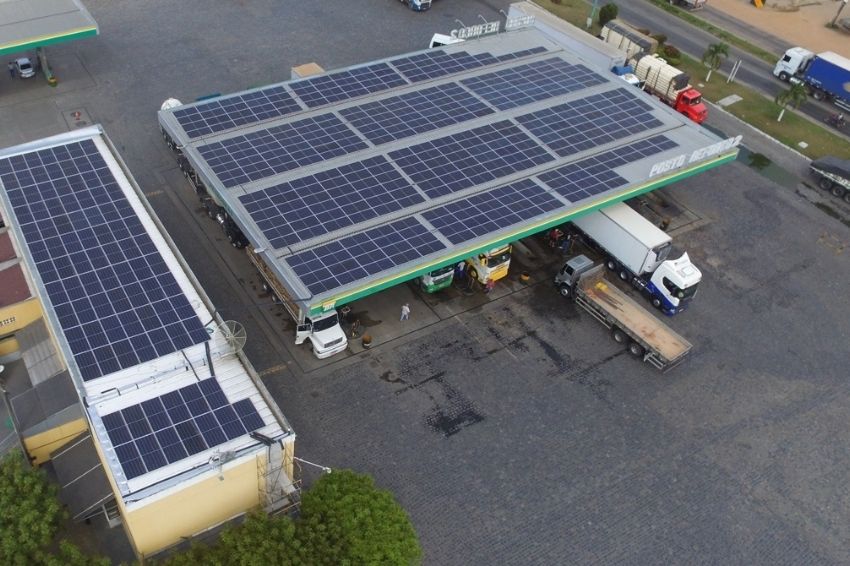
Reducing operating costs is a constant challenge for roadside service stations, which need to maintain their illuminated facade and facilities.
And with the constant rise in electricity rates in recent years, solar energy has become an alternative for these establishments to control their expenses and increase profitability.
This is the case of Autoposto Reinforço, a network with a 38-year tradition on northeastern roads, which invested in the photovoltaic energy system to promote savings and sustainability.
Read also
Rising electricity bills could take away 456 jobs by 2022; solar energy goes against the grain
With two stations in Bahia, one in Sergipe and one in Alagoas, the group receives an average of more than 1,3 travelers and around 1,2 trucks per day, which fuel their vehicles and use their facilities, such as a steakhouse, car wash -fast, bathroom, parking, among others.
All this movement generated a monthly expense for the company of R$ 145 thousand on the electricity bill, with the yellow flag tariff. “We decided to invest in solar energy to try to 'zero out' or reduce this bill as much as possible,” said Joemir Mocellin, administrative director of Reforço.
Developed by Enersol, in partnership with Fronius, the project represented an investment of more than R$5,35 million. To produce enough electricity capable of supplying 100% of the stations' consumption, 40 inverters between Fronius Eco and Eco Light and Fronius Symo were installed in the steakhouses and supply areas, connected to 3.844 photovoltaic panels.
According to the company, in one year, the solution already produces enough electricity to reduce energy costs across the entire network to less than R$30 per month, a reduction of more than 80%. The savings margin varies according to the station and region.
Reinforcement Group in Bahia and Alagoas
The best result was seen in Bahia and Alagoas, where there is an exemption from ICMS (Tax on Circulation of Goods and Services) on TUSD (tariff for using the distribution system). The payback was calculated in approximately 4 years.
Visited by around 700 to 900 people per day and stopping around 600 trucks, Posto Reinforço 1, in Poções (BA), which previously spent around R$ 27 thousand on the electricity bill, today does not need to pay more than R$300 per month for electricity, said Enersol.
For the approximately 200 people and 100 trucks served per day, Posto Reinforço 4 – Itatim (BA) spent up to R$ 24 thousand for the electricity consumed, and now also pays a minimum tariff (around R$ 100 reais, about).
In Reinforço de Rio Largo, in Alagoas, which receives around 120 people a day, the electricity bill fell from R$32 thousand reais per month to the range of R$7 to 8 thousand reais per month.
Even with ICMS charges on TUSD on compensated energy, the Umbaúba station, Sergipe, also had a significant reduction in electricity bills. With only part of the project completed, the bill was reduced from R$50 a month to around R$10 in one year.
What to consider before investing in solar energy?
Tassio Barboza, technical director of Enersol Brazil, highlights that, before deciding to implement a photovoltaic system, it is important to evaluate the establishment's consumption profile and analyze whether the monthly expense on the electricity bill is worth the investment.
He explains that the value of the investment in equipment is practically proportional to the necessary consumption. For example, to consume 12 thousand kWh per month (bill of approximately R$ 12,5 thousand), with generator, Fronius inverters and solar panels, it would be necessary to invest R$ 400 thousand, approximately R$ 4,2 per Wp .
Ariel Martins, technical specialist at Fronius, added that, in addition to the economy, the photovoltaic plant has a strong ecological appeal, which further reinforces the image of a sustainable service station concerned with the environment.





Comments (2)
Comments are moderated before publication.Comments should be respectful and contribute to a healthy debate. Offensive comments may be removed. The opinions expressed here are those of the authors and do not necessarily reflect the views of the author. Canal Solar.
….the Reinforcement Station 1, in Poções (BA), which previously spent around R$27 thousand on the electricity bill, today does not need to pay more than R$300 per month for electricity, said Enersol, I think you are commenting a mistake in stating this….because we have several things that affect the energy tariff, in this specific case certainly from R$27.000,00 to R$300,00 is not correct……
…..the Reinforcement Station 4 – Itatim (BA) paid up to R$ 24 thousand for the electricity consumed, and now also pays a minimum tariff (around R$ 100 reais, approximately). another error here, I would never go down to 100 reais….there are errors in the report,……
In Reinforço de Rio Largo, in Alagoas, (…..) the electricity bill fell from R$ 32 thousand reais per month to the range of R$ 7 to 8 thousand per month. Here I think the only place where the report told the truth, the others are all wrong…..
Hello Márcio, our journalist Mateus Badra checked the information with the management of Reinforcement 1 and 4, both in Bahia. And what they both said, that the discounted value below, respectively R$100 and R$300, were reached in the months with the highest solar incidence. And with the arrival of cloudy days and heavy rain in Bahia, solar energy generation is lower, therefore the credit (discount) has also been reduced. So the discounts on the electricity bill vary depending on the solar energy generated by the system that converts into credit.