

The annual tariff adjustment for Celesc (Santa Catarina Electric Power Plants), approved by the ANEEL (National Electric Energy Agency) at the beginning of the week.
For residential consumers, the increase will be 12,3% — a rate 2,3 times higher than the accumulated inflation over the last 12 months: 5,23%, according to the IPCA (Broad National Consumer Price Index).
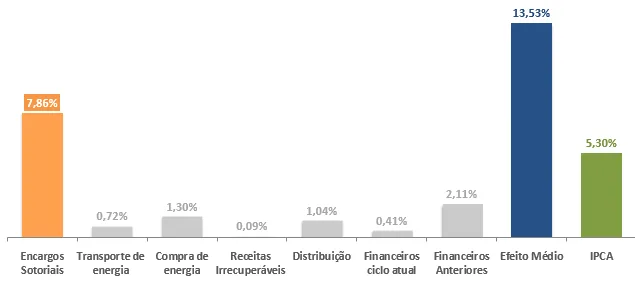
The average increase for low-voltage customers—such as small businesses and industries—will be 12,41%, while for high-voltage consumers (large industries) the increase will reach 15,8%. Overall, the average increase for all consumers will be 13,53%.
According to Celesc, the main factor behind the increase was the increase in sector charges, which are not borne by the distributor and must be passed on in full to the consumer. Even so, the company states that residential rates in the state remain below the national average and that, without the charges, the increase would be only 5,67%.
“It is worth remembering that, in 2023, industrial consumers had an average reduction of 0,81% in the tariff, while residential consumers received an adjustment of 3,64%, below the inflation of the period, which was 3,99%”, informed the company, in a statement.
Electricity increasingly expensive
The increase in Santa Catarina reinforces a trend of rising energy prices in Brazil. Only in 2025, residential tariff has already accumulated an increase of 10,18% between January and July, more than three times the inflation of the period (3,26%), according to the IBGE (Brazilian Institute of Geography and Statistics).
In July, energy was one of the main items that put pressure on the price index, according to FGV (Getulio Vargas Foundation). Last week, the ANEEL warned that electricity bills are expected to rise above inflation this year — a trend that repeats the trend of recent years.
A survey by Abraceel (Association of Electric Energy Traders) shows, for example, that, between 2010 and 2024, tariff in the regulated market increased by 177%, against 122% inflation in the same period.
This means that electricity bills rose 45% above the official inflation rate. Taking an even broader view, since 2003, residential rates have increased by 269%, while the IPCA (Consumer Consumer Price Index) has increased by 218%.
all the content of Canal Solar is protected by copyright law, and partial or total reproduction of this site in any medium is expressly prohibited. If you are interested in collaborating or reusing part of our material, please contact us by email: redacao@canalsolar.com.br.