
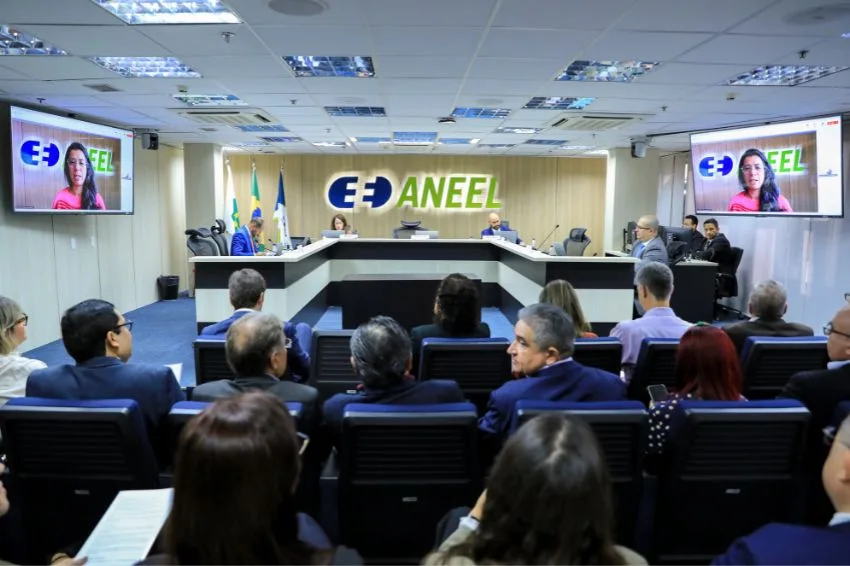
The agenda for the weekly public meeting of the board of directors ANEEL (National Electric Energy Agency) this Tuesday (29) foresees the analysis of the impacts of the negotiation of water risk debts, known by the acronym GSF, on discounts on wire tariffs (TUST/TUSD).
Another key point to be discussed by the regulatory body is a question among agents related to the extension period of the concessions of the projects that will benefit from the results of the competitive mechanism, if they are victorious.
The conclusions of the ANEEL will be decisive for the auction that aims to resolve a liability of R$ 1,13 billion in the MCP (Short Term Market) – as provided for in MP (Provisional Measure) 1300/2025 – and which will be operationalized by CCEE (Electric Energy Commercialization Chamber) on August 1st.
Discounts in check
The agency received requests for clarification from generators whose doubts are considered critical to the decision of their associates to participate or not in the mechanism as buyers of the securities representing the debts accumulated over more than a decade, the vast majority by controllers of PCHs (Small Hydroelectric Power Plants) and CGHs (Hydroelectric Generating Plants).
One of the main points of uncertainty is whether the extension of the grant, which is a benefit of the contest, guarantees the continuity of discounts on the TUSD or TUSD for hydroelectric plants that already benefit from these two types of subsidies.
There is a fear of losing these benefits with the extension, as Law 9.427/1997 establishes that the discount will end with the expiration of the concession. This clarification is considered crucial for interested parties to participate in the auction, given that the discount impacts both the generator and the end consumer.
Freedom of commercialization
Another question is whether the seven-year limit established in MP 1300/2025 is specific to this CCEE competitive process and can be added to concession extension periods already obtained in previous hydrological risk negotiations.
This definition is also important, as the possibility of cumulation directly affects the attractiveness of the event and may even enable the participation of these plants in future capacity reserve auctions.
Clarifications are also requested regarding the generator's right to freely dispose of the energy during the additional period of the concession resulting from the competitive procedure.
This right is already guaranteed for all hydroelectric plants participating in the MRE (Energy Reallocation Mechanism), including those operating under a quota system. The ability to trade energy on the Free Energy Market or participate in future auctions makes all the difference in entrepreneurs' decisions.
all the content of Canal Solar is protected by copyright law, and partial or total reproduction of this site in any medium is expressly prohibited. If you are interested in collaborating or reusing part of our material, please contact us by email: redacao@canalsolar.com.br.


Comments
Comments are moderated before publication.Comments should be respectful and contribute to a healthy debate. Offensive comments may be removed. The opinions expressed here are those of the authors and do not necessarily reflect the views of the author. Canal Solar.