
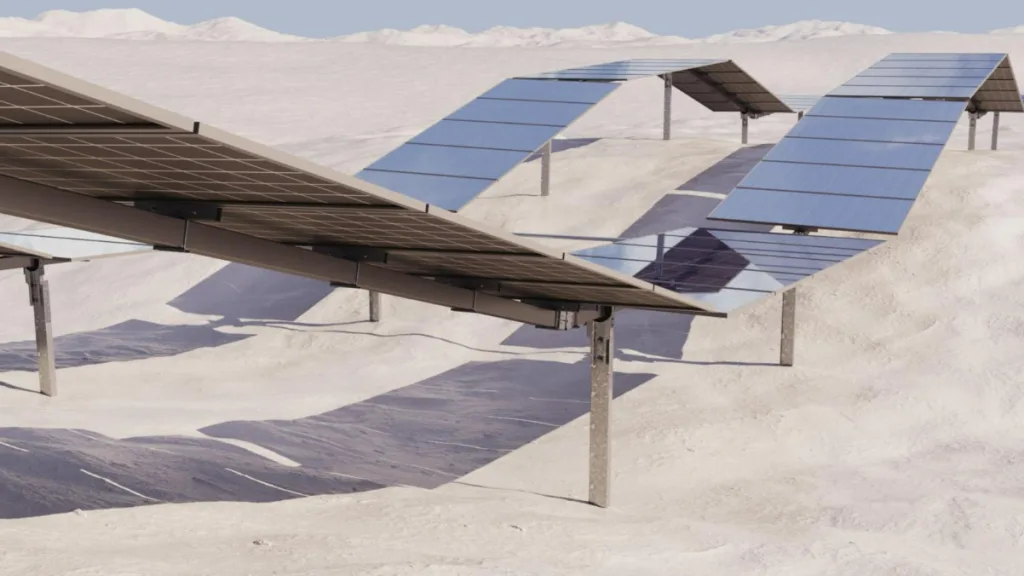
The Brazilian solar energy market is about to receive an innovation capable of transforming the way photovoltaic solar plants are installed on uneven terrain, which is prevalent in several regions of the country.
Spanish company Axial will present SlopeSync at Intersolar South America 2025 in São Paulo (SP) – a new solar tracker model developed especially to adapt to areas with large variations in relief.
According to the company, the technology eliminates the need for millimetric alignment of pillars and allows deviations of up to 30º between rows and 15% in height variation – which reduces the dependence on complex civil works, in addition to minimizing environmental impacts.
O Tracker It was developed with a cardan shaft installed at specific points along the rows. This allows for a tolerance of up to 400 mm and inclination variations of up to 15% in the North-South and East-West directions.
According to Axial, the system ensures greater structural flexibility, following the natural curves of the terrain and maintaining the performance of the solar modules.
Cost reduction and sustainability
In a statement, Axial highlights that studies carried out by the company indicate that the use of trackers can reduce earthmoving costs in the implementation of plants by up to 80%.
"This data reinforces not only the solution's economic efficiency but also its positive environmental impact by minimizing the need for civil engineering interventions on the site. Reducing this type of construction means preserving the natural landscape and contributing to the sustainability of solar projects," said Ronald Carias Esteban, general director of Axial in Brazil.
In addition to the financial and environmental savings, the new model allows for faster plant construction times, as it requires fewer ground interventions and adjustments to the original design, optimizing the CAPEX of photovoltaic plants.
Responses to a changing market
The development of the new tracker took into account the growing scarcity of flat land and the advancement of solar projects into more challenging areas, according to Esteban.
“As flat land becomes increasingly scarce around the world, especially in regions with great solar potential, it has become essential to create a solution that better adapts to areas with steep slopes,” he notes.
The director also pointed out that the main challenges faced by trackers in rough terrain involve:
- Reduce environmental impact by avoiding aggressive soil movements;-
- Optimize implementation costs;
- Speed up construction deadlines;-
- Maintain energy generation efficiency, even with large topographical variations.
all the content of Canal Solar is protected by copyright law, and partial or total reproduction of this site in any medium is expressly prohibited. If you are interested in collaborating or reusing part of our material, please contact us by email: redacao@canalsolar.com.br.



Comments
Comments are moderated before publication.Comments should be respectful and contribute to a healthy debate. Offensive comments may be removed. The opinions expressed here are those of the authors and do not necessarily reflect the views of the author. Canal Solar.