
The MME (Ministry of Mines and Energy) recently released the Brazilian Electricity Sector Monitoring Bulletin, consolidating the sector's main data throughout 2024. Below, we present a summary with the most relevant highlights of this survey.
Expansion of installed capacity
In 2024, Brazil added 10,8 GW to its installed power generation capacity, an increase of 5% compared to 2023. Of this total, 84% was allocated to the ACL (Free Contracting Environment) and 16% to the ACR (Regulated Contracting Environment) and isolated systems.
The distribution by source was as follows:
- 5.590 MW from solar generation (not considering Micro and Mini Distributed Generation – MMGD);
- 4.240 MW from wind power;
- 907 MW of thermoelectric plants;
- 56 MW of hydroelectric plants.
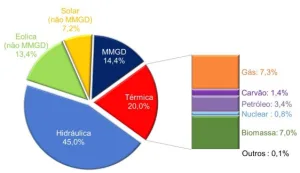
As a result, the SEB (Brazilian Electric System) ended the year with a total installed capacity of 243,9 GW, which represents an 8% growth compared to the previous year.
Distribution chart of installed capacity by source at the end of 2024
Verified generation
Verified generation – the sum of the energy effectively produced by all connected plants – totaled 687.692 GWh, which represents an increase of 5,1% compared to 2023.
Participation by source was as follows:
- 60,9 % of hydraulic origin;
- 15,3 % of wind origin;
- 12,9 % of thermal origin;
- 4,2 % of solar origin (not including MMGD);
- 6,7 % from MMGD*.
* MMGD data are estimates from the National Electric System Operator (ONS).
Transmission expansion
The national transmission network reached 189.308 km in 2024, a growth of 2,2% compared to 2023.
Distribution of lines by voltage level:
- 39,1 % at 500/525 kV
- 38,0 % at 230 kV
- 6,8 % at 600 kV
- 6,1 % at 345 kV
- 4,9 % at 800 kV
- 3,7 % at 440 kV
- 1,4 % at 750 kV
The system's transformation capacity reached 472.983 MVA, an increase of 4,4% compared to 2023.
International exchanges
Brazil maintains energy connections with Argentina and Uruguay. In 2024, the country exported an average of 292,5 MW, a volume 64% lower than that recorded in 2023. Imports totaled an average of 61 MW.
The trade balance generated a financial benefit estimated at R$185 million.
Consumer market
National electricity consumption (without considering losses) was 560.102 GWh, which represents a growth of 5,3% compared to 2023.
The division by type of contract in the electricity sector was as follows:
- 57,7 % consumption in the captive market;
- 42,3 % in the free market.
The average monthly consumption for all consumption classes was 504 kWh, an increase of 5,4% year-on-year. In the residential class, the average monthly consumption was 178 kWh, an increase of 5,7%.
Electrical system performance
In 2024, the National Interconnected System (SIN) recorded 50 occurrences of interruptions exceeding 100 MW for at least 10 minutes – an increase of 56,25% compared to the previous year.
Despite this, the total volume interrupted in the electricity sector was 13.258 MW, a significant drop compared to the 31.107 MW recorded in 2023. The data indicates that, although the number of occurrences has increased, the impacts were less severe.
Universalization of access to energy
Federal programs to universalize access to electricity served 60.179 families in 2024, benefiting approximately 241 people. The total investment was approximately R$1,7 billion.
all the content of Canal Solar is protected by copyright law, and partial or total reproduction of this site in any medium is expressly prohibited. If you are interested in collaborating or reusing part of our material, please contact us by email: redacao@canalsolar.com.br.




Comments
Comments are moderated before publication.Comments should be respectful and contribute to a healthy debate. Offensive comments may be removed. The opinions expressed here are those of the authors and do not necessarily reflect the views of the author. Canal Solar.