
• Sun, December 14, 2025
Facebook X-twitter Instagram Youtube LinkedIn Spotify
  • GC Solar: 17,95 GW
  • GD Solar: 41,3 GW
  • TOPCon Modules: $0,088/W
  • P-Type Cells: $0,034/W
  • N-Type Cells: $0,032/W
  • HJT Modules: $0,10/W
  • N-Type Wafer: US$0,128/pc
  • Polysilicon: US$ 19,00/kg
  • GC Solar: 17,95 GW
  • GD Solar: 41,3 GW
  • TOPCon Modules: $0,088/W
  • P-Type Cells: $0,034/W
  • N-Type Cells: $0,032/W
  • HJT Modules: $0,10/W
  • N-Type Wafer: US$0,128/pc
  • Polysilicon: US$ 19,00/kg
  • advertise here
  • About us
  • Expedient
logo site solar channel
  • News
    • energy storage
    • Market and Prices
    • Investments & Business
    • Policy and Regulation
  • Articles
    • Batteries
    • Photovoltaic structures
    • Photovoltaic inverters
    • Opinion
  • Renewable
  • Latam
  • Blog
  • Solar Energy Companies
  • Integrators
  • Magazine
    • Magazine Canal Solar
    • Conecta Magazine
  • Events
  • Videos
  • Electric Vehicles
  • Consultancy
  • Recent
  • News
    • energy storage
    • Market and Prices
    • Investments & Business
    • Policy and Regulation
  • Articles
    • Batteries
    • Photovoltaic structures
    • Photovoltaic inverters
    • Opinion
  • Renewable
  • Latam
  • Blog
  • Solar Energy Companies
  • Integrators
  • Magazine
    • Magazine Canal Solar
    • Conecta Magazine
  • Events
  • Videos
  • Electric Vehicles
  • Consultancy
  • Recent
  • News
    • Brazil
    • World
    • Technology and inovation
  • Articles
    • technicians
    • Opinion
  • Blog
  • Solar Energy Companies
  • Integrators
  • Magazine
    • Conecta Magazine
  • Events
  • Videos
  • About Us
  • Advertise Here
  • CS Consulting
  • Canal VE
  • Recent
  • News
    • Brazil
    • World
    • Technology and inovation
  • Articles
    • technicians
    • Opinion
  • Blog
  • Solar Energy Companies
  • Integrators
  • Magazine
    • Conecta Magazine
  • Events
  • Videos
  • About Us
  • Advertise Here
  • CS Consulting
  • Canal VE
  • Recent
logo site solar channel
Home / Articles / Coach / photovoltaic modules / Problems in transporting large photovoltaic modules

Problems in transporting large photovoltaic modules

Hi-MO 5 bifacial module breakage rate is generally lower compared to that of larger modules
Follow on Whatsapp
  • Photo by Engineering Team Canal Solar Equipe de Engenharia do Canal Solar
  • December 29, 2021, at 12:00 AM
6 min 33 sec read
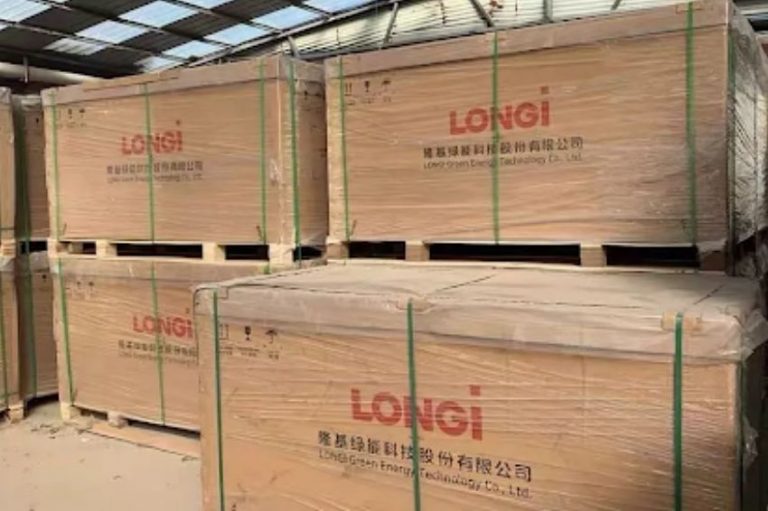
Longi's Hi-MO 5 products are designed to have an operating margin of 10 cm for loading and unloading containers

China is widely recognized as the world's manufacturing center for photovoltaic modules, shipping to all corners of the globe by sea, road, rail and air. 

With factors such as delivery cycle, capacity and cost to consider, sea transport has become the preferred mode for shipping and with this being the case, maximizing the utilization of container capacity is now a subject receiving great market attention. 

1) Packaging methods for photovoltaic modules

Vertical packaging is commonly seen as the ideal method, due to problems with the horizontal stacking alternative. 

Vertical packaging solves the three main problems of horizontal stacking, namely module frame deformation, glass breakage and invisible cracks caused in transit, and the vertical landscape solution has become the common choice over the portrait alternative.
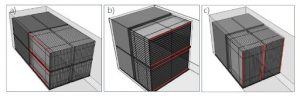
Figure 1. Three packaging methods for photovoltaic modules: a) Vertical landscape packaging is recognized as optimal; b) Horizontal stacking has been eliminated; c) Vertical packaging in portrait mode is applied for larger PV modules
Figure 1 – Three packaging methods for photovoltaic modules: a) Vertical landscape packaging is recognized as optimal; b) Horizontal stacking has been eliminated; c) Vertical packaging in portrait mode is applied for larger PV modules.

2) Maximum size allowed with vertical packaging

Meeting the ultimate objective of reducing the proportion of broken products or products with invisible cracks upon arrival, vertical landscape packaging has a lower center center with the consequent lower risk of modules tipping over during packaging and unpacking, due to its design-for-performance advantage of operational security. 

This is the main reason for its preferential status, better meeting the requirements of reliability in maritime transport, packaging stability and safety of the employees involved. According to the door height of a container, the maximum allowable height for ideal packaging can be determined. The logical relationship is shown below:

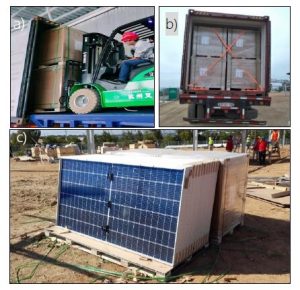
Figure 2. Images of photovoltaic module transportation, loading and unloading location: a) The Hi-MO 5 product is loaded into the container at the factory, with a forklift operating margin of about 10 cm; b) the container is delivered to a location with uneven terrain; c) vertically stacked modules with landscape orientation can be placed stably in different situations
Figure 2 – Images of photovoltaic module transport, location of loading and unloading: a) The Hi-MO 5 product is loaded into the container at the factory, with a forklift operating margin of around 10 cm; b) the container is delivered to a location with uneven terrain; c) vertically stacked modules with landscape orientation can be placed stably in different situations.

3) Questions about vertical stacking in portrait mode for large modules

The operating margin for loading and unloading containers is extremely limited, theoretically with only about 7 cm available. Longi's Hi-MO 5 products are designed to have an operating margin of 10 cm for loading and unloading containers.

However, this redundancy in operating height for larger modules in a vertical packaging scenario is reduced to about 7 cm once the height, packaging paper thickness and pallet height are taken into account, which means the total height will exceed 2,5m – and the container door is 2,575m. 

Although tightly packaged goods can be loaded and unloaded by skilled workers in a factory environment with equipment such as a loading dock, there are no such facilities available in overseas warehouses or on project sites.

Workers are at greater risk of injury when turning packages that are heavier and have a higher center of gravity. Compared to the bifacial Hi-MO 5's weight of 32,3 kg, the weight of a larger module exceeds 38,7 kg, an increase of almost 20%. 

Larger modules are also packaged via the vertical method in portrait format, which means the package height will exceed 2,5 m (see Figure 5a). The barycenter height is almost double compared to the Hi-MO 5, increasing the possibility of tipping over and subsequent injury.
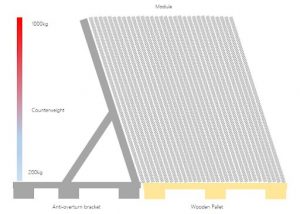
Figure 3. To prevent vertical packaging from tipping over, an anti-tip support and hundreds of kilograms of counterweight are required, which is difficult to obtain at the project site
Figure 3 – To prevent the vertical package from tipping over, an anti-tip support and hundreds of kilograms of counterweight are required, which is difficult to obtain at the project site

Taking an initial tilt angle of 75° as an example, the weight of the largest module is 38,7 kg, with a 31-unit pallet having an overall gravity as shown below:

G = 38,7 × 31 × 9,8 ≈ 11760 N

The pressure on the beveled side of the support:

F = G × cos 75° ≈ 3043 N

The coefficient of static friction between the support and the sand is considered to be 0,4, with its equilibrium relationship with the horizontal force as follows:

Fmax = (Msupport × 9,8 + F × cos 75°) × 0,4 ≥ F × sin 75°

As per the above, the weight of the support must reach over 660 kg to maintain non-slip status, with the use of a support of this weight in a project with larger modules being a challenge during the construction and installation phases.

The weight of the stand can also be calculated under different tilt angles. The smaller the unpacking angle, the greater the risk of the support slipping.

If an installer is unpacking, the modules can also be turned by the wind reaching the fifth scale when the number to be unpacked is less than 10 units and the tilt angle is greater than 85° (e.g. figure 4.)

In summary, larger packaged modules stacked vertically in portrait orientation are at greater safety risk, with additional limitations in terms of unpacking in ground-mounted PV plants.

Figure 4. Schematic diagram of unpacking the modules in the vertical method in portrait orientation, with wind support
Figure 4 – Schematic diagram of unpacking the modules in the vertical method in portrait orientation, with wind support

During the initial stage of construction of a large-scale ground-mounted photovoltaic plant, care must be taken to position the packaged modules to prevent them from tipping over, which makes traction more difficult on uneven terrain.

Compared to the weight per pallet of Hi-MO 5 bifacial modules, that of the larger modules shows an increase of 20%, resulting in a net weight of over 1,2 tonnes.

For this reason, a forklift or lifting machinery with a large load capacity is required for safe transportation, increasing labor and equipment costs to complete the installation within the construction period. When installing larger modules, there is also the possibility of lower efficiency and a higher rate of invisible cracks.

As shown in Figure 5b, it may be difficult for workers to handle a larger module, needing to place a corner on the ground, with the added concern of exceeding the recommended maximum weight of just under 35 kg for two-person handling (the maximum weight for handling by one person is 20 kg to 25 kg, with the coefficient for two people 0,666, i.e. 25 × 2 × 0,666 = 33,3 kg – see HSL Guide for Weight Limit in Manual Handling).
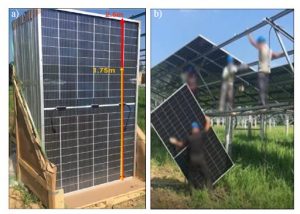
Figure 5. Unpacking and installation of larger modules: a) The height of the packaging is much greater than that of the installer; b) Size is too large and wide, leading to lower installation efficiency and potentially higher breakage rate
Figure 5 – Unpacking and installation of larger modules: a) The height of the packaging is much greater than that of the installer; b) The size is too large and wide, leading to lower installation efficiency and a potentially higher breakage rate.

According to research, the breakage rate of Hi-MO 5 bifacial module is generally lower compared to that of larger modules during installation, while the invisible cracking rate for larger modules increases by more than five times.

In conclusion, LONGi adheres to the proven reliability of vertical landscape packaging solution for its Hi-MO 5 modules, this minimizing shipping costs and making unpacking and installation more convenient for on-site workers.
Power Plant Course
Photo by Engineering Team Canal Solar
Equipe de Engenharia do Canal Solar
Engineering Team Canal Solar
PreviousPrevious
NextNext

An answer

  1. Tiburtino Lacerda said:
    6 April 2023 10 gies: 21

    Great article. I contracted for the purchase/installation of a photovoltaic kit, with 20 panels of 560 W each, for my home. I try to read everything I can find about solar panels and how to avoid damaging them. What is the MAXIMUM TORSION that modules can be subjected to without damage?

    Reply

Leave a comment Cancel reply

Your email address will not be published. Required fields are marked with *

Comments should be respectful and contribute to a healthy debate. Offensive comments may be removed. The opinions expressed here are those of the authors and do not necessarily reflect the views of the author. Canal Solar.

News from Canal Solar in your Email

Posts

Communities in Bahia receive training courses in an initiative by Canadian Solar and Statkraft.

Communities in Bahia receive training courses in an initiative by Canadian Solar and Statkraft.

Huawei's C2C technology redefines BESS security for C&I applications.

More news

Read More
Canal Solar - ArcelorMittal begins operation of 315 MW solar power plant.
  • December 10, 2025
Photo by Wagner Freire
Wagner Freire

ArcelorMittal begins operation of 315 MW solar power plant.

The danger of partial shading in photovoltaic systems.
  • November 26, 2025
Photo by Caique Amorim
Caique Amorim

The danger of partial shading in photovoltaic systems.

Canal Solar - APsystems is the world's most profitable microinverter manufacturer, according to Sinovoltaics
  • September 3, 2025
Photo by Caique Amorim
Caique Amorim

APsystems is the world's most profitable microinverter manufacturer, according to Sinovoltaics.

It is a news and information channel about the photovoltaic solar energy sector. Channel content is protected by copyright law. Partial or total reproduction of this website in any medium is prohibited.

Facebook X-twitter Instagram Youtube LinkedIn Spotify

Site Map

Categories

  • News
  • Articles
  • Interviews
  • Consumer Guide
  • Authors
  • Projects
  • Brazil
  • World
  • Technical Articles
  • Opinion Articles
  • Manufacturer Items
  • Electrical Sector
  • Biddings
  • Products

Channels

  • About Us
  • Contact
  • We’re hiring!
  • Privacy
  • Expedient
  • advertise here

Membership and certifications

Copyright © 2025 Canal Solar, all rights reserved. CNPJ: 29.768.006/0001-95 Address: José Maurício Building – Mackenzie Avenue, 1835 – Floor 3, – Vila Brandina, Campinas – SP, 13092-523

We use cookies to make your experience on this site better Find out more about the cookies we use or turn them off in your .

Receive the latest news

Subscribe to our weekly newsletter

Canal Solar
Powered by  GDPR Cookie Compliance
Privacy

This website uses cookies so that we can provide you with the best user experience possible. Cookie information is stored in your browser and performs functions such as recognizing you when you return to our website and helping our team to understand which sections of the website you find most interesting and useful.

Cookies strictly required

Strictly Necessary Cookie should be at all times so that we can save your preferences for cookie settings.

Cookies for third parties

This website uses Google Analytics to collect anonymous information such as the number of visitors to the site, and the most popular pages.

Keeping this cookie enabled helps us to improve our website.