
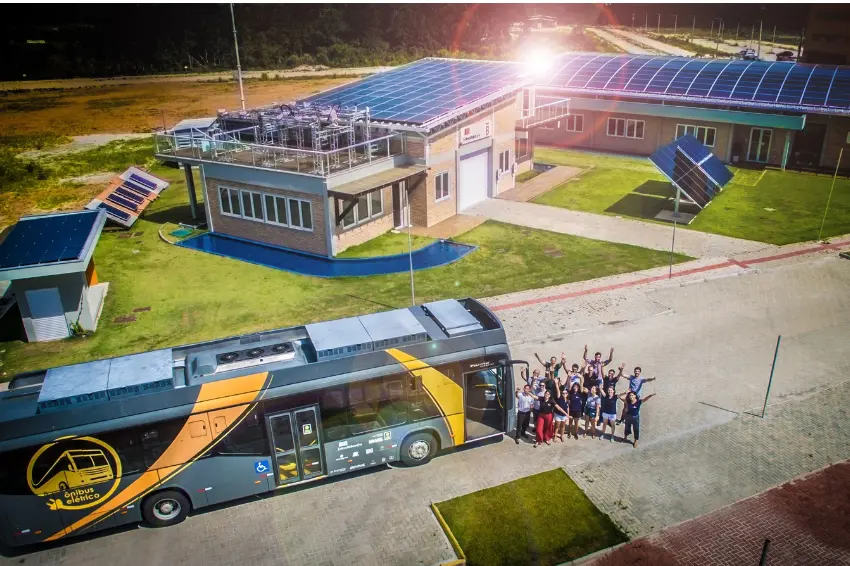
A bill currently being processed in the São Paulo City Council (SP) proposes the use of solar energy to help power the city's fleet of electric buses.
The proposal encourages the installation of solar power plants in bus garages and terminals, with the goal of providing energy for recharging vehicles and reducing the operational costs of transportation companies, through the "Energia e Mobilidade SP" program.
Bill No. 1.112/2025 received a favorable opinion on its legality from the Committee on Constitution, Justice and Participatory Legislation and was published in the Official Gazette of the City of São Paulo, this Thursday (20).
The aim of the measure is to enable transport companies to increase the share of renewable sources in the energy used to recharge electric buses.
Another planned action is the possibility for public transportation concessionaires and licensees to install solar power plants in public areas. To this end, the project foresees a public call for proposals and concession contracts for use or surface rights.
Transportation companies will also be able to enter into power purchase agreements, known as PPAs. These contracts allow for the establishment of conditions for the supply of energy and must comply with the regulations of... ANEEL (National Electric Energy Agency) and federal legislation.
The project also establishes possible counterpart obligations for the beneficiary companies. These include maintaining a minimum percentage of electric vehicles in circulation, proving that part or all of the energy used comes from renewable sources, and submitting annual reports on energy efficiency and reduction of operational costs.
Expanding photovoltaic energy is a priority.
The measures for public transportation are part of a broader policy to encourage solar photovoltaic energy in the municipality. The goal is to stimulate the use, development, and expansion of distributed generation (DG) in solar energy in São Paulo (SP).
Among the intended objectives are encouraging the installation of micro and mini-distributed generation systems, reducing greenhouse gas emissions, providing professional training, and generating green jobs.
The policy also seeks to stimulate technological and scientific innovation in the sector, expand access to energy, and encourage energy efficiency projects in municipal government agencies and entities.
The text also provides for incentives for the creation of solar power plants in public and community areas, and areas with greater generation potential. Other guidelines include support for companies and startups linked to renewable energies, financing or support for research and technological innovation, and attracting national and international investments in decarbonization solutions.
The originally planned tax incentive was withdrawn.
The original proposal envisioned a reduction of up to 20% in the Service Tax (ISS) rate for companies established in São Paulo that operate in the development of projects, construction, component installation, and maintenance of photovoltaic solar energy systems.
However, the Committee on Constitution, Justice and Participatory Legislation removed this tax benefit from the substitute bill presented along with the opinion. The municipal executive branch had also expressed its opposition to the project.
Among the arguments presented are the risk of revenue loss without compensation, the existence of incentives already granted in other spheres of government, possible inconsistencies in the definition of beneficiaries, and the impacts on the municipal tax system during the implementation of the tax reform.
The proposal will proceed despite the considerations.
Despite the opposing viewpoints, the Constitution, Justice and Participatory Legislation Committee understood that the proposal can continue to proceed from a legal standpoint, as long as it does not include the provisions related to the reduction of the ISS (Service Tax).
The opinion also stipulates that at least two public hearings must be held during the legislative process, given that it is an environmental policy proposal with potential tax implications.
The project is not yet in effect.
With a favorable opinion regarding its legality, the project moves on to analysis by the other committees of the City Council. The proposal still needs to advance through the legislative process and be approved before it can eventually come into effect.
all the content of Canal Solar is protected by copyright law, and partial or total reproduction of this site in any medium is expressly prohibited. If you are interested in collaborating or reusing part of our material, please contact us by email: redacao@canalsolar.com.br.



Comments
Comments are moderated before publication.Comments should be respectful and contribute to a healthy debate. Offensive comments may be removed. The opinions expressed here are those of the authors and do not necessarily reflect the views of the author. Canal Solar.