
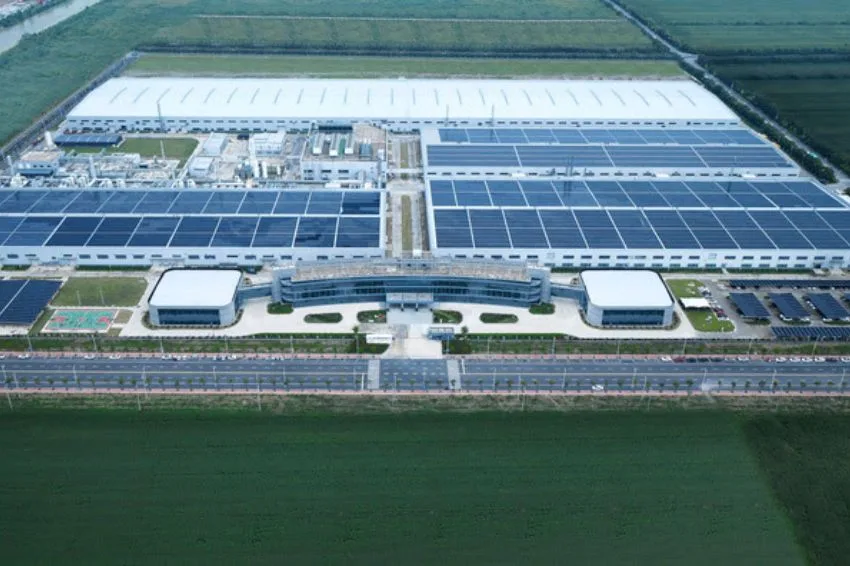
Astronergy Solar, a global leader in the production of photovoltaic cells and modules and a member of the CHINT Group, announced that its factory in Yancheng, located in Jiangsu Province, China, has been recognized as the first zero-carbon factory in the solar sector worldwide.
The project was certified by TÜV Rheinland – a German certification, inspection, project management and training body – based on the standards of the “Evaluation Specification of Zero-Carbon Factory”.
The factory transformation project in Yancheng, which began in 2022, emphasized improving energy efficiency, implementing energy-saving technologies and utilizing renewables.
The case, which also has carports installed, was even selected for the “2023 Business Climate Action Cases” at COP 28, in Dubai.
“Our project was not just a technical upgrade, but a redefinition of how the photovoltaic industry can operate environmentally responsibly,” said XUE Feng, Astronergy factory general manager.
“We managed to reduce our CO2 emissions by 42.221,37 tons, achieve an impressive renewable energy use rate of 69,61% and create an environmental impact equivalent to planting more than 2 million trees”, he highlighted.

The solar plant installed on the factory's roof, covering more than 80.000 m², is designed to generate approximately 11,18 million kWh of clean electricity every year, reducing carbon emissions by 6.376 tons per year.
“This milestone achieved by our factory in Yancheng is a testament to our continued commitment to innovation in sustainability,” highlighted Carolina Pain, Head of Marketing at Astronergy in Latin America.
“We are determined to provide photovoltaic energy solutions that not only satisfy our customers’ energy needs, but also significantly contribute to reducing the world’s carbon footprint,” he emphasized.
Astronergy further stated that it is committed to further expanding its initiatives in renewable energy and sustainable practices. The company plans to replicate Yancheng's successes and learnings in seven other factories by 2030, driving a broader transformation in the photovoltaic industry and reinforcing its role as a key player in the global transition.

all the content of Canal Solar is protected by copyright law, and partial or total reproduction of this site in any medium is expressly prohibited. If you are interested in collaborating or reusing part of our material, please contact us by email: redacao@canalsolar.com.br.





Comments
Comments are moderated before publication.Comments should be respectful and contribute to a healthy debate. Offensive comments may be removed. The opinions expressed here are those of the authors and do not necessarily reflect the views of the author. Canal Solar.