
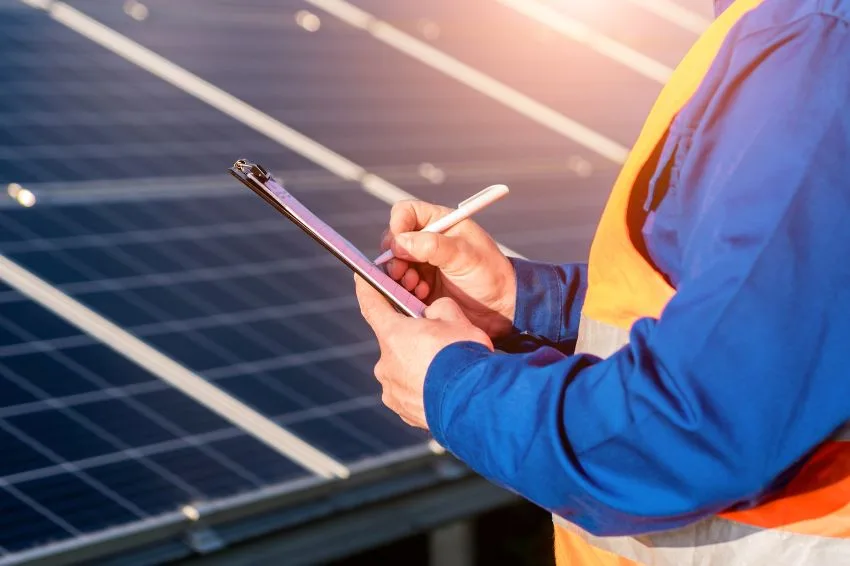
The ABNT CEE 253 Study Committee has initiated a new technical standard project that is in the correction phase and is dedicated exclusively to the electroluminescence (EL) inspection of photovoltaic modules.
The text follows successive reports and studies of cell failures that pass traditional tests but can still compromise field generation. The new document should serve as a reference for manufacturers, importers, laboratories, and certification bodies.
"We need to look at the cell, not just the module as a whole. EL exposes microcracks and gray variations that Flash Test doesn't see," said Lucas Monteiro, Product Manager at DMEGC Solar LATAM, during a webinar promoted by Canal Solar.
Why did EL enter the standardization radar?
Below are the reasons listed by Monteiro.
- Hidden flaws: Studies presented at the meeting showed that modules that passed the Flash Test but failed the EL lost up to -3,2% of power after MQT 19.1 stabilization;
- Scale of the problem: estimates indicate that more than 60% of the modules distributed in 2024 for distributed generation exhibited at least one EL criterion outside the tolerable range, which represents something close to 5 GWp in operation at risk of premature degradation;
- Regulatory vacuum: Inmetro's Ordinance 140/2022 already covers so-called "fake power" but does not define EL parameters. CEE-253's proposal fills this gap with objective metrics.
Harmonized criteria for the national market
The new draft standard establishes 18 technical criteria based on electroluminescence, including tolerances for grayscale differences, microcracks, black spots, dark edges, and other structural defects in the cells. The goal is to create a minimum standard for the acceptance of modules sold in the country, ensuring greater system reliability and durability.
The tests were applied to panels from different manufacturers, including products classified as Top Performer by PVEL, and all high-quality models met the suggested criteria.
"On the other hand, modules with defective cells, many of which had no history in international testing, failed due to criteria such as: grayscale difference above 40%, presence of microcracks in the network, black dots larger than 5% of the cell, and black edges exceeding 16,67% of the cell length. These defects can cause accelerated degradation, power loss, and even fire risk," he explained.
Expected impact
Among the impacts are:
- Protected consumer: less accelerated degradation and greater predictability of return on investment;
- Aligned industry: manufacturers will have to prove compliance with the 18 items already in process control, reducing rework upon delivery;
- Future regulation: the text may be adopted by Inmetro and ANEEL in complementary resolutions, as occurred with NBR IEC 61215-1:2024, published last year.
Next Steps
The draft standard is being developed collaboratively with the sector and may be incorporated into the regulations of the ANEEL, INMETRO and other bodies responsible for the technical regulation of photovoltaic equipment.
"We are facing a decisive moment to raise the standard of solar energy in Brazil. Electroluminescence is not just an inspection tool; it's a guarantee that what is being delivered to the consumer matches what was promised," the manager emphasized.
"The proposed EL inspection standard represents a decisive step toward professionalizing the quality control of photovoltaic modules in Brazil. By adopting clear and measurable parameters, the sector gains transparency, consumers are protected, and the country aligns with international practices for evaluating high-efficiency panels," he concluded.
all the content of Canal Solar is protected by copyright law, and partial or total reproduction of this site in any medium is expressly prohibited. If you are interested in collaborating or reusing part of our material, please contact us by email: redacao@canalsolar.com.br.


Comments
Comments are moderated before publication.Comments should be respectful and contribute to a healthy debate. Offensive comments may be removed. The opinions expressed here are those of the authors and do not necessarily reflect the views of the author. Canal Solar.