
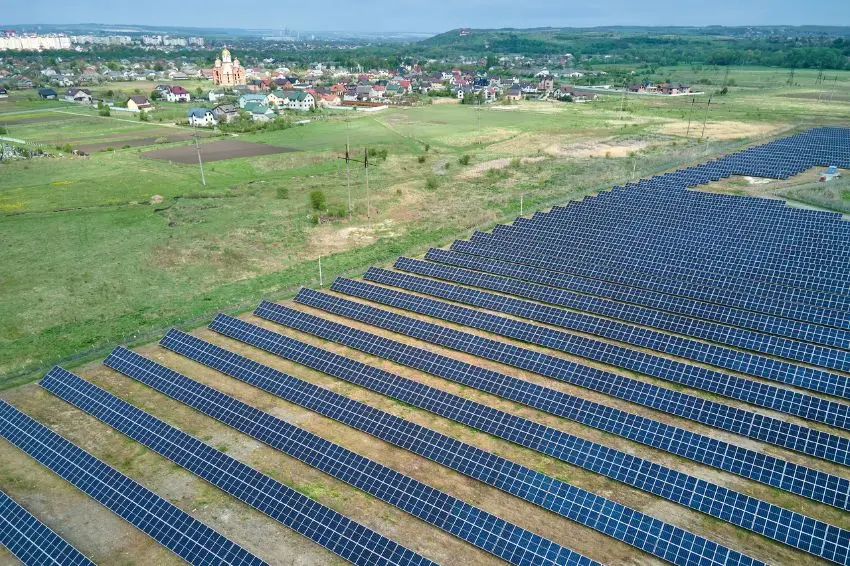
Brazil has dropped one position in the ranking of the world's largest solar energy markets and will occupy fifth place globally in 2025. This information is contained in the Global Market Outlook for Solar Power 2026-2030 report, prepared by SolarPower Europe with the participation of... ABSOLAR (Brazilian Photovoltaic Solar Energy Association).
According to the study, the country added 14,5 GWp of photovoltaic capacity throughout 2025, a volume 23% lower than the 18,9 GWp recorded in the previous year. With this, Brazil lagged behind China, India, the United States, and Germany among the markets that most expanded solar energy during that period.
The data considers the sum of large photovoltaic plants and distributed generation systems installed in homes, businesses, industries, and rural properties. The report uses the peak power unit (GWp), an internationally adopted standard for industry comparisons.
In addition to the decline in Brazil, the survey shows significant changes in the global scenario. For the first time, India surpassed the United States in added solar capacity during the year, consolidating its position as the second largest photovoltaic market in the world in annual expansion.
The study also highlights Australia's leadership in installed solar capacity per capita. The country already has approximately 1,7 kW of solar energy for each citizen, maintaining a significant advantage over other markets. The Netherlands appears in second place, while Germany occupies third.
Why did Brazil lose its position?
In evaluating the ABSOLARBrazil's loss of position is related to a combination of regulatory, operational, and economic factors.
These include cuts in renewable energy generation without adequate compensation to entrepreneurs, difficulties in connecting new systems to the electricity grid, high capital costs, exchange rate volatility, and increased import tariffs on photovoltaic equipment.
Currently, solar energy is the second largest source in Brazil's electricity matrix, with approximately 70 GWac in operation, equivalent to 26,2% of the country's installed capacity. Since 2012, the sector has attracted over R$ 305 billion in investments and generated more than 2,1 million green jobs.
For the Chairwoman of the Board of Directors of ABSOLARAccording to Bárbara Rubim, the Australian experience demonstrates the importance of combining the expansion of renewable energy generation with investments in electrical infrastructure and energy storage.
“If we applied Australia’s 1,7 kW to Brazil’s 213 million inhabitants, it would be an impressive 362 GWp. But, in the Brazilian case, the operation of the SIN (National Interconnected System) has reached a tipping point,” she stated.
However, the professional points out that scaling transitions, such as Brazil's, require compatible planning and infrastructure capable of enabling the proper management of available resources. "It is precisely in this area that the country has accumulated a worrying deficit," she emphasized.
For Rodrigo Sauaia, CEO of ABSOLARBrazil urgently needs to move forward in improving revenue recognition mechanisms for batteries, in tariff modernization—a topic discussed without progress since December 2018—and in the regulation of electricity storage systems, also at the consumer level, behind the meter, as already occurs in several countries around the world.
all the content of Canal Solar is protected by copyright law, and partial or total reproduction of this site in any medium is expressly prohibited. If you are interested in collaborating or reusing part of our material, please contact us by email: redacao@canalsolar.com.br.



Comments
Comments are moderated before publication.Comments should be respectful and contribute to a healthy debate. Offensive comments may be removed. The opinions expressed here are those of the authors and do not necessarily reflect the views of the author. Canal Solar.