
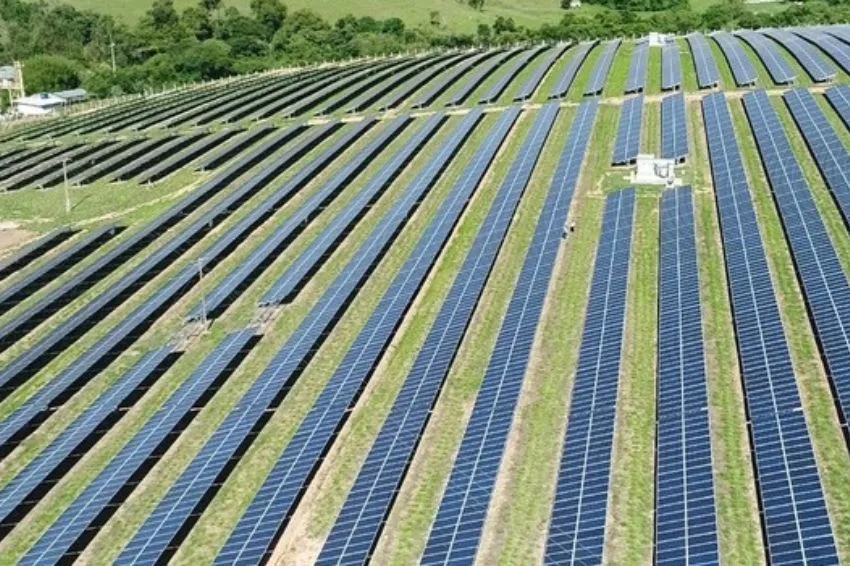
Cemig YES plans to expand its performance in the sector GD (distributed generation) beyond Minas Gerais, its home state, and is evaluating the offer of “subscription” solar energy for cities in the Southeast and Central-West regions.
The information was released by Iuri Mendonça, CEO of the subsidiary of Cemig (Companhia Energética de Minas Gerais) focused on the segment, in an interview with Reuters.
According to the executive, the expectation is that the first projects will come into operation this year, totaling 40 MWp of installed power.
Although Cemig SIM has focused its growth strategy on Minas Gerais in recent years, Mendonça highlighted that the expansion of DG will follow the same logic as the Free Energy Market, where the company already has a presence in other regions of the country.
“We are going to take our first step towards regions where we have greater brand awareness and relationship with the market, especially in the medium and high voltage segment, (which are part of) Mercado Livre,” the executive told Reuters.
Cemig SIM investment plan
The promised expansion is in line with Cemig SIM's investment plan, which foresees R$3,5 billion in investments between 2019 and 2029. To date, around R$1,2 billion has already been invested.
The company currently has 300 MWp of installed capacity in operational solar plants. According to Mendonça, the goal is to reach 1 GWp by 2029.
The executive also told Reuters that the business model for expansion has already been tested in 79 municipalities in Minas Gerais where Cemig is not the local distributor.
According to the Agency, in recent years, Cemig SIM has become a leader in the “subscription” solar energy segment in the state of Minas de Gerais.
With information from Reuters Agency
all the content of Canal Solar is protected by copyright law, and partial or total reproduction of this site in any medium is expressly prohibited. If you are interested in collaborating or reusing part of our material, please contact us by email: redacao@canalsolar.com.br.

Comments (4)
Comments are moderated before publication.Comments should be respectful and contribute to a healthy debate. Offensive comments may be removed. The opinions expressed here are those of the authors and do not necessarily reflect the views of the author. Canal Solar.
Regarding the first comment, the distributors do not state that “solar energy generation is only permitted from 19:5 p.m. to 19:5 a.m.,” which would be completely idiotic. What they state is that “energy can only be injected into the grid from XNUMX:XNUMX p.m. to XNUMX:XNUMX a.m..” This is because there is no flow reversal at the grid substations during this time. A possible solution for DG is to install a grid-zero plant in conjunction with a BESS, which may or may not inject energy into the grid at dawn. The BESS is already reaching prices that make this feasible, remembering that by using energy from the BESS, energy from the grid is no longer “imported” and therefore neither TUSD nor taxes on TUSD (and in some cases on TE as well) are paid on the energy that the BESS discharged to the load.
The Consumer Defense Committee of the Chamber of Deputies, of which federal deputy Celso Russomanno (Republicans/SP) is a member, will call a public hearing so that Cemig (Minas Gerais Energy Company) can clarify the restrictions imposed on DG (distributed generation) projects in the state.
Join the Community Canal Solar on WhatsApp.
The decision was made after a video went viral on social media in February. In the video, a digital influencer interviews a professional in the solar market who states that “it has become complicated to install solar panels” in Minas Gerais, claiming that today “it is only allowed to generate solar energy from 19 pm to 5 am”.
According to the interviewee, this restriction would be based on a “loophole in Law 14.300”, which would allow concessionaires to define the times at which consumers can generate energy. He also mentions that companies would be justifying this limitation based on the inversion of flow.
Hearing may take place in April
In an exclusive interview to Canal Solar, Russomanno stated that there is still no set date for the public hearing, due to the election period for the Chamber of Deputies committees.
However, as soon as this stage is completed, the hearing will be called. In addition to Cemig, ANEEL (National Electric Energy Agency) will also be called. If everything goes according to plan, the debate “could probably happen in April,” said the deputy.
Congratulations on the report. We are experiencing a huge energy transition in Brazil. Many people still do not understand the immense opportunity we have in our hands to help the environment, generate jobs and even financial independence; If you are an Entrepreneur. I work with a project in Distributed Generation of solar energy credits. Discounts of 8% to 20% can reach up to 90% in savings for our residential and business clients. I am looking for partners to expand the project. Interested parties should call directly at watts 51984863327.
This is a mockery.