

The result of the second round of the 2026 presidential elections provoked a strong reaction in the Brazilian financial market. Between the close of Friday (23) and Thursday (29) of October, the Ibovespa, the main index of the Brazilian Stock Exchange, accumulated a drop of 17,5%, with shares of companies in the electricity sector registering devaluations of more than 30%.
The movement began on Monday (26), the first trading day after the re-election of Luiz Inácio Lula da Silva (PT). On that occasion, the Ibovespa fell 13,88%, closing the day at 176.357 points, the worst daily performance since March 2020.
The intensity of the sales led B3 to activate the *circuit breaker* mechanism, which temporarily interrupts trading during periods of high volatility. By Thursday (29), the index reached 169.186 points, compared to 205.082 points registered in the last trading session before the second round.
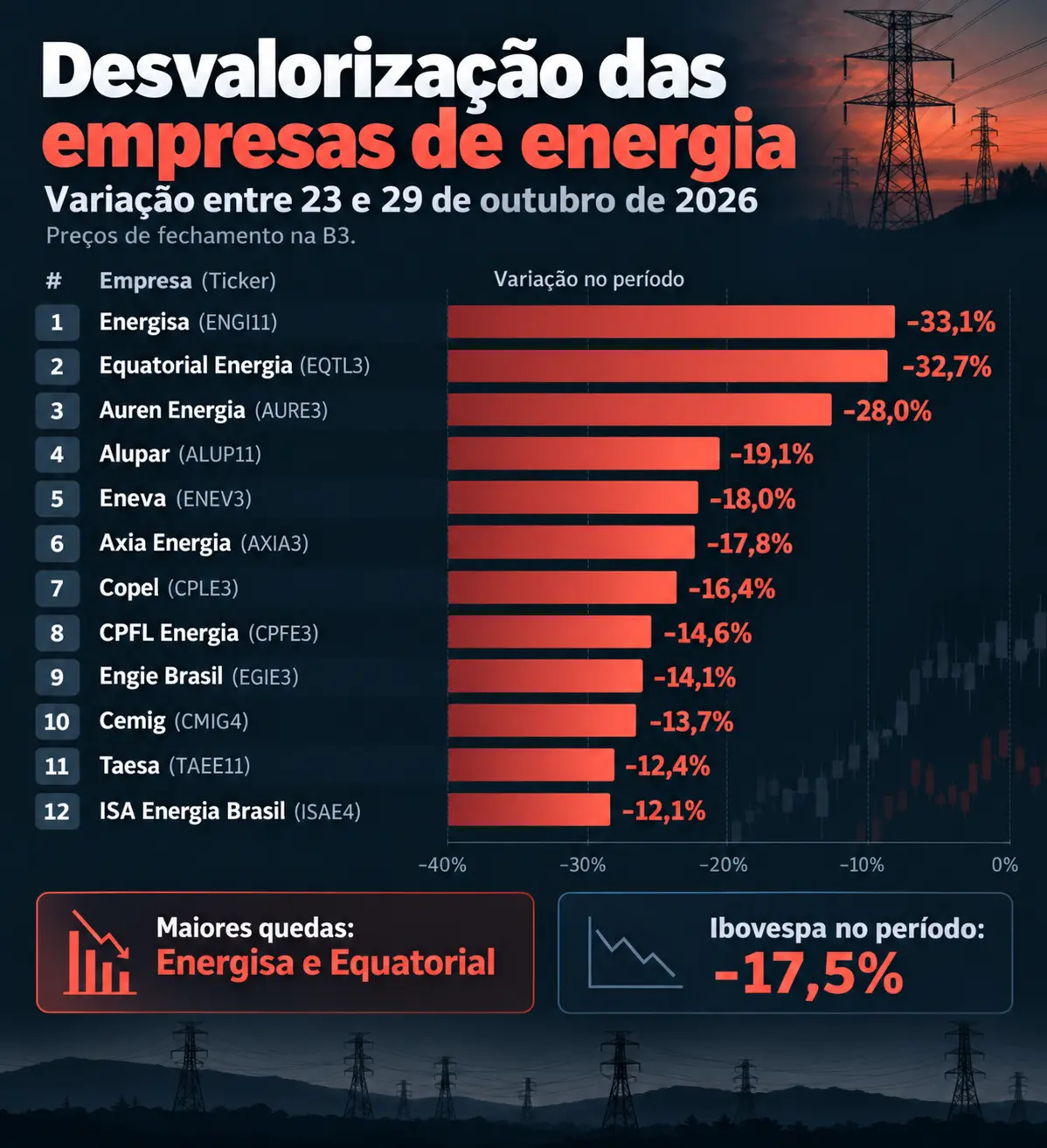
The electricity sector also followed the downward trend in valuations, although with significant differences between companies, according to a survey conducted by... Canal Solar, with 12 of the main companies listed on the B3, considering the generation, transmission and distribution segments.
Energisa and Equatorial register the largest drops.
Among the companies in the sector analyzed, Energisa (ENGI11) showed the greatest depreciation during the period. The company's shares fell from R$ 66,47 on October 23 to R$ 44,50 at the close of trading on October 29, a drop of 33,1%.
Next is Equatorial Energia (EQTL3), whose shares fell from R$ 48,88 to R$ 32,90, a devaluation of 32,7%. Auren Energia (AURE3) also registered a significant loss of 28%, going from R$ 15,24 to R$ 10,97 during the period.
Other companies experienced declines between 12% and 20%. This is the case for Alupar (ALUP11), with a drop of 19,1%; Eneva (ENEV3), with 18%; Axia Energia (AXIA3), with 17,8%; and Copel (CPLE3), with 16,4%. The table below shows the variation in the shares of the 12 companies.
What explains the market's reaction?
The sharp decline is related to the change in investor expectations following the election results. Before the second round, part of the market had established positions betting on a change of government, a move that contributed to the appreciation of Brazilian assets in the preceding weeks.
With Lula's re-election, these positions began to be reversed, while concerns increased regarding the trajectory of public finances and the conduct of fiscal policy. Uncertainty about the Brazilian economic scenario led investors to demand higher returns to take risks in Brazil.
The reaction was also observed in the exchange and interest rate markets. On Monday (26), the commercial dollar advanced 8,21%, closing the trading session at R$ 5,403, while future interest rate contracts registered a strong increase.
This movement is relevant for companies in the electricity sector because rising interest rate expectations can increase financing costs, raise financial expenses, and alter the valuation of projects that require high investments and offer long-term returns.
Devaluation does not necessarily mean operational deterioration.
Despite the significant losses on the stock exchange, the fluctuation in share prices does not, in itself, represent a deterioration in the companies' operating results.
The price of securities also reflects investors' expectations regarding interest rates, fiscal risk, debt, future investments, and growth prospects.
Furthermore, the companies analyzed have distinct business models. Generation, transmission, and distribution companies present different revenue structures, capital needs, and exposure to financial market conditions.
Therefore, the negative reaction to the stock should not be interpreted as an isolated indicator of the financial or operational situation of each company.
The performance of the next trading sessions will depend, among other factors, on the evolution of economic expectations, fiscal and monetary policy decisions, and the ability of companies to maintain their results in the face of a more volatile environment.
all the content of Canal Solar is protected by copyright law, and partial or total reproduction of this site in any medium is expressly prohibited. If you are interested in collaborating or reusing part of our material, please contact us by email: redacao@canalsolar.com.br.


Comments
Comments are moderated before publication.Comments should be respectful and contribute to a healthy debate. Offensive comments may be removed. The opinions expressed here are those of the authors and do not necessarily reflect the views of the author. Canal Solar.