
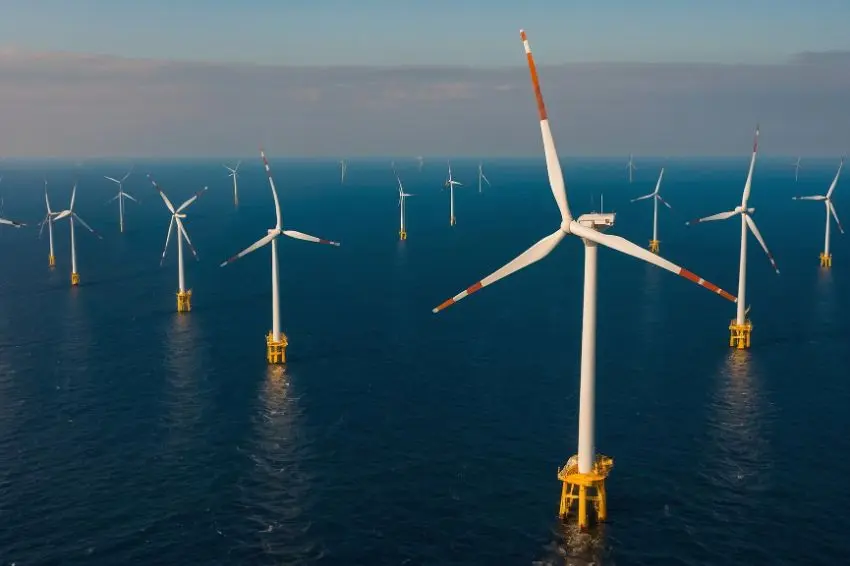
Three regions of the Brazilian coast stand out for their highest average wind speeds and potential for offshore wind power generation: a strip between Piauí and Rio Grande do Norte, the coast of Rio de Janeiro, and the stretch between southern Santa Catarina and Rio Grande do Sul.
In these hotspots, strategic ocean areas with exceptional conditions for the installation of wind farms, average wind speeds range between 7,0 m/s and 10,0 m/s, according to lifting released by EPE (Energy Research Company).
The study identifies the areas of highest wind speed, but also seeks to detail how the wind behaves along the coast.
The analysis identified 20 characteristic regions, or clusters, defined by location and the similarity of daily and seasonal patterns of wind resources.
With this, EPE seeks to offer a regionalized perspective that can be used in energy planning and evaluation studies.
Differences
Os hotspots They do not present exactly the same conditions. In the Northeast, the clusters are characterized by more constant winds and well-defined prevailing directions.
In Rio Grande do Sul, the lowest seasonal variation in speed stands out, while in Rio de Janeiro, high speeds are particularly noticeable in the months of January and February.
Overall, the survey indicates a trend of stronger winds in Brazil during the second half of the year.
In the daily cycle, the lowest velocities frequently occur during the daytime period, mainly in the early afternoon. However, the differences between the clusters show that both the intensity and the temporal variation of the resource change significantly depending on the location.
public information
To arrive at this picture, EPE compared three public databases used in wind energy studies: ERA5, MERRA-2, and GWA (Global Wind Atlas).
Differences were found between the models, especially depending on the region analyzed. ERA5 and MERRA-2 generally show similar results, but the former offers more refined spatial resolution.
EPE selected ERA5 for the clustering stage and applied Ward's method, grouping points that exhibit similar behavior over hours and months.
The procedure made it possible to identify 20 regions with their own seasonality profiles and reinforced the possibility of complementarity between different locations and between offshore generation and other energy sources.
Potential to be refined.
The survey is based on a technical potential previously estimated by EPE at around 700 GW in areas with a depth of up to 50 meters and more than 900 GW up to 100 meters.
At the same time, the company emphasizes that significant uncertainties still exist, mainly due to the scarcity of publicly available measurements conducted directly in the offshore environment.
Therefore, the Technical Note is presented as a step towards consolidating available information and reducing knowledge gaps.
EPE highlights the importance of new in situ measurements to validate the reanalysis data and complement the characterization of the resource before further studies focused on the source's contribution to the electrical system and the development of projects.
all the content of Canal Solar is protected by copyright law, and partial or total reproduction of this site in any medium is expressly prohibited. If you are interested in collaborating or reusing part of our material, please contact us by email: redacao@canalsolar.com.br.





Comments
Comments are moderated before publication.Comments should be respectful and contribute to a healthy debate. Offensive comments may be removed. The opinions expressed here are those of the authors and do not necessarily reflect the views of the author. Canal Solar.