
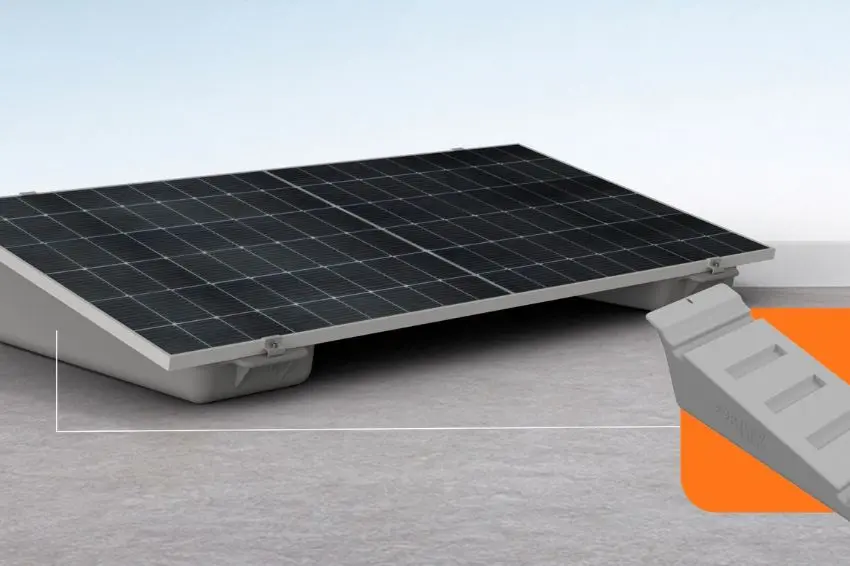
Fortlev Solar is introducing to the market a structure for installing photovoltaic modules on slabs without the need to drill into the roof. Called Lastro Laje, the solution uses a reservoir filled with water on-site to provide stability to the system.
According to the company, the product was developed based on a demand observed in projects where drilling into the slab could pose a risk of water infiltration into the building.
Traditionally, photovoltaic systems installed on this type of roof may require drilling or mounting structures that necessitate interventions in the slab. When performed improperly, these procedures can promote leaks and generate the need for maintenance.
In the Lastro Laje system, the manufacturer's proposal is to replace this type of fastening with the weight of water. The reservoir is positioned on the roof and filled only after assembly, acting as an anchor to hold the structure in place without the need to drill into the slab or build concrete bases.
Installation and transport
Produced from polyethylene, the same material used in Fortlev water tanks, the product is transported empty to the installation site. According to the manufacturer, this feature reduces weight during transport and facilitates the movement of components to the roof.
During installation, the structure is positioned on the slab, the modules are fitted and fixed without the need for metal profiles, and then the reservoir is filled with water.
The reservoir also features a sealing system that prevents mosquitoes from accessing the stored water, thus avoiding the formation of breeding grounds for Aedes aegypti, the mosquito that transmits dengue fever.
According to Fortlev Solar, the seal also prevents water evaporation, helping to maintain the volume and weight necessary for the structure's stability over time.
Wind resistance and overall stability
The Lastro Laje features a windbreak diffuser, a component designed to provide greater stability to the assembly, especially in locations subject to higher wind incidence.
According to the manufacturer, the system was designed to withstand winds of up to 40 m/s (isopleth 3), offering safety and reliability for its application on roofs.
The product was developed, tested, and approved considering the technical criteria applicable to solar power plant structures, following the same sizing and structural verification principles adopted for conventional solutions intended for the same application.
In this way, Lastro Laje combines ease of installation, structural stability, and reliability, offering an efficient solution for deploying photovoltaic systems on slabs.
Applications
The manufacturer recommends this structure for residential, commercial, and industrial projects with slab roofs, especially in locations where drilling is not permitted or could compromise waterproofing.
According to Fortlev Solar, the proposal aims to offer integrators an alternative mounting method that reduces interventions in the original roof structure.
Lastro Laje is part of the same family as Lastro Solar®, a solution from the company that also uses polyethylene structures, but designed for ground installation and filled with soil, sand, gravel, or similar materials to provide the necessary weight to support the photovoltaic modules.
You may also be interested
Fortlev Solar launches 100% polyethylene structure for panel assembly
all the content of Canal Solar is protected by copyright law, and partial or total reproduction of this site in any medium is expressly prohibited. If you are interested in collaborating or reusing part of our material, please contact us by email: redacao@canalsolar.com.br.




Comments
Comments are moderated before publication.Comments should be respectful and contribute to a healthy debate. Offensive comments may be removed. The opinions expressed here are those of the authors and do not necessarily reflect the views of the author. Canal Solar.