
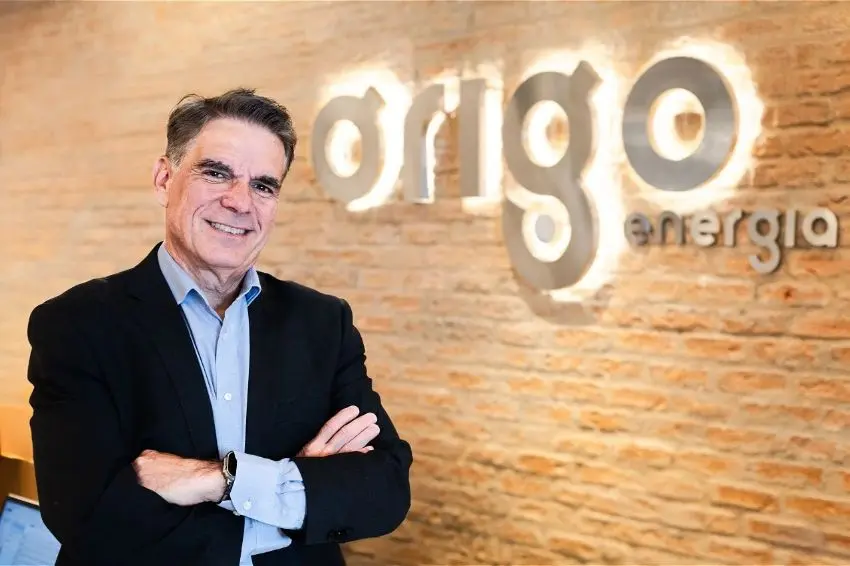
Órigo Energia has suspended investments in the construction of new solar power plants and is now focusing its growth strategy on operational efficiency, digitalization, and expanding the range of products offered to consumers. This decision comes after a period of rapid expansion for the company.
In an interview, the CEO of Órigo Energia, Aurélio Bustilho, explained that the scenario of high interest rates and increased competition in the shared distributed generation segment led the company to reconsider its priorities.
Currently, the company has approximately 830 MWp of installed capacity, distributed across roughly 430 solar power plants in 14 Brazilian states. “We’ve actually stopped building. With Brazil’s interest rates the way they are, it doesn’t make much sense. We might return to that in the future, but not today,” he stated.
According to the executive, the company is going through a period of reorganization after years of sustained growth driven by asset construction and the expansion of its sales force. The strategy now is to improve the utilization of the energy produced, reduce losses, and make operations more efficient.
One of the main changes occurred in the sales structure. Órigo once had approximately 1.500 employees, including nearly 800 salespeople who worked mainly in a door-to-door model. Currently, the workforce has been reduced to less than 500 professionals.
The company also closed three offices and began concentrating its administrative activities, seeking to reduce expenses and simplify management. “We started to realize that this way of selling was not sustainable. The acquisition cost was quite high. So, we started to migrate to a more digital journey,” explained Bustilho.
The transformation involves adopting artificial intelligence tools and data analytics to improve the allocation of energy credits, identify consumption patterns, and reduce contract cancellations.
The company is also expanding its digital contracting channels, allowing consumers to purchase its products without needing to interact with salespeople.
Despite the suspension of new projects, Bustilho does not rule out the possibility of growth through acquisitions or partnerships. According to him, the financial difficulties faced by companies in the sector may create opportunities for consolidation.
"The market has many companies facing financial difficulties. Eventually, an opportunity may arise to join forces with someone, to do M&A. At some point that will happen, but it's not my focus right now," he stated.
In addition to operational changes, Órigo is working on reorganizing its financial structure, including a debt restructuring process and measures to strengthen its balance sheet.
New growth front
Alongside the reorganization of its distributed generation business, Órigo began structuring an operation focused on the free energy market. This initiative is part of a strategy to diversify the solutions offered to consumers and take advantage of the opportunities expected with the opening of the low-voltage market.
According to Bustilho, the company already has a team dedicated to the new activity and serves approximately ten clients in an initial operation that combines distributed generation solutions and the free market.
"I can't imagine a shared distributed generation company without having an operation, even if initial, as a manager in the free market. The two businesses can complement each other very well," he stated.
The proposal is to use Órigo's existing customer base to identify opportunities for migrating to the free market. Currently, the company serves approximately 115 consumer units, with roughly 70% being residential and 30% small businesses and small industries.
According to the executive, entering the free market will not necessarily require new investments in generation. The company will be able to establish partnerships for energy supply and manage contracts, leveraging its commercial and technological structure.
“I’m not saying I’m going to have an open position, to do trading. I can have a platform and partners that supply energy. Since I already have a relationship with the client, I can add margin to that operation,” he explained.
Bustilho emphasized, however, that activity in the free market will initially be limited and should grow as the sector opens up and the company develops its digital tools.
The strategy also considers the possibility of offering different solutions to the same consumer over time. In certain cases, distributed generation may present a greater economic advantage in the short term, while migrating to the free market may become more attractive later.
According to Bustilho, the accumulated knowledge about consumer habits and the direct relationship with customers could represent competitive advantages in the face of the entry of large groups into the low-voltage market.
A more competitive environment
The decision to halt new investments also comes at a time of increased competition in the shared distributed generation segment.
According to the CEO, the sector has gone through a period of strong expansion in the supply of projects, while consumer knowledge about the benefits and characteristics of energy subscriptions is still limited.
Bustilho believes that opening the free market could contribute to expanding this knowledge and stimulating the search for solutions for managing and reducing energy costs.
The executive also believes that the demand for electricity will continue to grow in Brazil, driven by the electrification of the economy, the expansion of data centers, and the adoption of electric vehicles.
Despite the prospects for increased consumption, he believes that the current environment does not favor new investments in shared distributed generation plants.
“I’m not hearing anyone building anything today. Everyone is at a standstill. Sometimes we announce the connection of a power plant, but it was already built and the distributor delayed so much that we only managed to connect it now,” he stated.
In this scenario, Órigo's strategy is to make better use of existing assets and expand its service offerings. The company is also analyzing partnerships related to energy storage, although it does not intend to invest directly in the construction or acquisition of battery systems.
According to Bustilho, the company's next growth cycle will depend less on expanding installed capacity and more on its ability to offer solutions tailored to each consumer's profile.
"We need to shift our focus from simply offering discounts on electricity bills to solving customer problems related to efficiency, cost reduction, and energy consumption," he concluded.
all the content of Canal Solar is protected by copyright law, and partial or total reproduction of this site in any medium is expressly prohibited. If you are interested in collaborating or reusing part of our material, please contact us by email: redacao@canalsolar.com.br.
Comments
Comments are moderated before publication.Comments should be respectful and contribute to a healthy debate. Offensive comments may be removed. The opinions expressed here are those of the authors and do not necessarily reflect the views of the author. Canal Solar.