
Updated October 15, 2025
Photovoltaic inverters increasingly have embedded technologies and facilities for monitoring and detecting problems, with different types of alerts for each possible anomaly identified. As a result, their indications facilitate analysis by the technicians responsible for correcting the problem.
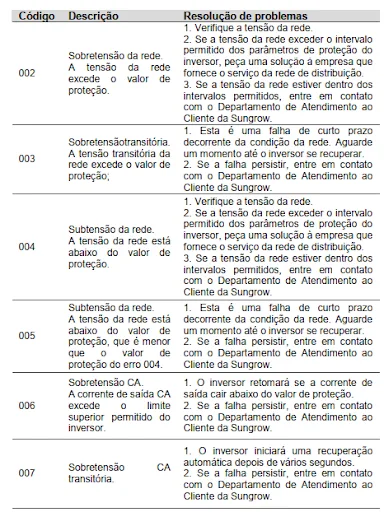
However, having more information about the system may not be beneficial if the person responsible for the analysis doesn't understand the reasons (root causes) behind each error. Equipment manuals, for example, contain lists of various error codes, as illustrated below.
In this article, we will discuss the three most common errors that reach technical support, all of which indicate abnormalities in the installation and require analysis and correction in the field. Most of the errors mentioned and presented in the inverter alerts relate to a problem in the installation and not in the inverter, which only identified it.
Remembering that the codes vary for each manufacturer, however the concept behind the cause of the error is the same for the vast majority of alerts generated.
Read also Learn all about solar energy..
Table 1 – List of errors in an inverter installation and operation manual. Source: Sungrow
Among the most common errors in photovoltaic systems that reach technical support are AC overvoltage, islanding, and low insulation resistance. Each of these will be addressed exclusively in a series of three articles, starting with this one, where we will address the overvoltage error, which is undoubtedly the most common.
The overvoltage error, when the occurrence is on the utility side (alternating voltage), represents that the inverter is measuring, at its input, a voltage value per phase greater than that configured for protection in the inverter.
All equipment of this type has a nominal operating voltage and a limit range of variation, defined by standards and resolutions of the ANEEL (National Electric Energy Agency), which regulates the sector in Brazil, as well as ABNT (Brazilian Association of Technical Standards).
According to these, every photovoltaic inverter must necessarily go into protection and shut down if the values in the table below are reached:
| Minimum operating voltage | Rated operating voltage | Maximum operating voltage |
| 0,8 x Vname (80% of Vname) | Vname | 1,1 x Vname (110% of Vname) |
In other words, in an electrical grid with a nominal voltage of 220 V, the inverter will act as overvoltage protection when it reaches 242 V and undervoltage at 176 V. This should be uncommon, but it occurs quite frequently in several installations in Brazil.
And what is the reason for this? There are a few reasons that can cause an overvoltage error. A less common one, and one that is simple to resolve, is when the setup was configured incorrectly. For example, let's say that the network where the system was installed is a single-phase rural 254V network, which is common in Brazil.
If the previously informed option is selected (Vnom = 220 V), the system will obviously not operate, as the nominal voltage (254 V) is already higher than the configured protection value, making it necessary to correctly adjust the protection values.
However, the most common cases do not concern this, but rather the actual increase in AC voltage that reaches the inverter, which is caused by one of the following two options: poor utility power supply or internal problems in the AC installation of the photovoltaic system.
However, before going into the details of each one, let's understand how overvoltage occurs. The voltage variation is related to the current that will be transported between the points of the installation or, in general, between the generator and the load. We can illustrate it as follows:
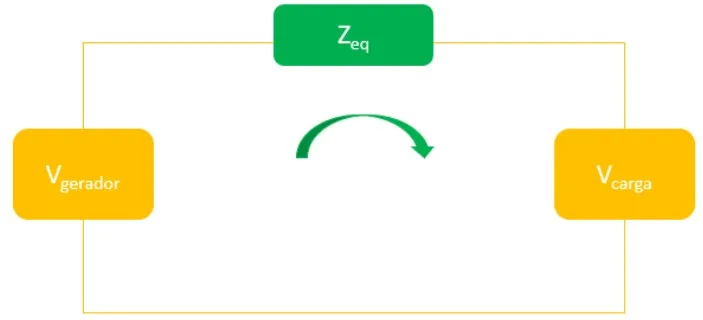
The point where the generator is located, in our case, represents the photovoltaic inverter. The load can be the customer's own internal consumption or, in cases where there is a surplus of generation, the additional energy is transported to the utility company, serving neighboring consumers. In both cases, when transporting energy between two points, there is a voltage variation due to the impedance or resistance existing in the section, which is obtained by Ohm's 1st Law:
ΔV=Vgenerator Vload=Zeq*I
Where Zeq is the equivalent impedance of the circuit and I is the current flowing through it. In other words, the greater the current flowing through it, and the greater the impedance (resistance) of the circuit, the greater the voltage variation. This is why overvoltage problems are so common, especially during peak hours in the photovoltaic system – this is when we have the highest value of electric current flowing through this section.
And for the same reason, during periods of lower generation or when the inverter is off, the measured voltage is "normal." Of course, there's no current flowing, and consequently, there's no voltage variation between points. Unless required by a regulatory agency, reducing the current injected into the grid isn't a good idea. Therefore, it's important to understand why the impedance rises to the point of tripping the inverter due to overvoltage.
As mentioned previously, this is due to the internal electrical installation to which the inverter is connected or to the power grid of the power company itself. In the first case, the precarious electrical installation may be caused by a very long section of cabling without adequate cross-section sizing, or a splicing or connection in the panels that may have poor contact, generating high resistance (hot spots)—all of which can cause a significant voltage spike.
Or, something very common to happen: you (or the engineer responsible for the work) correctly sized the cable section for the inverter, checked all the connections up to the customer's internal panel, and everything is fine. However, what is the quality and reliability of the existing network, connecting your customer's general panel to the input standard? That could be the problem.
In cases where the problem is in the utility grid, it is very common to occur mainly in rural grids and end-of-line grids, with lower quality and reliability in the supply of electrical energy. Problems generally occur in older electrical grids, with less maintenance. When they suffer a high injection of current from inverters, they cannot transmit this energy over a long distance, with satisfactory quality to maintain the electrical levels required by standard.
As mentioned at the beginning, in most cases, overvoltage errors will be a problem with the installation, not with the inverter. Therefore, the first step is to identify the origin or cause of the overvoltage in the electrical grid. Many installers go straight to expanding the operating voltage range of the inverter, since the vast majority support higher voltages, reaching values such as 270 V, for example. However, this has some implications:
- This high voltage range will not always make the inverter work at its optimum point, reducing system efficiency;
- If there is a problem in the installation, sooner or later it can get worse and, even with the overvoltage adjustment, the error continues to occur, causing loss of performance;
- The voltage, when adjusted, will be high as a whole in the installation. Therefore, there is a risk of burning the customer's electronic equipment, which may be more sensitive to this variation;
- Current standards require overvoltage protection to operate at 10% above the nominal voltage (as previously mentioned). Any damage to the electrical network resulting from these changes may be held responsible for the consumer unit where the inverter operates outside these limits.
Therefore, we must understand the concepts that cause this increase and act to correct the problem. First, we must verify that the electrical design actually meets the minimum requirements, is correctly dimensioned, and, based on this, determine whether the installation complies with the design.
Once this is done, one possible way to get a first clue as to the location of the problem is to measure the voltage at several points simultaneously to determine where the voltage is changing. For example:
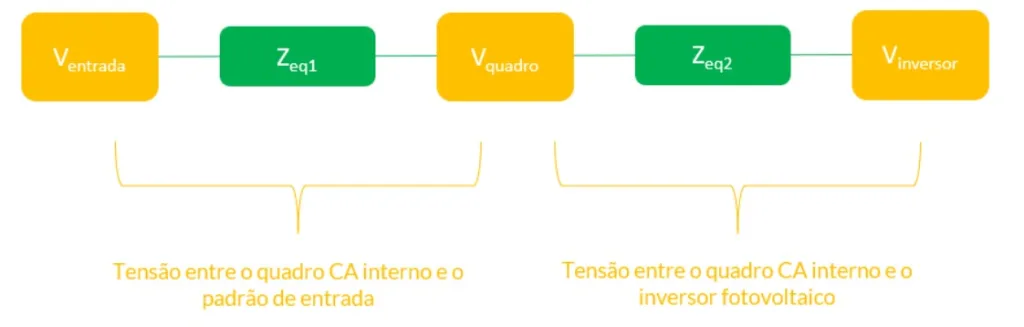
In the figure above, we can see the voltage measurement being performed at 3 different points of the installation: at the photovoltaic inverter, at the customer's internal AC panel, where the photovoltaic system is interconnected, and finally at the utility's input standard. The measurement must be performed with the inverter running, of course, since this is when the overvoltage occurs. With this, we can have an initial diagnosis as follows:
- Voltage increase in the section between inverter and AC panel. Possible problem in PV installation: cables, connections, poor tightening, poor quality transformers (high impedance), etc.;
- Elevation in the AC frame section – input standard: Existing infrastructure at the customer with problems, whether of low quality, poorly dimensioned, with poor connection, etc.;
- “Joint” elevation at all points, that is, from the inverter to the standard, the voltage remains very close, even during the voltage elevation. Possible infrastructure problem at the dealership.
In the first two, a detailed inspection of the installation will be enough to find the problem and correct it. In the latter, it depends on a complaint being made to the energy company for reinforcement or repair of the network, as it is the only permanent solution in the case.
Let us remember that when issuing the access report, the concessionaire guarantees us that we can make the PV connection with the informed power and that the electrical grid will support such a system. A quality analyzer installed on site for a period of time, collecting information, will be of great value in this argument with them.
Is your solar system malfunctioning or generating less energy than expected? Learn how to identify and avoid installation errors. Check it out. all about solar energy in our blog!
Conclusion
Overvoltage should not be, but it is a common problem in photovoltaic systems installed in Brazil. Low-quality electrical grids from the concessionaires, especially in more remote locations, make it impossible or impair the generation of electrical energy by the inverters. Add to this several installation errors, poor quality of materials and equipment used, and we have the most common error in Brazilian photovoltaic systems.
To make the situation worse, in many cases the solution sought is to adjust the inverter protection parameters to their maximum limits, as simply as if we were adjusting the date and time of the equipment, without prior analysis of the problem and without understanding the risks involved in this process, without knowing the origin of the problem of rising AC voltage.
These and other reasons support increasingly frequent complaints from end users (customers) dissatisfied with a product that should only bring security and savings on their energy bills.
These challenges highlight the importance of invest in solar energy training, where professionals can acquire specialized knowledge about identifying and solving problems related to the operation of photovoltaic systems. The search for suitable solutions and understanding the underlying principles are essential to ensure customer satisfaction and the efficiency of solar systems.
Remember that economy and sustainability go hand in hand! Learn more about renewable energy in our articles about solar energy produced by our experts.
Take the opportunity to follow the movements of the solar market in an intelligent way. See our curation of unmissable events in agenda of Canal Solar.


Comments (14)
Comments are moderated before publication.Comments should be respectful and contribute to a healthy debate. Offensive comments may be removed. The opinions expressed here are those of the authors and do not necessarily reflect the views of the author. Canal Solar.
An electrovoltaic system was installed in the building. The phase-to-phase voltage reading at the outlets in my apartment is 241V, as explained in the article above. This is a low voltage, which could be influenced by the photovoltaic installation, considering that the electrical circuits are over 40 years old and do not undergo periodic preventive maintenance. Could this be a contributing factor?
Hello everyone, everything good?
I would like to know the following:
My client has a photovoltaic system installed and wants to increase the load at home by installing air conditioning, an electric shower and a socket to charge the car. Can this be done without increasing the capacity of the installed solar system?
Thank you
Edimar Gomes – Salvaor
Hello, Eimar!
It can be done. However, since you are increasing your household's energy consumption, the previously designed system may not fully meet the new load and could increase the cost of your new energy bills.
I installed photovoltaic systems in my house 2 years ago, and 4 inverters have already burned out. The installer says that the installation is correct. What could be happening? The inverter is a Growatt 3000TL-x, and there is no string box between the panels and the inverter.
Wellington, choose to install the stringbox. Although the Growatt manual says that you don't need a stringbox, I use it and I've already had to activate the warranty for a customer who installed his inverter 6 months ago. Growatt asked for an investigation of the entire installation and the problem was with the inverter itself. I only managed to get them to fix the inverter free of charge because I used the stringbox. Their analysis report said that they recommended the use of a stringbox.
the system was installed, the inverter indicates normal, but it is not supplying power to the dealership
Hello, after installing the PV on my rural property, the voltage of my network is high (= ~250v to 275v), this only occurs during the hours of greatest PV generation. I contacted the concessionaire, but they explained that it is an inverter adjustment, which would be with the PV service provider. Have you ever resolved a similar situation?
Ideally, the inverter should be switched off and the voltage measured at the service entrance. Because it's a rural area, the voltage is usually higher due to the long distances the cables cover and the lack of sufficient transformers to adjust the voltage at the necessary points. In this case, utility companies don't usually adjust the voltage, and integrators often choose to adjust the voltage on the inverter. However, not all inverters support this adjustment. Furthermore, the property's loads may not withstand voltages at this level and could burn out. Be very careful. Ideally, check if the voltage is already high at the service entrance or if the increase is caused by impedance along the way. If it's the latter, the best course of action is to try to reduce this impedance by increasing the cable cross-sections, tightening connections, and using good quality connections.
I lost my peace after installing the photovoltaic system, the company that installed it configured the overvoltage range at 270v, this is a crime! I only detected the problem after devices burned out. When lowering to the correct range, the simple dealership network cannot receive the excess produced without the voltage exceeding 242v. In the end, one takes over the other and no one solves anything! I'm very disappointed.
Hello, after installing my photovoltaic system I had two showers and an air conditioner burn out. But I'm not sure if this could be related to the photovoltaic system or if it's for other reasons. The devices were burned sequentially, one after the other over a period of 2 weeks, four months after the installation of the photovoltaic system. What do you guys think?
Hello, Victor Hugo, how are you? The chance of the problem being caused by the PV system is low, since the problems highlighted were in equipment that requires high energy consumption, we suggest measuring the voltage at the inverter output to check for a possible overvoltage and if there are no problems, we suggest a check of the electrical part of the property, for both services we recommend that they be carried out by trained professionals.
One customer started overvoltage more than 1 year after installation.
After review and measurement, an increase in voltage was observed at all measurement points.
When analyzing the neighborhood, I noticed that there are many generators installed.
When looking at homes served by the same utility transformer, I observed at least 10 installations.
Is there a possibility that this increase is generating this increase in tension, which did not happen before?
Excellent article. Very technical, concise, competent and very enlightening. Congratulations.
All the stories mentioned above are very important, I loved them!